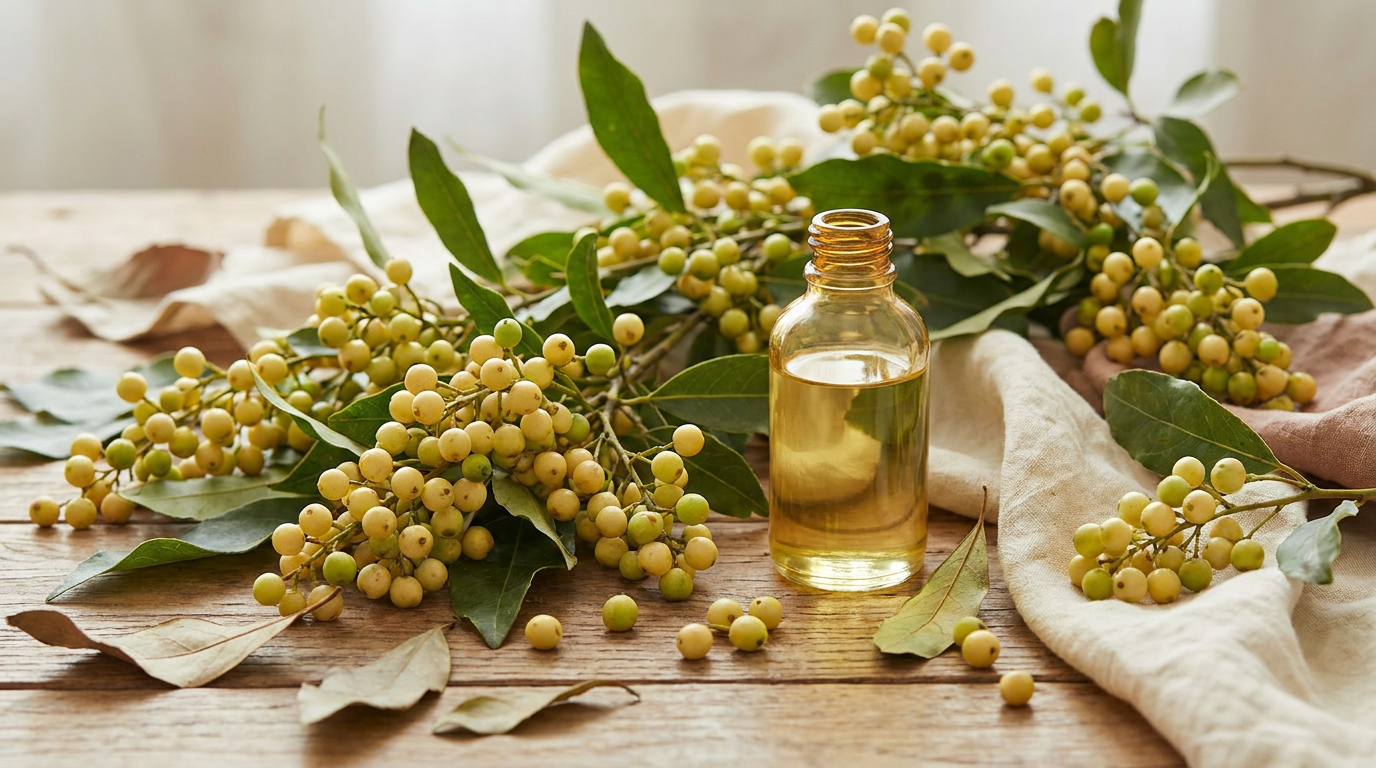
A Candle Studio's Litsea Cubeba Trial: Six Batches, Better Throw
A small candle studio came to litsea cubeba oil the way a lot of makers do: looking for a citrus note that would hold up better than lemon or sweet orange in a finished candle. Bright top-notes are notoriously hard to carry through a burn, and the studio's owner had grown tired of pouring batches that smelled vivid in the jar and said almost nothing once lit. This piece walks through what they tried, batch by batch, and what they observed along the way. It is a record of a candle maker's testing process, not a claim about how any oil performs for every wax, wick, or workspace.
The problem: citrus that faded by the second hour
Before the trial, the studio's go-to citrus blend leaned on sweet orange and a small amount of lemongrass. Cold throw, the scent strength a candle gives off unlit, was strong. Hot throw, what a room actually picks up once the candle is burning, dropped off fast. Testers described the scent as "present near the jar" but gone from across a small room within an hour. That gap between cold and hot throw is one of the more common frustrations in small-batch candle work, and it's what pushed the studio to test litsea cubeba as a possible substitute rather than an additive.
Litsea cubeba, sometimes called may chang, has a citrus profile that reads closer to lemongrass and verbena than to sweet orange: sharper, a little green, with less of the soft sweetness that orange oils carry. On paper, that sharper character seemed like it might project further in a scent throw context, since lighter, higher molecular weight aromatics are often reported by makers to volatilize more readily under a candle's heat. The studio treated this as a hypothesis worth testing rather than an assumption to build a product line on.
Approach: six batches, one wax, controlled variables
The studio kept the trial simple by design. All six batches used the same coconut-soy wax blend, the same 8 oz. tin, and the same wick size, changing only the fragrance load percentage and, in two batches, the pour temperature. This is standard practice in essential oil candle testing notes: hold everything constant except the variable being measured, or the results are impossible to compare honestly.
- Batch 1: 5% litsea cubeba fragrance load, standard pour temperature
- Batch 2: 6% fragrance load, standard pour temperature
- Batch 3: 7% fragrance load, standard pour temperature
- Batch 4: 8% fragrance load, standard pour temperature
- Batch 5: 7% fragrance load, lower pour temperature
- Batch 6: 7% fragrance load blended with a small amount of cedarwood to test whether a base note would anchor the citrus longer
Each batch cured for the studio's usual two-week window before testing began. Testers logged cold throw immediately after unwrapping, then hot throw at 30 minutes, 90 minutes, and three hours into a burn, in a closed 150 square foot room. Three separate testers scored each batch independently on a simple weak/moderate/strong scale, and their notes were compared rather than averaged into a single number, since scent perception varies enough person to person that averaging can mask disagreement worth knowing about.
Observations and outcomes
The results were not a straight line where more oil meant more throw. That in itself was one of the more useful things the studio took away from the trial.
| Batch | Fragrance Load | Cold Throw | Hot Throw (30 min) | Hot Throw (3 hr) | Tester Notes |
|---|---|---|---|---|---|
| 1 | 5% | Weak | Weak | Barely present | Testers felt this load was under threshold for the room size used |
| 2 | 6% | Moderate | Moderate | Weak | Noticeable improvement over Batch 1, still faded by hour three |
| 3 | 7% | Strong | Strong | Moderate | Most testers' preferred balance point in this trial |
| 4 | 8% | Strong | Strong | Moderate | No meaningful gain over Batch 3; one tester noted a slightly harsher top note |
| 5 | 7% (lower pour temp) | Strong | Moderate | Weak | Pour temperature appeared to matter more than expected; possible early oil loss |
| 6 | 7% + cedarwood | Moderate | Strong | Strong | Longest-lasting throw in the trial, though the citrus character read as less distinct |
A few patterns stood out across the six batches, described here as the studio's own observations rather than settled fact:
Diminishing returns above 7%
Batch 4, at 8% fragrance load, did not outperform Batch 3 in any tester's notes, and one tester found the higher load pushed the scent slightly sharper than they preferred. This lines up with something a lot of experienced candle makers report anecdotally: past a certain litsea cubeba fragrance load percentage, more oil doesn't reliably translate to more throw, and it can start to work against the scent's character. The studio settled on 7% as its working ceiling for this wax and wick combination going forward, while noting that a different wax base or wick size could shift that number.
Pour temperature seemed to matter
Batch 5 used the identical 7% load as Batch 3 but was poured at a lower temperature. Cold throw was comparable, but hot throw fell off faster over the three-hour window. The studio's working theory, offered as a hypothesis rather than a conclusion, is that a cooler pour may trap the fragrance oil less evenly through the wax, letting more of it evaporate near the surface before the candle is ever burned. They plan to test this variable on its own in a future trial rather than treating it as confirmed.
Blending shifted the outcome more than concentration did
The most interesting result, in the studio's notes, was Batch 6. Adding a small amount of cedarwood at the same 7% total load extended hot throw further than any straight litsea cubeba batch, including the 8% version. The tradeoff was character: testers felt the citrus note became less distinct and more of a background layer under the woodier base note. Whether that tradeoff is worth it depends entirely on what a given candle line is trying to sell: a bright standalone citrus, or a rounder blended profile that lasts longer once lit.
Key learnings for other makers testing litsea cubeba
The studio didn't come away with a universal formula, and they're careful to say so. Wax blends, wick types, room size, and even the specific lot of oil used can all shift results. What they did come away with is a testing process other makers can borrow, along with a few directional takeaways worth weighing against their own trials:
- Test fragrance load in small, deliberate steps rather than jumping straight to a manufacturer's maximum suggested percentage. The useful information often sits in the middle of the range, not at the edges.
- Log cold throw and hot throw separately, and log hot throw at more than one time point. A candle that reads strong at 30 minutes can still fade hard by hour three, and that gap is often the whole story.
- Keep pour temperature as a controlled variable, or test it deliberately. Treating it as a fixed constant when it isn't can quietly contaminate results across a whole batch run.
- Consider that a small amount of a base note oil may do more for longevity than raising the concentration of the citrus note itself.
- Use more than one tester and record disagreement, not just an average. Scent perception is genuinely subjective, and a single tester's nose can miss real variation.
None of this is a guarantee that any other maker will see the same numbers with a different wax, wick, or room. Essential oil behavior in candles is affected by enough variables that the honest framing is always "here's what we observed in our conditions," not "here's what will happen in yours." That's part of why the studio is treating this as the first of several planned trials rather than a finished formula.
Where the studio goes from here
The next round on their list tests litsea cubeba against a wider set of anchor notes beyond cedarwood, and a second pass isolates pour temperature as its own variable rather than a side note inside a concentration test. They're also planning to repeat the 7% batch in a larger 12 oz. vessel, since throw behavior in a small 8 oz. tin doesn't always scale cleanly to a bigger candle.
For makers considering their own litsea cubeba trial, the studio's biggest piece of advice wasn't about a specific percentage or blend. It was to write everything down, even the batches that don't work, since the batches that underperform often explain more about a wax and wick system than the ones that hit the mark on the first try.
Testing notes and results described here reflect one studio's process and conditions. Fragrance load percentages, pour temperatures, and wax and wick pairings that work well in one setup will not necessarily produce the same scent throw in another. Anyone formulating candles for sale should run their own controlled tests with their specific materials before finalizing a recipe.