Litsea Cubeba and Acne: One Lab Paper, No Human Trials
For acne, the first person to see is a dermatologist, and nothing about litsea cubeba oil changes that. In the searches we ran, the evidence on this oil and acne is a single laboratory paper on one bacterial strain, with no human trial, while the documented risk on skin is allergic sensitisation to citral. This post lays out each side with numbers so you can see why we do not position our oil as an acne ingredient.
Litsea Cubeba Essential Oil
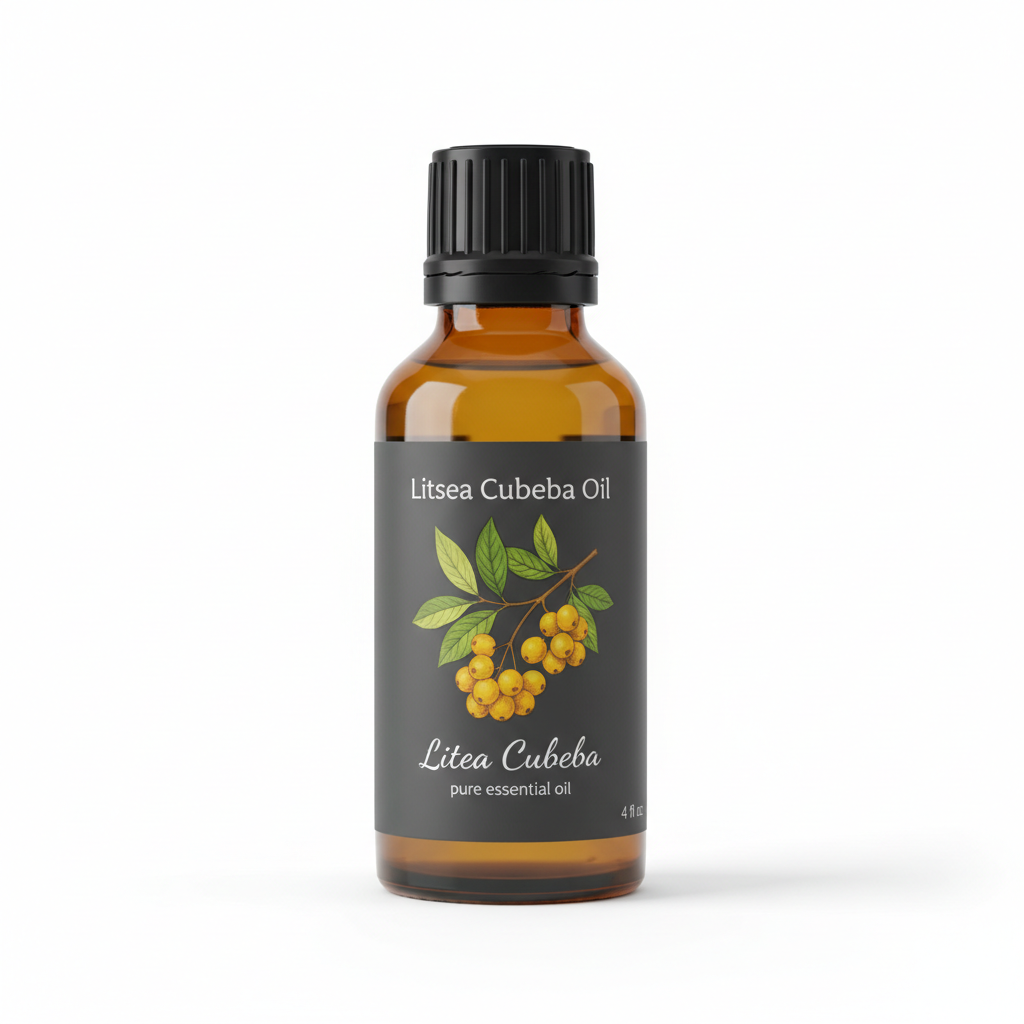
Our own Litsea Cubeba Essential Oil, in sizes from 0.5 oz to bulk.
From $12.99
Shop Now →Step one: what dermatology says
The American Academy of Dermatology page on acne diagnosis and treatment (last updated 6/19/24) says treatment starts with an accurate diagnosis, that "there is no one-size-fits-all acne treatment," and that it takes at least 6 to 8 weeks before you start to see fewer breakouts. It also warns that what looks like acne sometimes is not, naming hidradenitis suppurativa and perioral dermatitis as look-alikes (AAD, 2024). The over-the-counter products it names are benzoyl peroxide and adapalene; the page, as we read it, does not mention essential oils. So the order of decisions is: get the skin condition identified, follow the plan a board-certified dermatologist builds, and treat anything you add (including a scented oil) as something that has to be compatible with that plan.
Step two: what exists for litsea cubeba and acne bacteria
On 2026-10-28 we searched "Litsea cubeba essential oil Cutibacterium acnes Propionibacterium acnes inhibition" and "Litsea cubeba essential oil acne randomized clinical trial human participants topical". The first found one peer-reviewed paper on this oil and the acne-associated bacterium; the second found no human trial.
That paper is Chen et al., Frontiers in Microbiology, 2022. What it did:
- Oil: mature fruits collected in mid-July in Conghua District, Guangzhou, hydrodistilled for 5 hours by the authors. Their GC-MS reading was alpha-citral 38.12% and beta-citral 32.97% (about 71% together), limonene 9.72%, linalool 2.45%.
- Organism: one strain, Cutibacterium acnes ATCC 6919, an antibiotic-susceptible reference strain.
- Method: broth microdilution following CLSI guidance, with the oil dissolved using 0.1% Tween 80.
- Numbers: MIC 400 micrograms/mL (0.4 mg/mL, or 0.04%) and MBC 800 micrograms/mL (0.8 mg/mL).
- What else: electron microscopy, staining and metabolomics showing altered cell morphology and 86 changed metabolites, all at one sublethal dose and one time point.
Its limits, from the paper: in vitro only, one strain, one oil batch, and the authors say the biomarker pattern is not unique to antibacterial action. No skin, no follicle, no sebum and no person was involved. The authors suggest the work may inform future drug discovery; they report no clinical or animal data. For how to read an MIC and what it would mean in drops, see our antibacterial research post.
A contrast, clearly labelled as a different oil
The one essential oil with a real set of human acne trials is tea tree (Melaleuca alternifolia), and it shows what the evidence for an oil looks like when it exists. A 2026 meta-analysis in Phytotherapy Research (Ye et al., 2026) pooled seven clinical studies with 445 participants in the treatment arms, using concentrations from 5% to 50%. For its post hoc outcome, "clinically significant improvement," it reported a pooled odds ratio of 0.74 (95% CI 0.63 to 0.88 in the abstract, 0.63 to 0.86 in the results). The authors call the evidence limited and inconsistent, and list small trials, short durations (4 to 12 weeks), risk of bias, possible blinding problems because of the oil's odour, and signs of publication bias. Two of the trials in it: Enshaieh et al. (2007) used a 5% tea tree gel in 60 people against placebo in 30 over 45 days and recorded itching in 10%, slight burning in 3.33% and a scab sensation in 3.33%; Bassett et al. (1990) used a 5% gel and the review reports adverse reactions in 44% of the tea tree group (its own counts for that trial are not internally consistent).
Three lessons carry over, none of them a statement about litsea. First, a human trial uses a defined product at a defined strength, and the strength (5% and up) is well above the 0.5% to 2% in our own skin copy for litsea; the numbers cannot be transplanted. Second, even the best-studied oil produces local reactions. Third, nothing comparable has been found for litsea cubeba in our searches.
The risk side: citral and sensitisation
- The European Commission's scientific committee (SCCS, 2012) lists citral among established contact allergens in humans, rated +++ in its summary table (SCCS, Table 7-1).
- DermNet describes allergic contact dermatitis to essential oils as a delayed hypersensitivity reaction, says people often react to several oils, advises against applying neat oils to skin because that can lead to sensitisation, and notes that the allergen may be an oxidised component (DermNet, 2020). Tea tree and lemongrass are both on its list of commonly allergenic oils.
- IFRA's standards library carries a restriction standard for citral (listed as Amendment 49, published 2020-01) (IFRA Standards library). The library is the place to read the current text and categories. We publish no IFRA certificate for our oil, and its COA carries no composition data, so we cannot calculate an IFRA-based limit for it.
Acne-prone skin may already be inflamed or treated with drying agents, which we raise as reasoning, not as a finding. A rash from a new oil on top of an acne regimen is hard to tell from the acne, which is one more reason to bring the question to the dermatologist before adding it.
Why we do not sell it as an acne ingredient
The FDA decides whether a product is a cosmetic or a drug by its intended use, shown by labelling, advertising, the internet and other promotion, and its page names acne-directed cleansers among products regulated as drugs (FDA, page current 2024). We sell litsea cubeba oil neat, as an aroma ingredient, in amber glass. It is not a skincare product, and we state no acne, blemish or oily-skin use for it. The COA for the current batch lists appearance, smell, relative density 0.883, refractive index 1.483 and optical rotation +10.04; that is all it shows.
If you still choose to put it on skin
Our own copy is the only ceiling we state: dilute to 0.5% to 2% in a carrier oil (roughly 3 to 12 drops per ounce of carrier, depending on drop size), patch test a small area first, start at the low end, keep away from eyes, children and pets, and stop if irritation occurs. Because citral is a recognised sensitiser, keep dilutions modest. The steps and the dilution table are in skin basics; a worked face-serum calculation, with the same caveats, is in the face serum post. Store the oil cool, dark and closed, since the allergen concern includes oxidised material (storage guide). Pregnancy, children and anyone on prescription skin treatment should ask a physician or dermatologist first. Quick questions are in the FAQ.
The honest summary: one test-tube result for litsea, a real but modest and conflicted body of trials for a different oil, a documented allergen on the other side, and a dermatologist who can tell you what the spots are.
Litsea Cubeba Essential Oil
Litsea Cubeba Essential Oil from our own shop, in sizes from 0.5 oz to bulk.
From $12.99
Shop Now →Sources & Further Reading
- American Academy of Dermatology, 2024. Acne: Diagnosis and treatment. aad.org/acne/derm-treat
- Chen J. et al., 2022. Antibacterial Activity of the Essential Oil From Litsea cubeba Against Cutibacterium acnes, Frontiers in Microbiology 13:823845. pmc.ncbi.nlm.nih.gov/PMC8924494
- Ye Y. et al., 2026. Efficacy and Safety of Melaleuca alternifolia (Tea Tree) Oil for Acne: A Systematic Review and Meta-Analysis, Phytotherapy Research 40(7). pmc.ncbi.nlm.nih.gov/PMC13340978
- European Commission SCCS, 2012. Opinion on fragrance allergens, Table 7-1 (lay summary). ec.europa.eu/SCCS table 7-1
- DermNet, 2020. Allergic contact dermatitis to essential oils. dermnetnz.org/topics
- IFRA. IFRA Standards library (citral entry). ifrafragrance.org/safe-use/library
- FDA. Is It a Cosmetic, a Drug, or Both? (Or Is It Soap?). fda.gov/cosmetics