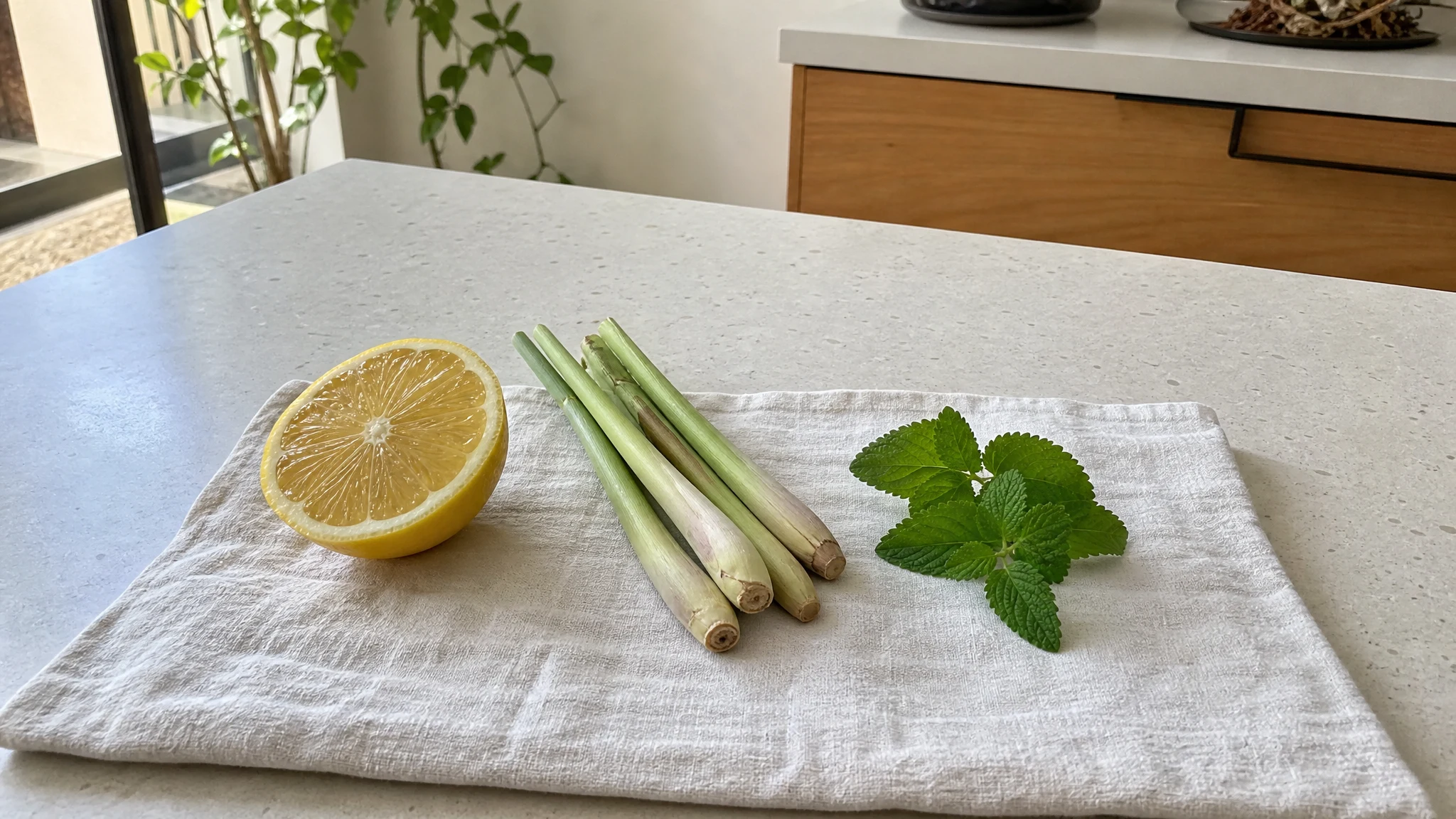
Citral-Rich Essential Oils Compared: One Table, Real Ranges
A citral percentage on a label does not tell you which plant an oil came from. Published analyses of litsea cubeba, lemongrass, lemon myrtle and melissa oils overlap heavily in total citral (the sum of neral and geranial), and the spread inside a single oil is often wider than the gap between two oils. The table below is built only from papers read for this article, with the sample size beside each row.
Litsea Cubeba Essential Oil
Our own Litsea Cubeba Essential Oil, in sizes from 0.5 oz to bulk.
From $12.99
Shop Now →The table
| Oil (plant part) | Geranial % | Neral % | Citral sum % | Main non-citral components | What was sampled |
|---|---|---|---|---|---|
| Litsea cubeba (fruit) | 44.4 to 50.0 | 34.2 to 37.4 | 78.7 to 87.4 | limonene 0.7 to 5.3; citronellal to 6.2 | 8 samples, 6 Chinese provinces, one season (Si, 2012) |
| Litsea cubeba (fruit) | 38.12 | 32.97 | 71.1 | limonene 9.72; linalool 2.45 | one hydrodistilled oil, Guangdong (Chen, 2022) |
| Litsea cubeba (fruit) | 35.62 | 29.76 | 65.4 | alpha-terpineol 6.25; ylangene 4.38 | one purchased oil, Jiangxi, extraction not stated (Wang, 2025) |
| Litsea cubeba (fruit) | citral not among the major constituents reported | citronellal 17.32; citronellol 13.85; nimbiol 9.35; myrcenol 7.40 | one oil, Arunachal Pradesh, India (Boruah, 2019) | ||
| Lemongrass (leaf) | 29.21 to 51.69 | 11.44 to 23.72 | 40.7 to 75.4 | myrcene 0.24 to 7.29; geraniol in some | 11 commercial dried-leaf samples, Brazil (Barbosa, 2008) |
| Lemongrass (leaf) | 53.1 | 36.1 | 89.2 | not itemised here | one leaf oil, eastern Nepal (Dangol, 2023) |
| Lemon myrtle (leaf) | 44.0 to 60.7 | 32.0 to 40.9 | 80.0 to 96.0 | remainder 4 to 20% by difference | range quoted in a review, Australia (Southwell, 2021) |
| Melissa (herb) | 6.22 to 51.21 | 4.28 to 35.02 | 11.4 to 78.9 in the four single studies I could sum | citronellal 0.4 to 20.3; caryophyllene oxide to 43.55 | pooled from many studies (Petrisor, 2022) |
| Lemon verbena (leaf) | 18.7 to 21.1 | 15.3 to 16.2 | 34.0 to 37.3 | limonene 5.0 to 5.4; 1,8-cineole 4.2 to 4.5 | one commercial batch, Portugal, two extraction methods (Sprea, 2023) |
Sums are added from per-sample isomer figures, except where the paper gave its own total (Si, Barbosa, Southwell). Dangol et al. also analysed lemongrass roots, which gave only 25.0% geranial and 16.6% neral, with alpha-elemol at 31.5%: the plant part matters as much as the species. The lemon verbena paper additionally quotes other studies (Portugal geranial 26.8% to 38.3%, Greece 26.8% to 38.7%, a Moroccan oil with neral 6.27% to 10.02% and no geranial detected), so one batch is not the species.
What the overlap means in practice
Take an oil that analyses at 80% citral. By the table it could be a mid-range litsea (Si's samples run 78.7% to 87.4%), a commercial lemongrass at the upper part of Barbosa's 40.7% to 75.4% spread, or a lemon myrtle at the bottom of its 80.0% to 96.0%. The melissa oils from Poland listed in the Petrisor review sum to 78.0% and 78.9%. One number, four candidate plants.
The isomer ratio does not rescue you. Geranial divided by neral is 1.30 to 1.34 at the two ends of Si's litsea samples (44.4 / 34.2 and 50.0 / 37.4), 1.47 in the Nepal lemongrass (53.1 / 36.1), 1.38 in the first Polish melissa year (45.2 / 32.8), and Southwell gives 1.2 to 1.5 for lemon myrtle. These all share a band.
What differs is the remainder. Litsea carries some limonene and citronellal; lemongrass carries myrcene and sometimes geraniol; verbena carries limonene and cineole; melissa can carry caryophyllene oxide; lemon myrtle, by difference from Southwell's totals, has 4% to 20% of something else. The Indian litsea oil in the table shows the opposite failure: a litsea fruit oil whose major constituents were citronellal and citronellol, so a citral-based check would have read it as something else. The authors attribute their difference to geography and report a 3 hour complete protection time in a mosquito cage test; that is a lab result for that oil, not a property of litsea oil in general.
A 2006 paper in Analytical and Bioanalytical Chemistry studied lemon, two lemongrass species, Ceylon and Java citronella, litsea, Lippia citriodora, lemon myrtle, lemon gum and lemon balm with enantioselective GC and isotope-ratio mass spectrometry, and reports that principal-components analysis of selected compounds separated lemongrass from litsea (Nhu-Trang et al., 2006, abstract only). Separating two citral oils took a multivariate analysis of a full profile.
Why the number still matters: a cap divides by it
The IFRA Standard for citral (IFRA_STD_021, a restriction, as listed in the IFRA library with Amendment 49, 2020) sets a maximum citral level in the finished product per product category, for example 0.60% in Category 4 (fine fragrance) and 0.15% in Categories 5A to 5C (IFRA library; IFRA, 2020). The cap is on citral, so the oil you may add is the cap divided by the oil's citral fraction. Using the table as example inputs (not our oil's figures): 0.60% divided by 0.874 allows about 0.69% of a litsea oil at 87.4% citral, 0.60% divided by 0.654 allows about 0.92% of the 65.4% litsea, and 0.60% divided by 0.407 allows about 1.5% of a lemongrass at 40.7%. A buyer who does not know the lot's citral figure cannot do this sum. These limits can change with each IFRA amendment, they cover citral from all sources in a formula, and a regulatory consultant or a cosmetic safety assessor should check any product you plan to sell; the compliance side is in our IFRA article.
Where our oil stands
The published COA for the batch on the sheet shows appearance, smell, relative density 0.883 at 20 C (standard 0.880 to 0.890), refractive index 1.483 (standard 1.480 to 1.490) and optical rotation +10.04 degrees (standard 0 to +15). It shows no GC-MS data and no citral figure, and we make no citral claim for our oil here. Reasoning rather than measurement: when most of an oil is the same two molecules, bulk constants such as density and refractive index are dominated by them, so three numbers on a certificate cannot tell lemongrass from litsea from lemon myrtle. I did not fetch reference constants for the other oils to test that, so treat it as an inference. If you need identity, ask any supplier, us included, for a GC-MS report in writing before you order, and read it as described in our GC-MS guide.
For single comparisons already written, see lemongrass, lemon myrtle and lemon verbena; for the melissa case, litsea against melissa.
We sell litsea cubeba oil only, none of the other oils in the table. All of them are citral oils, so treat all of them as skin sensitisers, keep dilutions low, and patch test.
Litsea Cubeba Essential Oil
Litsea Cubeba Essential Oil from our own shop, in sizes from 0.5 oz to bulk.
From $12.99
Shop Now →Sources & Further Reading
- Si L. et al., 2012. Chemical Composition of Essential Oils of Litsea cubeba Harvested from Its Distribution Areas in China. Molecules 17(6):7057. pmc.ncbi.nlm.nih.gov/PMC6268156
- Chen J. et al., 2022. Litsea cubeba essential oil and Cutibacterium acnes. Front Microbiol 13:823845 (composition table only). pmc.ncbi.nlm.nih.gov/PMC8924494
- Wang C. et al., 2025. Litsea cubeba essential oil and Salmonella typhimurium. Plants 14(9):1343 (composition table only). pmc.ncbi.nlm.nih.gov/PMC12073681
- Boruah N. et al., 2019. Chemical analysis of Litsea cubeba essential oil harvested from Arunachal Pradesh, India. Asian J Pharm Clin Res 12(5). journals.innovareacademics.in/32672
- Barbosa L.C.A. et al., 2008. Evaluation of the Chemical Composition of Brazilian Commercial Cymbopogon citratus Samples. Molecules 13(8):1864. pmc.ncbi.nlm.nih.gov/PMC6244952
- Dangol S. et al., 2023. Essential Oil Composition Analysis of Cymbopogon Species from Eastern Nepal. Molecules 28(2):543. pmc.ncbi.nlm.nih.gov/PMC9863348
- Southwell I., 2021. Backhousia citriodora F. Muell. (Lemon Myrtle), an Unrivalled Source of Citral. Foods 10(7):1596. pmc.ncbi.nlm.nih.gov/PMC8305781
- Petrisor G. et al., 2022. Melissa officinalis: Composition, Pharmacological Effects and Derived Release Systems. Int J Mol Sci 23(7):3591. pmc.ncbi.nlm.nih.gov/PMC8998931
- Sprea R.M. et al., 2023. Volatile Compounds and Biological Activity of the Essential Oil of Aloysia citrodora Paláu. Molecules 28(11):4528. pmc.ncbi.nlm.nih.gov/PMC10254266
- Nhu-Trang T.T. et al., 2006. Authenticity control of essential oils containing citronellal and citral by chiral and stable-isotope gas-chromatographic analysis. Anal Bioanal Chem 386:2141 (abstract). link.springer.com/s00216-006-0842-2
- IFRA, 2020. IFRA Standard: Citral (IFRA_STD_021, Amendment 49) and standards library listing. IFRA_STD_021.pdf