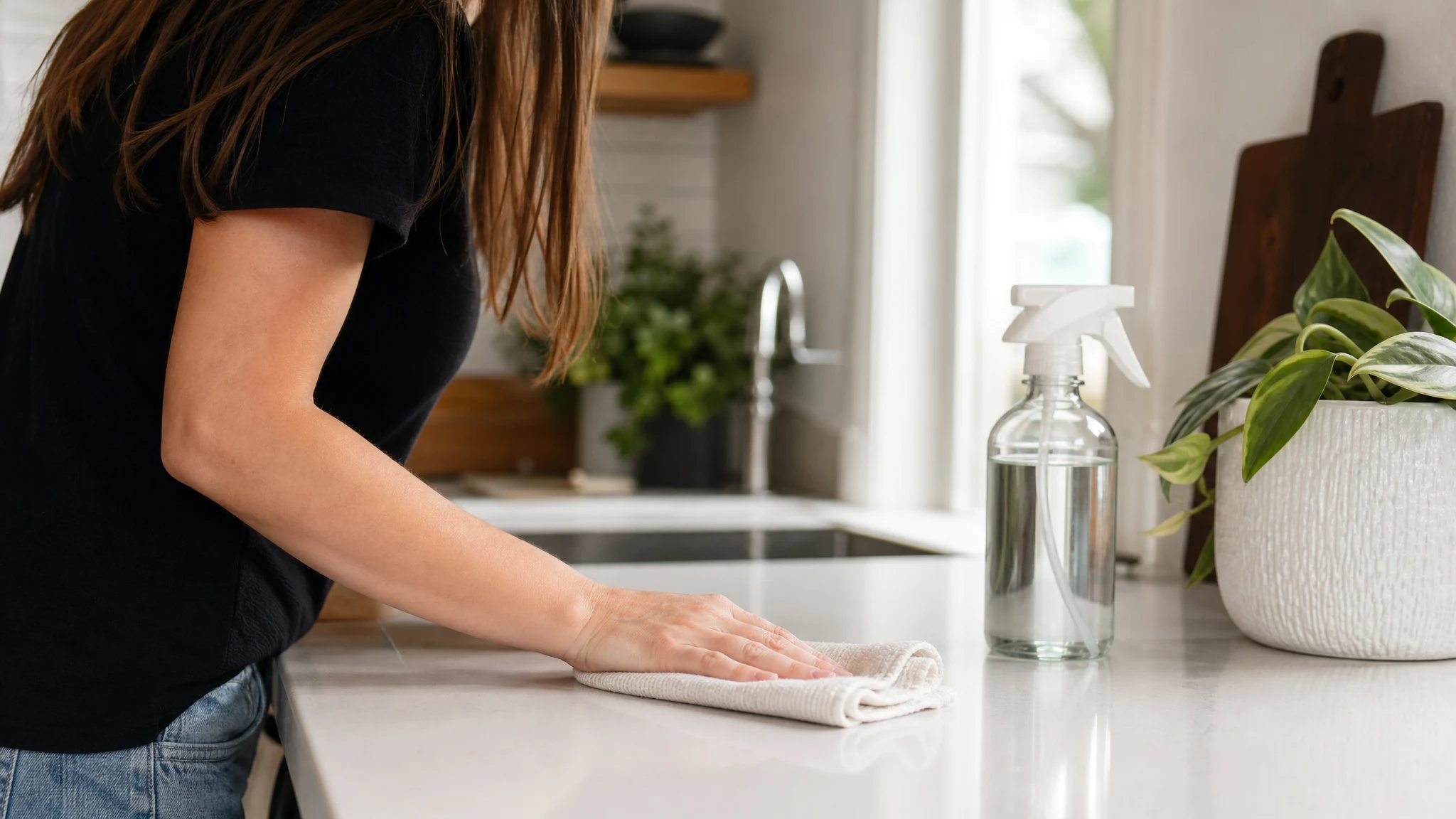
Litsea Cubeba All-Purpose Cleaner: Scent on a Soap Base
In a spray cleaner, litsea cubeba oil is the perfume. The cleaning is done by whatever surfactant or acid is already in the bottle, and we make no cleaning, disinfecting or germ claim for the oil. So the order of decisions is surface, then base, then how much scent, and the oil is the last of the three.

Litsea Cubeba Essential Oil
Our own Litsea Cubeba Essential Oil, in sizes from 0.5 oz to bulk.
From $12.99
Shop Now →What the oil is not doing
EPA's page on whether a cleaning product is a pesticide (last updated July 6, 2026) lists claims that make a cleaner a pesticide under FIFRA, and so subject to registration: "sanitizes, disinfects or sterilizes," cleaning away named pests, and odor claims that name bacteria. Claims such as cleaning dirt, dust and stains are not pesticidal, and neither is a plain deodorising claim with no pest named, but EPA says those hold only when no pest claim appears anywhere on the label, website or advertising (EPA, 2026). The page does not mention essential oils. It applies the same test to everything.
For a home cleaner you make for yourself, that is context, not a licence. If disease risk is the reason you are cleaning (a sick household member, raw meat on a board), use a product registered for that purpose and follow its label. Our oil is a scent. The room spray post covers scenting air; this one is about surfaces.
Surface first
The Natural Stone Institute says "vinegar should never be used on calcareous stones such as marble, limestone, or travertine," and that some granite species contain trace minerals that acid can attack, so vinegar should not be used on granite without asking the stone supplier (Natural Stone Institute, sanitation bulletin). Its care page recommends a "neutral cleaner, stone soap, or a mild liquid dishwashing detergent and warm water," and warns that products with lemon, vinegar or other acids "may dull or etch" calcareous stone (Natural Stone Institute, consumer care). Neither page carries a date. A lemon-scented spray is not lemon juice, and we have no data on whether litsea oil etches stone; but the oil is not acidic evidence either way, so on stone test a hidden corner first, or leave the spray off it.
Base: soap or vinegar, not both
Many recipes put castile soap and vinegar in the same bottle. Lisa Bronner, of the castile soap maker Dr. Bronner's, writes that soap is alkaline and vinegar is dilute acetic acid, and that combining them splits the soap back into fatty acids, leaving a curdled mixture with no cleaning ability. Her hands-on comparison: soap alone removed an oily coating, while the soap and vinegar mix left it. She suggests an all-purpose spray of 2 tablespoons of soap in 2 cups of water, and a separate spray of equal parts white vinegar and water for glass (Bronner, published 2011, updated 2026). That is a manufacturer's account of its own product, not independent testing, and it covers true soap, not synthetic dish detergent. It is still enough to settle the layout.
- Stone, wood sealed with a finish, laminate: water with a small amount of soap or mild dish detergent (the stone institute's wording). No vinegar.
- Glass and mirrors: the vinegar and water spray, no soap. Our reasoning, not a tested step: leave the oil out of this one, because an oil film is the thing glass cleaners exist to remove.
We do not sell soap, detergent, vinegar, bottles or sprayers; get them at a supermarket or a soap and craft supplier.
How much oil in a 500 ml bottle
We have not made this cleaner and no one on our side has tested it. No authority we read sets a figure for essential oil in a cleaner, so these numbers are our arithmetic, set below the 0.5% bottom of our own skin range because a cleaner leaves a film on surfaces you touch and is used often. The batch on our published COA has a relative density of 0.883 (1 ml is about 0.883 g), and about 20 drops make 1 ml (droppers vary).
| Oil in 500 g of finished cleaner | Grams | Millilitres | Drops, about |
|---|---|---|---|
| 0.25% | 1.25 g | 1.4 ml | 28 |
| 0.5% | 2.5 g | 2.8 ml | 57 |
Start at 28 drops. More scent is a decision for a second batch.
The oil floats: solubilizer
Oil does not dissolve in water. A shaken bottle looks fine for a minute and then shows oil droplets on top, which land on surfaces as spots. A supplier, Makesy, says the ratio of polysorbate 20 to essential oil is "generally always within the range of 1:1 to 5:1," that citrus oils should start at about 3:1 or more, and that you mix the solubilizer and oil together first, then add that to the water slowly, stirring, and judge success by clarity (Makesy). That is a retailer's guidance, not a data sheet, and litsea is not a citrus oil, though it smells like one. Using the 3:1 starting point, 28 drops (1.25 g) of oil calls for about 3.75 g of polysorbate 20. If you use soap in the bottle, some oil may stay dispersed without it; shake-test a small jar and see. If the mix turns milky or separates, the ratio is wrong for your oil and your water. A spray that has to be shaken hard each time is a sign to adjust, not a design.
Bottles, mixing and skin
- Plastics. A search for a source on essential oils cracking plastic spray bottles found only general descriptions of environmental stress cracking, not a test of litsea or any citral oil on a named plastic, so we cannot cite one. Use the bottle's maker for a chemical resistance chart, check the bottle weekly at first, and do not leave an oil-bearing spray in a bottle that has been marked or has gone cloudy.
- Never mix with other cleaners. A CDC MMWR report on a May 2020 survey of 502 US adults found that only 35% said bleach should not be mixed with vinegar and 58% with ammonia, and that 25% reported at least one adverse health effect in the previous month that they attributed to cleaners or disinfectants. The article notes that bleach with vinegar or ammonia can generate chlorine and chloramine gases that may severely damage lung tissue (Gharpure et al., CDC, 2020). Spray this cleaner onto a surface you have rinsed clean of other products, never into a wet bleach residue.
- Skin and eyes. The oil is a recognised skin sensitiser per our own copy. Wear gloves if you clean for long stretches, and wipe residues off surfaces that bare skin touches, such as counters and handles. The skin basics post covers sensitisation basics.
- Pets. The ASPCA Animal Poison Control Center says that "in their concentrated form (100%), essential oils can absolutely be a danger for pets," that walking through oils or getting them on fur can cause problems, and that cats and dogs are both covered by its concerns (ASPCA, 2018). A diluted spray is not the 100% case, but our copy says to keep the oil away from children and pets. Keep the bottle out of reach, let cleaned floors dry before pets cross them, and ask a veterinarian about your animals. The ASPCA line for suspected exposure is (888) 426-4435.
The oil bottle itself keeps best cool, dark and tightly capped; see the storage post. For the smell side of the problem, where a spray does not reach the cause, the odor eliminator post works room by room.
Label the bottle with its contents and date, and make a half-batch first so a mistake costs little.
Litsea Cubeba Essential Oil
Litsea Cubeba Essential Oil from our own shop, in sizes from 0.5 oz to bulk.
From $12.99
Shop Now →Sources & Further Reading
- US EPA, 2026. Determining If a Cleaning Product Is a Pesticide Under FIFRA. epa.gov/pesticide-registration
- Natural Stone Institute. Countertop sanitation technical bulletin. naturalstoneinstitute.org/sanitation
- Natural Stone Institute. Learn about cleaning products for natural stone. naturalstoneinstitute.org/consumers/care
- Bronner L. A word of caution about vinegar and castile soap (2011, updated 2026). lisabronner.com
- Makesy. How to solubilize fragrances and essential oils for beauty products (supplier guidance). makesy.com
- Gharpure R, et al., 2020. Knowledge and Practices Regarding Safe Household Cleaning and Disinfection for COVID-19 Prevention, United States, May 2020. MMWR 69(23):705-709. cdc.gov/mmwr/mm6923e2
- ASPCA, 2018. The latest home trend that could be harmful to your pets. aspca.org/news