
How to Read a Litsea Cubeba MIC Study
"Minimum inhibitory concentration" sounds like a verdict, but it is really a recipe note: this much oil, in this much broth, with this strain, stopped visible growth under these conditions. Several papers have reported such numbers for litsea cubeba oil, and reading them well is a small lesson in how lab science works. Here is how to make sense of them, with the arithmetic that makes the scale visible, and why we leave the claims about infections to physicians.
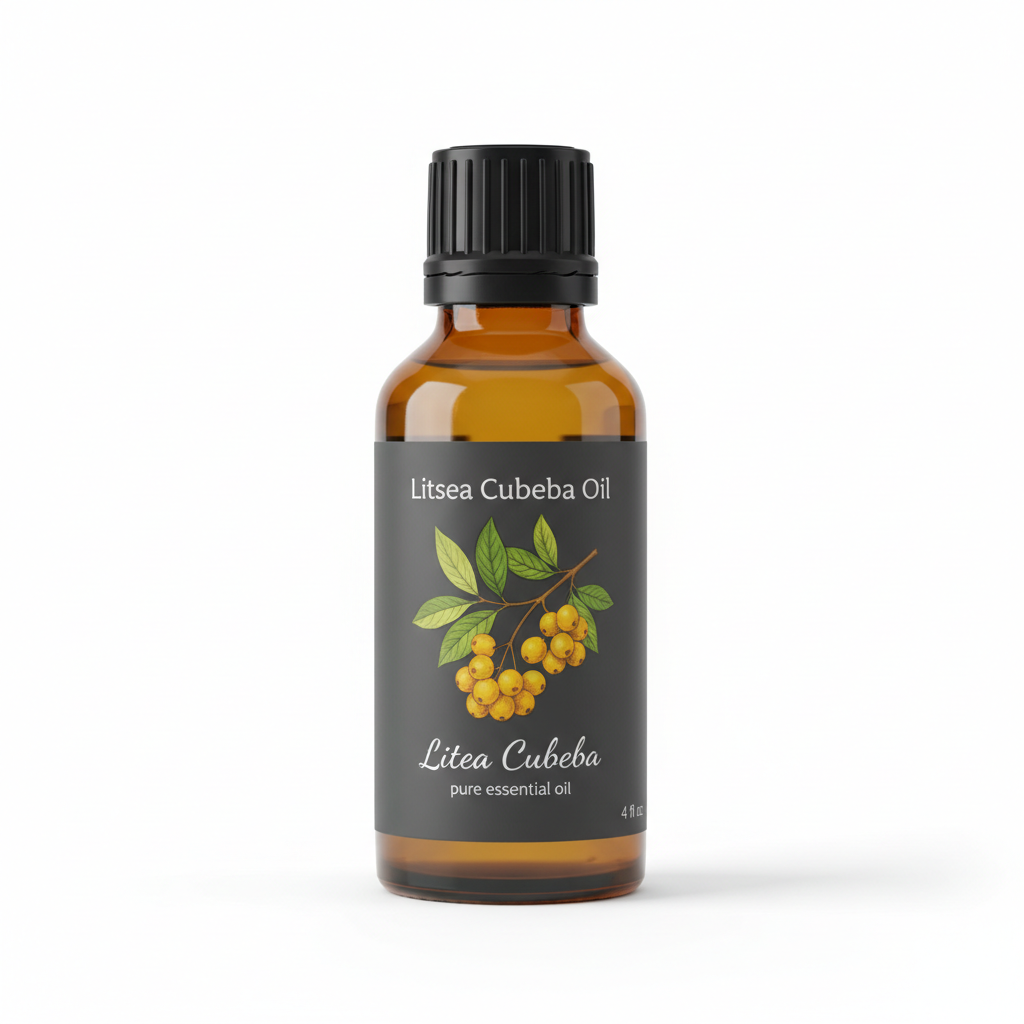
Litsea Cubeba Essential Oil
Our own Litsea Cubeba Essential Oil, in sizes from 0.5 oz to bulk.
From $12.99
Shop Now →What an MIC is
An MIC is the lowest concentration in a dilution series where no growth is visible after a set incubation. Its companion, the MBC, is the lowest concentration at which plated cells did not recover. Both depend on the strain, the starting cell count, the temperature, the broth and, importantly, how the oil was dissolved. Oil does not mix with water, so labs add helpers such as DMSO or Tween 80, and those are part of the result.
Three papers, read closely
Researchers at China Agricultural University bought litsea oil from a producer and tested it against four reference strains. The MIC against Salmonella typhimurium was 0.4 mg/mL and the MBC 0.8 mg/mL, using broth with a little DMSO and Tween 80. Their GC-MS reading put geranial at 35.62% and neral at 29.76%, so about 65.4% citral. Citral on its own was effective at a lower concentration than the whole oil, and heating the oil to 100 C nearly erased its activity in their assay (Wang et al., 2025).
A team at Sun Yat-sen University distilled their own fruit oil and tested it against Cutibacterium acnes, a common skin bacterium. They reported an MIC of 400 micrograms per milliliter and an MBC of 800 (Chen et al., 2022). That is a result about a culture in a dish.
A third study compared oils from 31 families of litsea trees at one site and found large differences in activity and four families giving strong activity against gram-negative bacteria such as E. coli at 50 microliters per milliliter (Wang et al., 2022). The big message of all three is the same: each paper tested the particular oil its authors distilled or bought, so "litsea cubeba oil" in a paper is a specific composition, not a standard reagent.
Turning an MIC into drops
At the relative density of 0.883 on the Certificate of Analysis for our current batch, 1 mL weighs about 0.883 g, and at roughly 20 drops per milliliter (droppers vary) one drop is around 44 mg. A concentration of 0.4 mg/mL is 0.04% weight per volume. One drop divided by 0.4 mg/mL is about 110 mL, so a single drop spread evenly through a bit under four fluid ounces of liquid would sit at that level. At 0.8 mg/mL, one drop covers about 55 mL.
Now set that beside our skin guidance of 0.5% to 2% in a carrier, which is 5 to 20 mg per gram. That is roughly 12 to 50 times the 0.4 mg/mL figure, and it would be a mistake to read it as headroom. The two numbers answer different questions. The MIC asks what stops growth of one strain in broth. The skin range asks what is modest enough to avoid irritation and sensitization, and citral is a recognized contact allergen: a European scientific committee lists it among the established contact allergens in humans (Table 7-1: Established contact allergens in humans).
Why a well is not a countertop or a hand
- The oil needs a helper to be in the water at all. In a spray bottle, oil and water separate, so much of it is not where microbes are.
- The test cells are alone in clean broth, without skin oils, sweat, soil or competing organisms.
- The oil is volatile and, as the 100 C result shows, sensitive to heat, so conditions in a pot or a warm room differ from the plate.
Why we keep to scent
Whether a product is a cosmetic or a drug depends on its intended use, and the FDA treats claims made for a product as part of that picture (Is It a Cosmetic, a Drug, or Both? (Or Is It Soap?)). On the cleaning side, the EPA lists claims such as sanitizing or disinfecting among those that make a product subject to pesticide registration (Determining If a Cleaning Product Is a Pesticide Under FIFRA). We sell litsea cubeba as an aroma ingredient and make no antibacterial, cleaning or disinfecting claim for it. None of the studies above tested our oil or a finished product, and for a wound, a spreading rash or any infection, a physician or pharmacist is the right person to ask.
If you make products, the accurate answer when someone asks whether your litsea-scented spray or soap is antibacterial is that you have no data on it and make no such claim. Our citral post introduces the molecule, our fungal studies post reads the companion papers, and skin basics covers dilution. If you want a GC-MS profile for a lot, ask us in writing through the contact page before ordering; our current batch's certificate gives appearance, smell, relative density, refractive index and optical rotation.
A published MIC is a precise answer to a narrow question, and understanding that is what lets you read the next paper with confidence.
Litsea Cubeba Essential Oil
Litsea Cubeba Essential Oil from our own shop, in sizes from 0.5 oz to bulk.
From $12.99
Shop Now →Sources & Further Reading
- Wang C, et al. Antibacterial Activity and Mechanism of Litsea cubeba Essential Oil Against Salmonella typhimurium. Plants, 2025. pmc.ncbi.nlm.nih.gov
- Chen J, et al. Antibacterial Activity of the Essential Oil From Litsea cubeba Against Cutibacterium acnes and the Investigations of Its Potential Mechanism by Gas Chromatography-Mass Spectrometry Metabolomics. Frontiers in Microbiology, 2022. pmc.ncbi.nlm.nih.gov
- Wang X, et al. Antimicrobial activity of essential oils extracted from Litsea cubeba. Forestry Research, 2022. pmc.ncbi.nlm.nih.gov
- European Commission, Table 7-1: Established contact allergens in humans. ec.europa.eu
- FDA, Is It a Cosmetic, a Drug, or Both? (Or Is It Soap?). fda.gov
- US EPA, Determining If a Cleaning Product Is a Pesticide Under FIFRA. epa.gov