Litsea Cubeba on Skin: Start Low, Test Patiently
Litsea cubeba smells like lemon drops, and it is natural to want to wear it. The part worth understanding first is that its scent comes mostly from citral, and citral is also the molecule fragrance chemists watch most closely on skin. That does not make the oil off limits. It does mean the sensible way in is to start low, go slowly, and know what a patch test can and cannot tell you.
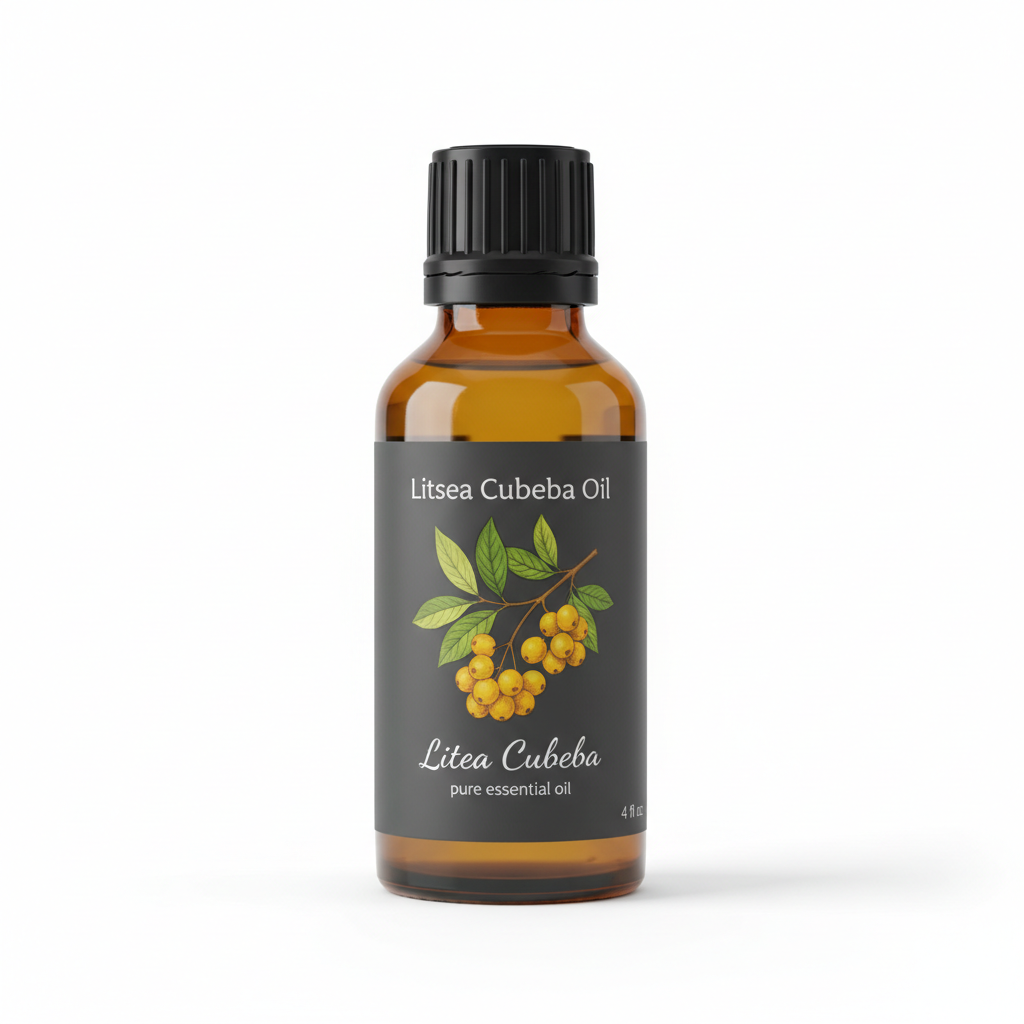
Litsea Cubeba Essential Oil
Our own Litsea Cubeba Essential Oil, in sizes from 0.5 oz to bulk.
From $12.99
Shop Now →Why citral sets the pace
Citral is really two closely related molecules, geranial and neral, and dermatologists have studied them as contact allergens. In a Swedish clinic study, 1,476 patients with suspected contact allergy were patch tested, and 2.9% reacted to citral, 3.4% to geranial and 1.9% to neral (Hagvall et al., 2020). That is a group chosen because they already had skin problems, so it says nothing about how common the allergy is in everyone else. What it does show is that the reaction is real, and the Tisserand Institute adds a point that is worth taking to heart: once someone is sensitized, the sensitivity generally persists for the rest of their life (Irritation and allergic reactions). Starting gently is how you avoid that outcome in the first place.
So the first question is a personal one. If you have ever reacted to perfume or scented products, or a dermatologist has told you that you are allergic to a fragrance material, ask that dermatologist before putting a citral-rich oil on your skin.
Our dilution guidance, and where we start
Our oil is sold neat. For skin, we recommend diluting it to between 0.5% and 2% in a carrier oil and patch testing a small area first. For a leave-on product, though, we would start at the low end and go lower than that, and here is the reasoning.
The fragrance industry's standard for citral (IFRA Standard for Citral, Amendment 49, 2020) caps citral in the finished product at 0.15% for body lotions and creams, 0.60% for fine fragrance and 1.2% for bar soap and body wash. Those caps are written for products made for sale, so a home maker is not bound by them, but they are the clearest published guide. To turn a citral cap into an oil figure, divide by the oil's citral share. Researchers who distilled fruit from eight sites across China found 78.7% to 87.4% citral (Si et al., 2012), while six commercial batches reviewed in an EFSA opinion averaged about 66% (our sum of its two isomer averages). We cannot say where our own batch falls, so the table uses both ends as an illustration.
| Oil in the carrier | Citral in the product (66% oil) | Citral in the product (87.4% oil) | Against the 0.15% lotion cap |
|---|---|---|---|
| 0.5% | 0.33% | 0.44% | about 2 to 3 times |
| 1% | 0.66% | 0.87% | about 4 to 6 times |
| 2% | 1.32% | 1.75% | about 9 to 12 times |
Run the other way, 0.15% divided by 0.874 is 0.17% and 0.15% divided by 0.66 is 0.23%. In a 1 oz (29.57 mL) carrier, that is around one drop at the usual 20 drops to the milliliter, while our 0.5% to 2% range works out to roughly 3 to 12 drops. Both are real numbers answering different questions, and we would not call 2% safe for a leave-on product. If you are making something that stays on the skin, we suggest starting at or below 0.2%, and keeping the higher figures for rinse-off products.
Rinse-off and leave-on are different
The same IFRA standard allows eight times more citral in bar soap and body wash (1.2%) than in a lotion (0.15%). The reason is simply exposure: a wash touches skin briefly and is rinsed away, while a lotion stays. That makes rinse-off the gentler way to enjoy this oil on skin. Our scalp oil post follows the same rinse-off or leave-on split, and our massage oil and face serum posts work from the lowest end of the range.
What a patch test tells you
A dab on the forearm is a sensible habit, with one caveat. Tisserand notes that patch testing is not 100% reliable, and proper testing is done by dermatologists with specially prepared patches. So think of a home test as a precaution, not a clearance. If you do one, use the dilution you actually plan to use, apply it to forearm skin rather than your face or neck, repeat it daily for a week, and stop at the first redness, itch or swelling. A clean week means no reaction so far. It says nothing about a stronger dilution, a different carrier, or a bottle that has aged (our storage post covers keeping it fresh).
A simple order of decisions
- Ask whether you need it on skin at all. For a room, a candle or a diffuser, you do not.
- With any history of fragrance allergy, ask your dermatologist first.
- Choose rinse-off before leave-on.
- Work out percentages by weight, because drop sizes vary.
- For leave-on use, begin well below 0.5%.
- Stop at the first reaction, and see a dermatologist for rash that lasts, blisters or spreads.
Pregnancy, young children and pets change the picture again, and our pregnancy and children post sets out what is published. We keep our oil away from eyes, children and pets, and it is not for internal use.
A little litsea goes a long way in scent, which is good news: the amounts that suit skin are tiny, and they still smell wonderful.
Litsea Cubeba Essential Oil
Litsea Cubeba Essential Oil from our own shop, in sizes from 0.5 oz to bulk.
From $12.99
Shop Now →Sources & Further Reading
- Hagvall L, Bruze M, Engfeldt M, et al. Contact allergy to citral and its constituents geranial and neral, coupled with reactions to the prehapten and prohapten geraniol. Contact Dermatitis, 2020. europepmc.org
- Tisserand Institute, Irritation and allergic reactions. tisserandinstitute.org
- IFRA, Standard: Citral, 2020 (Amendment 49). ifrafragrance.org
- Si L, et al. Chemical composition of essential oils of Litsea cubeba harvested from its distribution areas in China. Molecules, 2012. pmc.ncbi.nlm.nih.gov
- EFSA Panel on Additives and Products or Substances used in Animal Feed, Safety and efficacy of a feed additive consisting of an essential oil from the fruits of Litsea cubeba (Lour.) Pers. (litsea berry oil) for use in all animal species (FEFANA asbl). EFSA Journal, 2021. pmc.ncbi.nlm.nih.gov