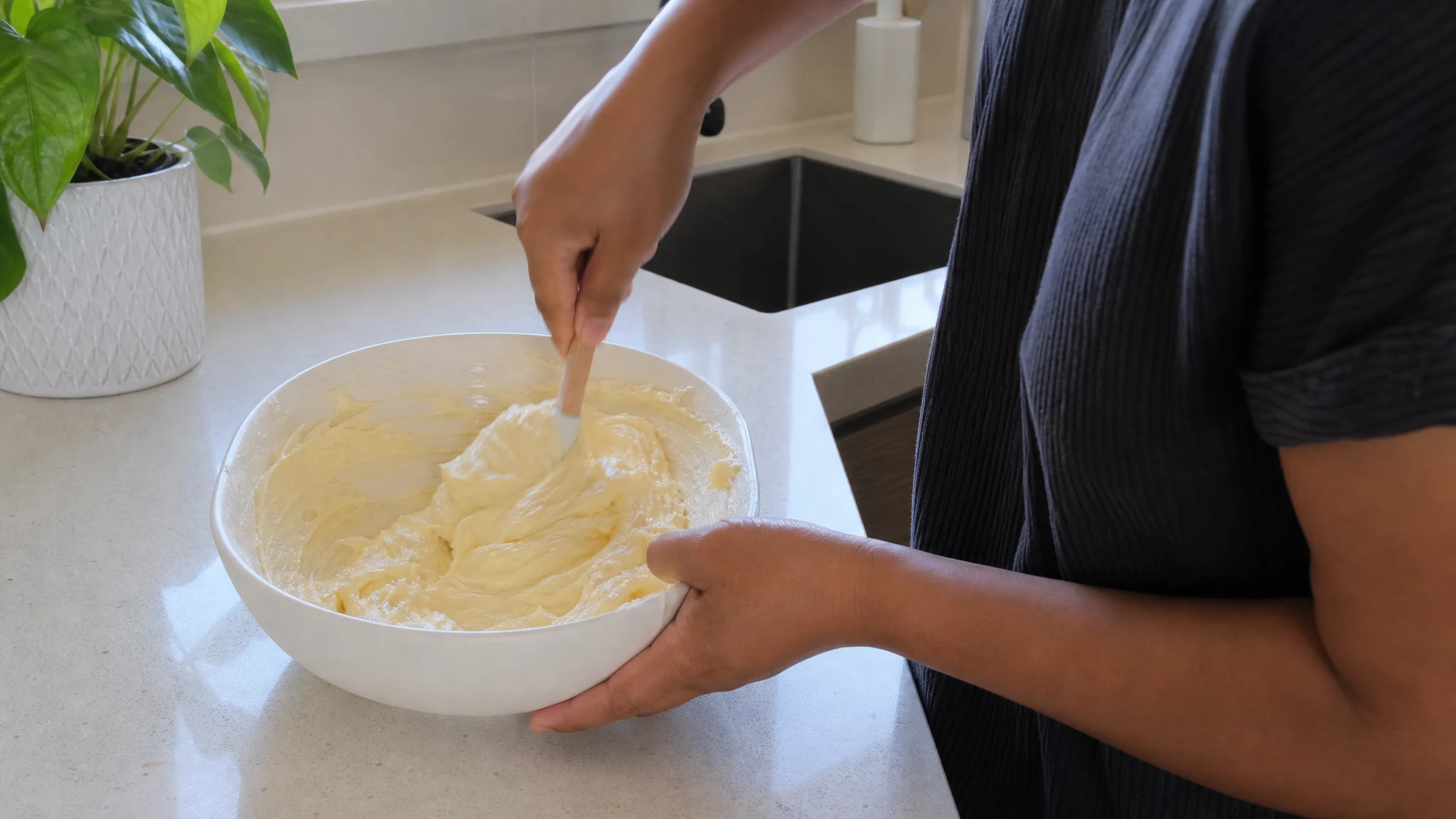
Litsea Cubeba Body Butter: A 200 g Water-Free Batch
A whipped body butter with litsea cubeba oil is simple to make and easy to get wrong in three places: the oil level, the cooling, and the assumption that a water-free product needs no care. Below is a 200 g batch worked out in grams and drops, with the oil at 0.5%, the bottom of our own 0.5% to 2% skin range.

Litsea Cubeba Essential Oil
Our own Litsea Cubeba Essential Oil, in sizes from 0.5 oz to bulk.
From $12.99
Shop Now →Why 0.5%, and why not for the reason you might expect
A tempting argument is that a body butter covers a large area, so the dose is bigger than a roller bottle and the oil should be lower. The Tisserand Institute says otherwise for skin reactions. Its Q&A states that some topical maximums are "for adverse skin reactions, and these don't change," that they are measured as micrograms of oil per square centimetre of skin, and that area makes little difference to them. Maximums for internal toxicity are different: they assume "maximum possible whole body application," set at 30 ml of finished oil, and fall as the amount applied grows (Tisserand Institute). The page mentions neither citral nor litsea.
The human study usually behind the citral number uses the same per-area unit. Lalko and Api (2008) reviewed the data and put the human no-observed-effect level for induction of citral sensitisation at 1400 micrograms per square centimetre, to support a proposed IFRA standard (Regul Toxicol Pharmacol 52:62-73). That figure is for citral alone, not for our oil, and we cannot convert it: the COA we publish shows no constituent data, so how much citral our oil carries is not something we can state.
So the reason for 0.5% is not area. It is that a body butter is a leave-on product used daily, that citral is a recognised sensitiser (our own copy says so), and that the only ceiling we can state for our oil is the 0.5% to 2% in our safety copy, where we tell you to start at the low end. DermNet adds that fragrance allergy affects roughly 1% of adults and about 10% of people who are patch tested (DermNet, 2020). The generic dilution table and patch-test steps live in the skin basics post; this post does not repeat them.
The 200 g batch
We have not made this butter and no one on our side has tested it. The 60:40 split of butter to liquid oil is our starting point, not a supplier figure; shea and carrier suppliers publish their own recommended ranges, and you should check them. We do not sell butters or carrier oils; buy them from a soap or cosmetics supply shop.
| Ingredient | Grams | Share |
|---|---|---|
| Shea butter | 120 g | 60% |
| Liquid carrier oil (jojoba, or a refined oil you tolerate) | 79 g | 39.5% |
| Litsea cubeba oil | 1 g | 0.5% |
One gram of our oil is about 1.13 ml (the COA batch has a relative density of 0.883), which is about 23 drops at 20 drops per ml. Droppers vary, so weigh it on a 0.01 g scale if you have one. For comparison:
| Oil level in 200 g | Grams | Drops, about |
|---|---|---|
| 0.5% | 1 g | 23 |
| 1% | 2 g | 45 |
| 2% | 4 g | 91 |
Stay on the first row for the first batch. Quadrupling the oil to reach 2% would quadruple the oil on the skin in a product that stays on skin.
Why shea turns grainy, and the cooling that avoids it
Shea is a mix of fats that crystallise at different temperatures. Oseni and colleagues heated shea to 80 C for 30 minutes to erase its crystal memory, cooled it fast to room temperature, and held it at the tempering temperature with continuous agitation for 6 hours; the hardness index fell by about half against the untreated control. Their abstract ties smooth fat to beta-prime crystals and coarse, grainy fat to beta crystals (Oseni et al., Physical Science & Biophysics Journal). That is an lab process on one sample of shea, not a kitchen method.
The kitchen version comes from a supplier. From Nature With Love says butters turn grainy when melted and cooled too slowly, that shea is the most prone, and recommends melting fully in a double boiler, holding at 175 F (80 C) for 20 minutes, pouring at once and refrigerating so the whole batch cools quickly (From Nature With Love). The two sources agree on the principle (hot enough to clear the crystals, then cool fast) and differ on hold time, 30 minutes against 20. Neither is a test of a whipped butter with an essential oil in it. Use the supplier's version and treat grain as a sign the cooling was too slow.
Order of work
- Melt the shea fully, hold it at 80 C for 20 minutes, then stir in the carrier oil.
- Chill the bowl in the fridge until the mix is soft-set at the edges and thick in the middle, not hard.
- Whip with a hand mixer until pale and airy.
- Add the litsea oil at the end and whip for another 30 seconds. Our reasoning, not a tested step: the shop's own note is that this oil "ages faster than a wood or a resin" and should be kept cool, so it belongs in the coolest, last stage, not in the hot melt.
- Spoon into clean, dry jars. Label with the date and "0.5% litsea cubeba oil."
The carrier choice matters for how the butter keeps. A 2022 study heated crude jojoba oil, olive oil and squalene at 60 C for 60 days; jojoba had the lowest peroxide and carbonyl values, which the authors read as the most resistance to autoxidation of the three (Tsuchimoto et al., BPB Reports, 2022). Three oils and one heating condition is a small base, and almond and grapeseed were not in it, so using jojoba is an inference. The same paper notes that stability varied between producers.
Water-free is not the same as care-free
With no water in the jar there is little for microbes to use, and many makers skip a preservative on that basis. FDA's page on microbiological safety does not discuss water-free products, so it neither confirms nor rules out that approach. It does list contaminated water or raw materials, poor storage and consumer use such as "dipping fingers into the product" as ways a cosmetic gets contaminated, and warns against adding water (FDA, 2024). A jar opened with wet hands in a bathroom is a route in. Practical steps from that list: make small batches, dry every bowl and whisk, use a spatula or a pump jar, keep lids on, and bin the jar if it smells off or shows spots. Whether the butter needs a preservative is a question for a cosmetic chemist.
What to expect from the scent
Our oil is lemon-bright and a top note, per the shop. In a fat base, top notes fade first. Whether 23 drops in 200 g leaves any lemon after a week, we do not know; no one has tested it. The bulk page of the shop says the oil's scent fades faster than synthetic fragrance oils in cold process soap, so makers there use it slightly heavier. That is a statement about soap, and it is not a reason to raise a leave-on skin product above 0.5%. If the scent is too faint, make a small batch at 1% and test it on your forearm for a few days. The storage post covers keeping the bottle itself fresh, and the solid perfume balm is the better format if you want scent on a small area rather than a lotion on the whole body.
Skip a scented butter if you have eczema, a history of fragrance allergy, or are pregnant or buying for a child, and ask a physician, pharmacist or dermatologist first. Keep it off eyes and broken skin, and stop if skin reddens. Our oil is not for internal use.
Litsea Cubeba Essential Oil
Litsea Cubeba Essential Oil from our own shop, in sizes from 0.5 oz to bulk.
From $12.99
Shop Now →Sources & Further Reading
- Tisserand Institute. Q&A: safety maximums for dermal application. tisserandinstitute.org/learn-more
- Lalko J, Api AM, 2008. Citral: identifying a threshold for induction of dermal sensitization. Regul Toxicol Pharmacol 52(1):62-73. doi.org/10.1016/j.yrtph.2008.01.006
- DermNet, 2020. Fragrance allergy. dermnetnz.org/topics/fragrance-allergy
- Oseni NT, Iyasele JU, Uwadia OE. Rheological and Microstructural Properties of Thermal and Mechanically Treated Shea Butter. Physical Science & Biophysics Journal 3(1). medwinpublishers.com/PSBJ
- From Nature With Love. Vegetable butter crystallization (supplier guidance). fromnaturewithlove.com
- Tsuchimoto S, Sakai H, Fukui K, 2022. Oxidative Stability and Antioxidant Activity of Crude Jojoba Oil. BPB Reports 5(6):121-124. jstage.jst.go.jp/bpbreports
- FDA, 2024. Microbiological Safety and Cosmetics. fda.gov/cosmetics