
Litsea Cubeba and Mosquitoes: What the Studies Measured
Litsea cubeba oil has been tested against mosquitoes, and the papers are real, but they measure minutes of protection on a volunteer's forearm or behaviour inside a laboratory chamber, not protection from disease. We sell a neat essential oil and make no repellent claim for it. Where a mosquito-borne illness is a concern, the CDC's advice is to use an EPA-registered product, and the rest of this article shows why the gap between those two things is wider than the headline numbers suggest.
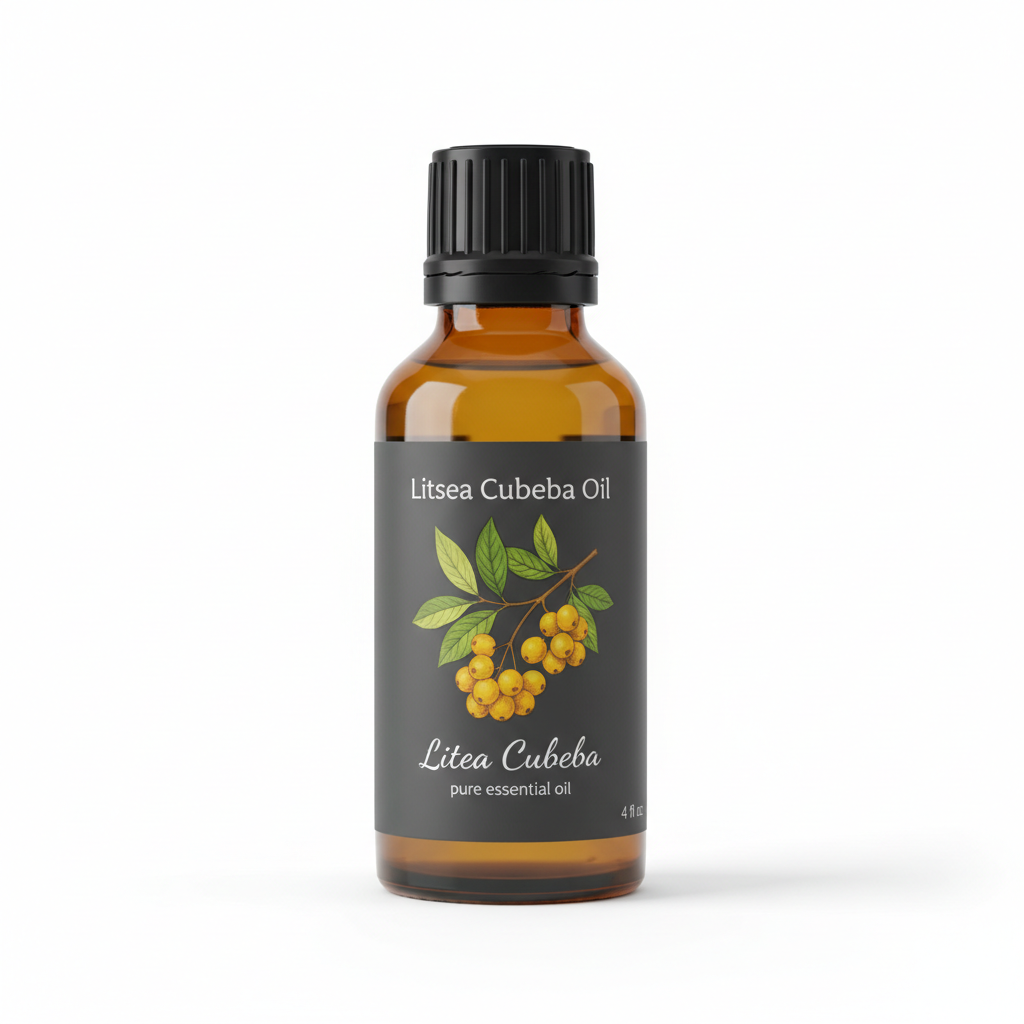
Litsea Cubeba Essential Oil
Our own Litsea Cubeba Essential Oil, in sizes from 0.5 oz to bulk.
From $12.99
Shop Now →What four sources actually did
Each row below is what the source's own abstract or text reports. None of them tested our oil, and none involved a person using a bottle of neat essential oil from a shop.
| Source | Material and method | What it reported | What it did not show |
|---|---|---|---|
| Amer and Mehlhorn, 2006, Parasitology Research | 41 plant oils and 11 oil mixtures applied to human volunteers' skin; three species: Aedes aegypti, Anopheles stephensi, Culex quinquefasciatus | Five oils (litsea, cajeput, niaouli, violet, catnip) were the most effective, with up to 8 hours of protection and 100% repellency; the authors note a special formulation is needed to keep oils on skin | The 8 hours is the best result across those five oils, not a litsea figure; I read the abstract record only, which does not give a per-oil time |
| Noosidum et al., 2008, Journal of Vector Ecology 33:305 | L. cubeba, L. salicifolia and Melaleuca leucadendron oils against female Ae. aegypti in excito-repellency test chambers | All three oils irritated and repelled the mosquitoes in the chamber; 24-hour mortality among mosquitoes that escaped after contact with litsea oil was 2.3% to 20.4% | A chamber measures escape behaviour. It is not a bite count on skin and gives no protection time |
| Sutthanont et al., 2026, Scientific Reports | A ready-to-use spray with 6% w/w litsea cubeba oil; WHO arm-in-cage protocol; skin-patch test in 48 healthy volunteers | Median complete protection time 225 minutes against Cx. quinquefasciatus and 120 minutes against both Ae. aegypti and An. dirus; no visible skin reactions up to 96 hours; authors call for semi-field and field work | I read the abstract record, not the full paper; it does not report the oil's constituents in the text I saw, and cage tests are not field conditions |
| Noguera-Gahona et al., 2024, Frontiers in Insect Science (review) | Review of synthetic and natural repellents against Ae. aegypti | Lists litsea among oils with activity; says natural repellents face rapid volatilisation and a limited duration of protection | Gives no litsea data and no hours for essential oils |
Read together, the strongest litsea result is the 2026 spray: about two hours against Ae. aegypti and An. dirus, in a cage, at 6% oil. That is a useful result for the authors' research question. It is not the same as a product a person can rely on in a place where mosquitoes carry disease.
Why "registered" is a different kind of claim
The EPA's repellent search page (last updated September 8, 2026) says a registration number means the company gave EPA technical information on the product's safety and its effectiveness against mosquitoes or ticks. The CDC's mosquito prevention page (August 28, 2024) lists six active ingredients in EPA-registered repellents: DEET, picaridin, IR3535, oil of lemon eucalyptus, para-menthane-diol and 2-undecanone. It also says: "We do not know the effectiveness of non-EPA registered insect repellents, including some natural repellents."
There is a middle category. EPA exempts certain "minimum risk" pesticides from registration. Its page on personal repellents and minimum risk pesticides (last updated February 26, 2026) says such a label may say "controls mosquitoes" but may not tie pests to a specific disease, and that EPA is considering a future proposal to remove personal mosquito and tick repellents from the exemption (docket EPA-HQ-OPP-2010-0227; not a final rule). The same page records EPA's conclusion that "public health products must be supported by evidence that they are effective against the target pest." The practical reading is that a shelf label carrying a disease claim and no registration number deserves suspicion, and that the rules here are under review and can change.
The dose arithmetic that the headline hides
The 6% in the 2026 spray is a lot of oil by the standards of our own safety copy. Using the batch density on our published COA (0.883 g/ml) and about 20 drops per ml, one drop is about 44 mg.
- 6% w/w in 100 g of spray is 6 g of oil, or about 6.8 ml, or about 136 drops.
- Our skin copy says 0.5% to 2%. The study's 6% is three times the top of that range.
- The IFRA citral standard (Amendment 49, 2020) sets 0.15% citral in the finished product for Category 5A, and the IFRA guidance lists "Insect repellent (intended to be applied to the skin)" in that category. Literature on litsea oils from eight Chinese regions found 78.7% to 87.4% neral plus geranial (Si et al., 2012). If an oil sat in that range, 0.15% citral would allow about 0.17% to 0.19% oil, so a 6% spray would carry roughly 31 to 35 times that.
Two cautions on that last line. First, it is arithmetic on a literature range, not a statement about our oil: our COA reports no citral figure. Second, the IFRA standards are an industry system for fragrance mixtures; they are not a law that governs a person mixing at home, and the Citral standard names dermal sensitisation and systemic toxicity as what drives the limit, not repellent performance. The point is narrower: the oil share that produced two hours in a cage is far above the share that fragrance-safety assessors allow in a skin product, which is one more reason not to copy it. For the sensitiser background see our skin basics and patch test article, and for the sun-exposure side see phototoxicity.
What we recommend, and what we will not say
We do not sell a repellent, and we make no claim that our oil repels, protects against, or has any effect on insects. The published COA shows appearance, smell, relative density 0.883, refractive index 1.483 and optical rotation +10.04 for the batch it covers; it carries no composition data, so nothing on it ties our oil to any of the studies above.
- Anywhere mosquitoes carry disease (travel, an outbreak, a region with local transmission): use a product from the EPA list and follow its label. The pharmacist or a local health department can say which suits a child or a pregnancy; the CDC page notes that products containing oil of lemon eucalyptus or PMD are not for children under 3.
- If you simply want a lemon scent on skin: that is a skin-care use, covered by the 0.5% to 2% copy and a patch test, and it is not a repellent claim.
- If you plan to sell a spray or balm with insect claims: the claim itself triggers EPA rules, and the formulation question belongs to a regulatory consultant or your state pesticide regulator, not to a supplier of essential oil. Our IFRA and compliance guide covers the paperwork a buyer should ask for first.
- Comparing with citronella: see litsea cubeba versus citronella, which sets the two oils side by side.
The studies are a reasonable starting point for a laboratory, and a poor basis for a bottle of oil on a shelf. If you want the scent for its own sake, the shop page lists current sizes.
Litsea Cubeba Essential Oil
Litsea Cubeba Essential Oil from our own shop, in sizes from 0.5 oz to bulk.
From $12.99
Shop Now →Sources & Further Reading
- Amer A, Mehlhorn H, 2006. Repellency effect of forty-one essential oils against Aedes, Anopheles, and Culex mosquitoes. Parasitol Res 99:478-490. pubmed.ncbi.nlm.nih.gov/16642384
- Noosidum A, Prabaripai A, Chareonviriyaphap T, Chandrapatya A, 2008. Excito-repellency properties of essential oils from Melaleuca leucadendron, Litsea cubeba and Litsea salicifolia on Aedes aegypti. J Vector Ecol 33:305-312 (PMID 19263850). europepmc.org record
- Sutthanont N et al., 2026. Topical mosquito repellency of a Litsea cubeba essential oil spray against Aedes aegypti, Anopheles dirus, and Culex quinquefasciatus. Sci Rep. doi.org/10.1038/s41598-026-61769-z
- Noguera-Gahona M et al., 2024. Repellents against Aedes aegypti bites: synthetic and natural origins. Front Insect Sci. PMC11795662
- CDC, 2024. Preventing mosquito bites. cdc.gov/mosquitoes/prevention
- US EPA, 2026. Find the insect repellent that is right for you. epa.gov/insect-repellents
- US EPA, 2026. Personal insect repellents and minimum risk pesticides. epa.gov/node/64461
- IFRA, 2020. IFRA Standard: Citral (Amendment 49). ifrafragrance.org/standards/IFRA_STD_021.pdf
- IFRA, 2023. Guidance for the use of IFRA Standards (51st Amendment, 30 June 2023). ifrafragrance.org guidance PDF
- Si L et al., 2012. Chemical composition of essential oils of Litsea cubeba harvested from its distribution areas in China. Molecules 17:7057-7066. PMC6268156