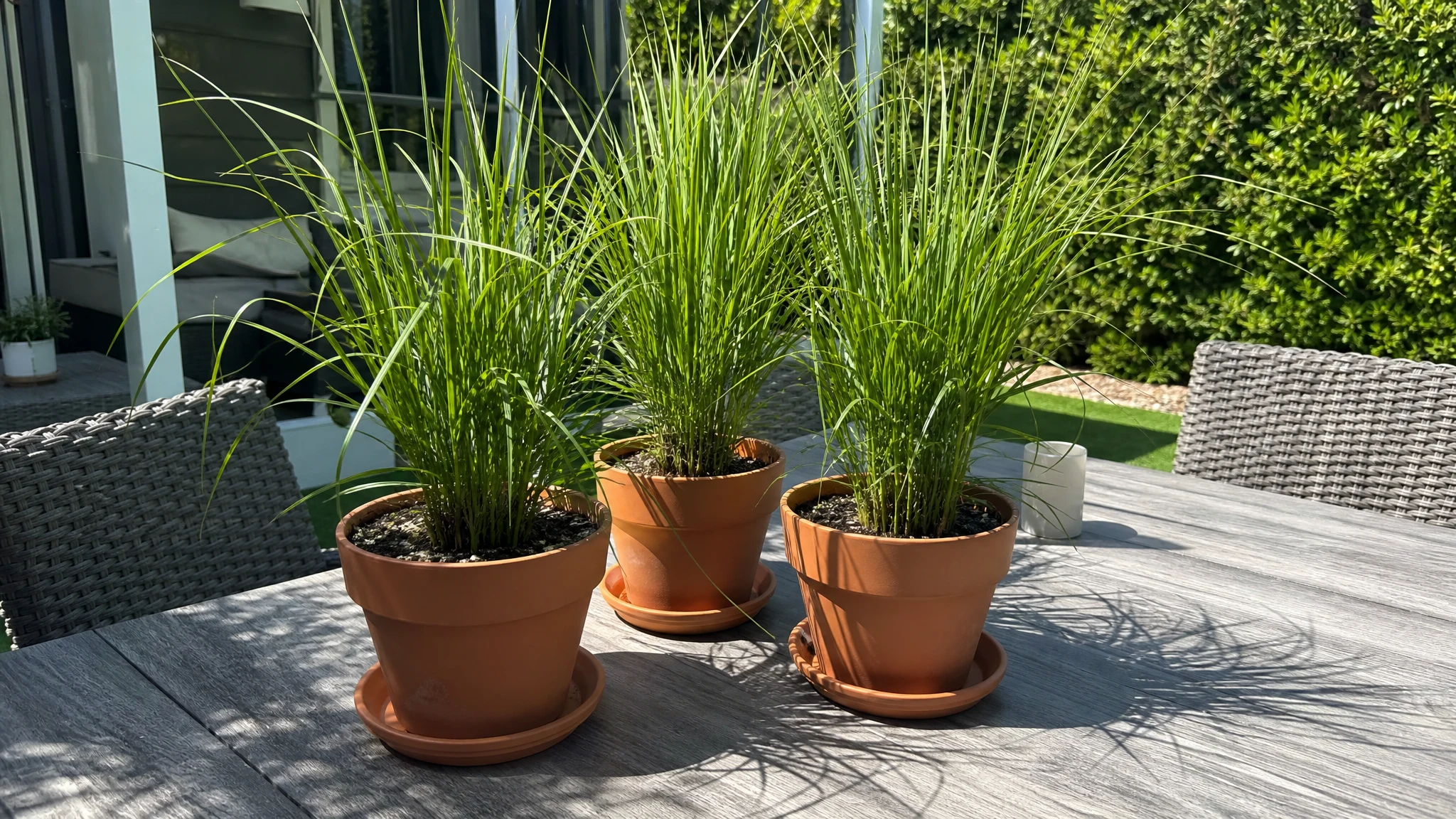
Litsea Cubeba vs Citronella: Chemistry, Studies, EPA Status
Citronella and litsea cubeba are two different oils with different chemistry, and neither is a stand-in for the registered repellents that CDC recommends where mosquitoes carry disease. Citronella oil is named in the federal minimum-risk pesticide list; litsea cubeba is not. We sell litsea oil as a fragrance material and make no repellent claim for it. This post lays out what the papers and the regulators actually say about each.

Litsea Cubeba Essential Oil
Our own Litsea Cubeba Essential Oil, in sizes from 0.5 oz to bulk.
From $12.99
Shop Now →Start with the regulatory line
Under 40 CFR 152.25(f), a pesticide made only from the active ingredients in that section's Table 1, plus allowed inert ingredients, is exempt from federal registration. Table 1 lists citronella, citronella oil, lemongrass oil, geraniol and cedarwood oil, among others; neither litsea nor lemon eucalyptus appears in Tables 1 or 2 (40 CFR 152.25, Cornell LII copy, read 28 October 2026). The same paragraph says such a product must not claim to control or mitigate microorganisms that threaten human health, and must not claim to control disease-carrying insects, with Lyme-disease ticks named as an example. Reading that list, a litsea-based product sold to repel insects does not obviously fit the exemption; whether a particular product does is a question for a regulatory consultant or product-safety attorney, not for this article.
EPA's own repellent page says most skin-applied repellents must be registered, meaning evaluated and approved for human safety and effectiveness on the label's instructions, and that products made from minimum-risk ingredients "have not been evaluated for effectiveness" (EPA, skin-applied repellents). CDC's Yellow Book chapter, dated 23 April 2025, lists DEET, picaridin, oil of lemon eucalyptus or PMD, IR3535 and 2-undecanone as typically giving reasonably long-lasting protection, and adds: "The effectiveness of non-EPA-registered insect repellents, including some natural repellents, is unknown, and travelers should avoid using them" (CDC, 2025). Being on the minimum-risk list is an exemption from registration. It is not a finding that the oil works.
The chemistry is not the same
| Citronella (Cymbopogon leaf oil) | Litsea cubeba (fruit oil) | |
|---|---|---|
| Main molecules | Citronellal 36.53%, geraniol 25.56%, citronellol 13.10%, elemol 8.24% (C. nardus, Tocantins, Brazil, steam-distilled leaves; Aguiar, 2014) | Neral plus geranial 78.7% to 87.4%; limonene 0.7% to 5.3% (8 samples, 6 Chinese provinces; Si, 2012) |
| A second sample | C. winterianus leaf oil, eastern Nepal: geraniol 37.1%, citronellal 13.7%, geranyl acetate 11.3% (Dangol, 2023, one oil) | Arunachal Pradesh oil: citronellal 17.32%, citronellol 13.85%, nimbiol 9.35%, myrcenol 7.40% (Boruah, 2019, one oil) |
| What it tells you | Citronellal dominates in one sample and geraniol in the other | Usually citral, but one published litsea oil was not |
The Indian litsea row matters for this comparison. When people say litsea "repels mosquitoes", the paper behind it may be about an oil that is closer to a citronella profile than to the citral-dominated oils in the Chinese survey. Scent follows chemistry. The shop describes our oil as intense, sweet and lemon-bright, with a soft fruity, floral roundness; I have no sourced scent description for citronella to quote, so smell them side by side from your own samples before you assume one can replace the other. Citral is the signature of litsea in most analyses; citronellal and geraniol are the signature of citronella. They are different molecules.
The repellency studies, and what each measured
No study I could find and read compares the two oils head to head on skin. What exists is separate:
- Citronella, review. Maia and Moore (2011, Malaria Journal) state that citronella-based repellents protect from host-seeking mosquitoes for about two hours, because the oils evaporate quickly. Their Table 1 lists 100% C. nardus oil giving complete protection against Aedes aegypti for 120 minutes, against Culex quinquefasciatus for 100 minutes, and against Anopheles dirus for 70 minutes, and a 10% preparation giving 20 minutes against Ae. aegypti. Citronella candles reduced biting by about 50% in field studies but, in the review's words, did not provide significant protection. The review concludes that repellents containing only essential oils should not be recommended in disease-endemic areas (Maia and Moore, 2011).
- Litsea, cage test. Boruah et al. (2019) applied 1 mL of a 20% ethanolic solution of their Arunachal Pradesh litsea oil to one arm and 1 mL of 20% DEET to the other, following a WHO protocol with modifications, exposing arms to cages of 200 to 250 female Ae. aegypti for 3 minutes every 30 minutes. First landing or probing came at 180 minutes for the oil and the DEET standard lasted 6 hours (Boruah et al., 2019). One oil, one mosquito species, and an oil whose major components were citronellal and citronellol, not citral.
- Litsea, olfactometer. Uniyal et al. (2016) put 23 oils through a Y-tube with female Ae. aegypti at 1, 10 and 100 ppm. "Litsea oil" scored 50.31%, 60.2% and 77.26% repellency against 59.63%, 68.63% and 85.48% for DEET. The abstract also says litsea oil was more effective than DEET, which its own numbers contradict: the oil is lower at every concentration (Uniyal et al., 2016). A Y-tube measures choice in a tube, not protection on a person.
Do not line these up as a ranking. Different oils, different concentrations, different labs, different endpoints. The 120 minutes for neat citronella against Ae. aegypti and the 180 minutes for 20% litsea in a different cage test do not make litsea better; they show how much protection time depends on the test.
The arithmetic of a 20% solution
If you read "20%" and want to try it, work out the cost. Assuming 20% by volume, a 1 oz (29.57 ml) bottle of spray holds 0.20 x 29.57 = about 5.9 ml of oil, which at 0.883 g/ml is about 5.2 g, or roughly 118 drops at 20 drops per ml. Our skin copy for litsea is 0.5% to 2%, about 3 to 12 drops per ounce. A 20% mix is ten times the top of that range. Citral is a recognised skin sensitiser, which is why that copy keeps dilutions modest. We do not recommend a 20% litsea mix on skin, and no study here says you should.
What to do with this
If you live or travel where mosquitoes spread disease, use a product that carries an EPA registration number, and ask a physician or pharmacist about the right one for children and pregnancy. If you want a scent, choose by smell: lemon-bright citral (litsea) versus citronellal and geraniol (citronella, from a supply shop, as we do not sell it). If you want a candle or a diffuser blend, the Maia and Moore finding is a reason not to expect protection from either. Our own page on the oil's repellent literature is the repellent article; the molecule is covered in the citral article; the other lemon-scented oil sold as a repellent is in the lemon eucalyptus comparison; and the spread between citral oils is in the citral table. Questions about the oil itself are in the FAQ.
Litsea cubeba is sold here as a fragrance and craft oil, undiluted, and not for internal use.
Litsea Cubeba Essential Oil
Litsea Cubeba Essential Oil from our own shop, in sizes from 0.5 oz to bulk.
From $12.99
Shop Now →Sources & Further Reading
- US Code of Federal Regulations, Title 40, 152.25, Exemptions for pesticides of a character not requiring FIFRA regulation (paragraph f). law.cornell.edu/cfr/text/40/152.25
- US EPA. Regulation of skin-applied repellents. epa.gov/insect-repellents/regulation-skin-applied-repellents
- CDC, 2025. Yellow Book: Mosquitoes, Ticks, and Other Arthropods (page dated 23 April 2025). cdc.gov/yellow-book
- Maia M.F., Moore S.J., 2011. Plant-based insect repellents: a review of their efficacy, development and testing. Malaria Journal 10(Suppl 1):S11. pmc.ncbi.nlm.nih.gov/PMC3059459
- Boruah N. et al., 2019. Chemical analysis of Litsea cubeba essential oil harvested from Arunachal Pradesh, India, and estimation of mosquito repellent activity. Asian J Pharm Clin Res 12(5). journals.innovareacademics.in/32672
- Uniyal A. et al., 2016. Behavioral Response of Aedes aegypti Mosquito towards Essential Oils Using Olfactometer. J Arthropod-Borne Dis 10(3):372. jad.tums.ac.ir/article/view/319
- Aguiar R.W.S. et al., 2014. Corymbia citriodora and Cymbopogon nardus essential oils, citronellal. Sci World J (composition table only). pmc.ncbi.nlm.nih.gov/PMC3926400
- Dangol S. et al., 2023. Essential Oil Composition Analysis of Cymbopogon Species from Eastern Nepal. Molecules 28(2):543. pmc.ncbi.nlm.nih.gov/PMC9863348
- Si L. et al., 2012. Chemical Composition of Essential Oils of Litsea cubeba Harvested from Its Distribution Areas in China. Molecules 17(6):7057. pmc.ncbi.nlm.nih.gov/PMC6268156