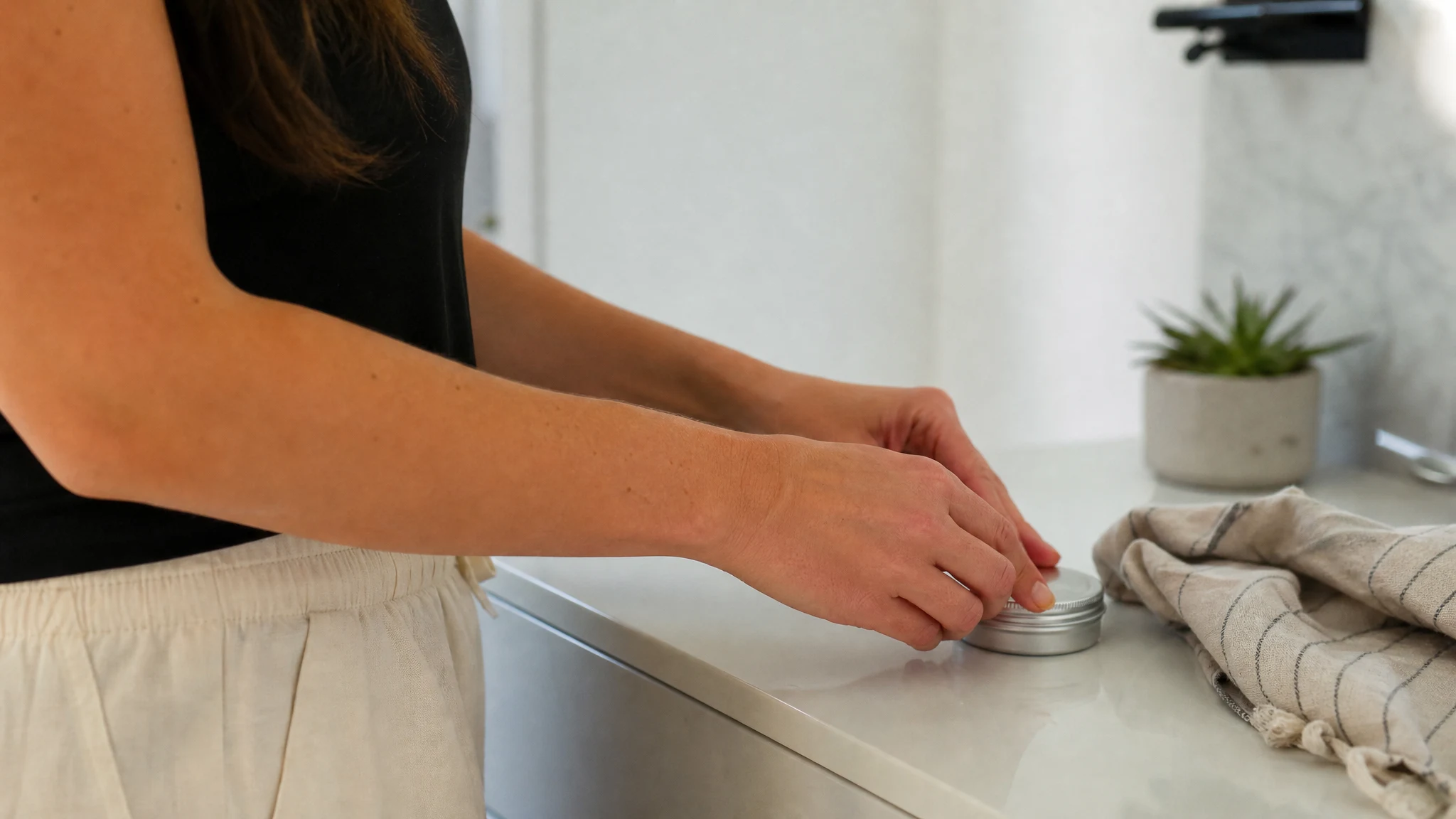
Litsea Cubeba Deodorant Stick: Base First, Scent Last
Litsea cubeba oil can scent a homemade deodorant, and that is all it can do. The odor under an arm is made by bacteria working on sweat, and a lemon-bright top note does not change that. If you make a stick, the base decides whether it works, and the oil goes in last, at a level well below the top of our own 0.5% to 2% skin range.

Litsea Cubeba Essential Oil
Our own Litsea Cubeba Essential Oil, in sizes from 0.5 oz to bulk.
From $12.99
Shop Now →What a deodorant stick is, legally and chemically
FDA says whether a product is a cosmetic or a drug "is determined by a product's intended use." Its page, current as of September 2024, lists deodorants as cosmetics and gives "deodorants that are also antiperspirants" as an example of a product that must meet the rules for both cosmetics and drugs (FDA, 2024). So the stick below is a deodorant at most. It makes no attempt to stop sweat, and we make no deodorising claim for our oil.
On the chemistry, a 2025 review in International Journal of Molecular Sciences describes underarm odor as a three-step process: odorless precursors are made in the body, odor-forming bacteria such as Corynebacterium striatum and Staphylococcus hominis take them up, and bacterial enzymes convert them into volatile smelly compounds. The same review sorts existing deodorants into four routes: less sweat, fewer odor-forming bacteria, masking, and neutralising (Son et al., 2025). A scented oil sits in the masking route only. That is a limit worth stating before you spend an afternoon on a recipe: if the underarm smells sour by midday, a fresher scent on top will not stop the cause. We have no data on how long litsea's top note lasts on skin; the shop lists it as a top note, and the live post on the citral molecule covers the chemistry.
Where the irritation probably comes from, and what the sources do not show
The common advice is that baking soda is the irritant in homemade deodorants and the scent is incidental. Searches for a case series on sodium bicarbonate deodorant dermatitis returned brand blogs and patents, not dermatology papers. The one primary document available to read is a 1982 US patent for a bicarbonate deodorant (Marschner, US 4,534,962). It says bicarbonate solutions "have been observed to cause skin irritation" and that bicarbonate in solution slowly converts to sodium carbonate, "a known skin irritant", while claiming that its own bicarbonate suspensions "are essentially non-irritating to the armpit." That is an inventor selling a product, so read it as a claim, not a finding. It does show the disagreement: solution versus dry suspension may matter, and nobody I fetched measured it in a home stick.
What the clinical sources do name is fragrance. DermNet says fragrance allergy is "believed to affect around 1% of adults," that "around 10% of those undergoing patch testing" have it, that deodorants are among the products that may contain fragrance, and that armpit involvement is common (DermNet, 2020). Citral, the main aroma chemical in litsea oil, is one of the six fragrances in Fragrance Mix II and is on the EU list of 26 fragrances that must be labelled, per the same page. Our own copy calls citral "a recognised skin sensitiser."
Our position follows from that. We cannot show that baking soda is the main culprit, and the sources do show that scent is a named trigger. So the first batch has no baking soda in it, and the oil is the last thing added, at the lowest figure that still smells of anything.
A 50 g stick, in grams and drops
We have not made this stick and no one on our side has tested it. The proportions are a starting point worked out for this article, not figures from a supplier data sheet: ask your butter, wax and powder suppliers for their own usage ranges and adjust. We do not sell any of these materials; buy them from a soap or cosmetics supply shop.
- 24 g shea butter (48%)
- 12 g liquid carrier oil, such as jojoba (24%)
- 8 g beeswax (16%)
- 6 g arrowroot powder (12%)
- Litsea cubeba oil, from the table below (taken out of the carrier oil, so the total stays 50 g)
Our oil is sold neat, so the dilution is your arithmetic. The batch on our published COA has a relative density of 0.883, so 1 ml is about 0.883 g, and about 20 drops make 1 ml (droppers vary; weigh if you can).
| Oil in the 50 g stick | Grams | Drops, about | Our view |
|---|---|---|---|
| 0.25% | 0.125 g | 3 | Start here |
| 0.5% | 0.25 g | 6 | Top of what we would suggest for this use |
| 1% | 0.5 g | 11 | Inside our skin range, but we would not use it under the arm |
| 2% | 1.0 g | 23 | Top of our skin range; not for this product |
Three drops in a 50 g stick is a faint smell. That is deliberate: it is the dose to start with, not the one to end with. If you want more scent after a clean test, step to 0.5% in the next batch, not in the same jar.
Order of work
- Melt the butter, carrier oil and beeswax together gently, then stir in the arrowroot until no lumps remain.
- Let the mix cool until it is thick and just pourable. Our reasoning, not a tested step: litsea is a volatile top-note oil and the shop says it "ages faster than a wood or a resin," so adding it to a hot melt wastes it.
- Add the oil, stir for a full minute, pour into a clean, dry tube or tin.
- Label the date and the oil percentage. Keep the oil bottle capped, cool and dark, as our storage copy says.
Cooling speed also affects texture. Shea can set grainy if it cools slowly; the body butter post covers the cited fix, and the same logic applies to a stick.
The base is water-free, which is not the same as germ-proof. FDA's page on microbiological safety lists contaminated water or raw materials, ineffective preservation, packaging that does not protect, poor storage, and "dipping fingers into the product" as routes into a cosmetic, and advises against adding water to products (FDA, 2024). The page does not discuss water-free products. A stick is applied to damp skin, so make small batches, use dry tools, and discard anything that changes smell or colour. A cosmetic chemist can tell you whether your base needs a preservative.
Test before you wear it
Our copy says to patch test and start low, and the skin basics post has the generic steps. For a product you will wear daily, DermNet describes the repeated open application test: apply the product twice a day for 10 days, often to the inner forearm (DermNet, 2023). The Tisserand Institute takes a different line, saying that in general it does not recommend patch testing because it is "not 100% reliable" and can itself provoke reactions, and suggests dose escalation, starting around 1% and rising in 0.5% steps, for high-risk people (Tisserand Institute). We recommend the forearm test on the finished stick, at 0.25% first. If you have eczema, a history of fragrance allergy, or any underarm rash, ask a physician or dermatologist before using a scented stick, and stop if skin reddens or stings.
One more practical point: the lab work on litsea oil that you may see quoted is about bacteria in dishes, not bacteria under an arm. The antimicrobial research post reads what those studies did and did not show; none of it is a reason to expect a deodorant effect from this stick.
If the stick is for scent only, three drops in 50 g is a reasonable place to stop. If you need something that works against sweat, a registered antiperspirant is a drug product and the right place to look.
Litsea Cubeba Essential Oil
Litsea Cubeba Essential Oil from our own shop, in sizes from 0.5 oz to bulk.
From $12.99
Shop Now →Sources & Further Reading
- FDA, 2024. Is It a Cosmetic, a Drug, or Both? (Or Is It Soap?) fda.gov/cosmetics
- FDA, 2024. Microbiological Safety and Cosmetics. fda.gov/cosmetics
- Son HT, Choi HS, Cho SS, Park DH, 2025. Human Body Malodor and Deodorants: The Present and the Future. Int J Mol Sci 26(21):10415. doi.org/10.3390/ijms262110415
- DermNet, 2020. Fragrance allergy. dermnetnz.org/topics/fragrance-allergy
- DermNet, 2023. Contact reactions to cosmetics. dermnetnz.org/topics/contact-reactions-to-cosmetics
- Marschner FW, 1982 filing. Sodium bicarbonate suspension as deodorant product, US patent 4,534,962. patents.google.com/US4534962A
- Tisserand Institute. Irritation and allergic reactions. tisserandinstitute.org/safety