Litsea Cubeba Oil and Acne Bacteria: One Lab Study
Search for litsea cubeba and acne and you will find one real piece of science: a 2022 laboratory study in which oil distilled from fresh litsea fruit was set against the bacterium that lives on skin and is involved in acne. It is a genuinely interesting paper. It is also a long way from a skin routine, and because we sell an aroma oil rather than a skincare product, the most useful thing we can do is explain what the researchers did and where that leaves you.
Litsea Cubeba Essential Oil
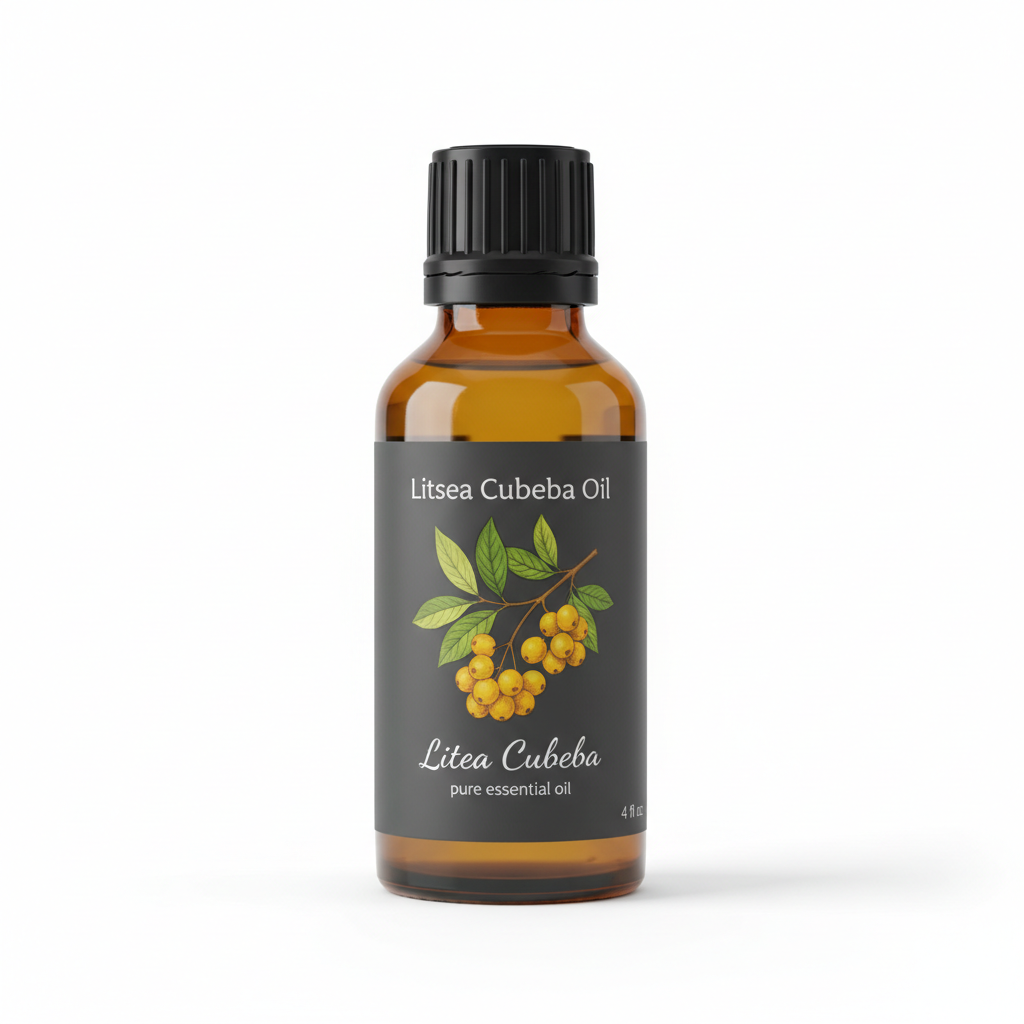
Our own Litsea Cubeba Essential Oil, in sizes from 0.5 oz to bulk.
From $12.99
Shop Now →What happened in the dish
The team behind the study, Chen and colleagues, exposed a reference strain of Cutibacterium acnes to the oil in broth. The oil stopped the bacteria growing at 400 micrograms per millilitre, which is a very small amount (0.04%), and killed them at 800. Under the microscope the cells looked visibly disrupted, and the metabolic tests showed 86 changed metabolites and a sharp drop in the cells' energy production. In plain English, in a dish and at that concentration, the oil upset the bacterium's structure and its fuel supply.
That is a nice result for a microbiology lab, and the authors frame it that way: as a lead that might inform new drug discovery. It was one strain, one batch of oil, and no skin.
Why a dish is not a face
Skin brings sebum, follicles, the rest of the skin's own bacteria and, of course, a person. None of that was in the broth. A result like this tells researchers where to look next; it does not tell anyone how an oil behaves when it is diluted in a carrier and put on a cheek. We could not find a human trial of litsea cubeba oil for acne, so there is nothing yet to lean on beyond the dish.
What dermatologists say first
The American Academy of Dermatology is blunt and practical about acne: treatment starts with a proper diagnosis, there is no one-size-fits-all plan, and it takes at least 6 to 8 weeks of sticking with a plan before you see fewer breakouts. It also points out that some things that look like acne are another condition altogether. That is the real answer to the question behind this article. If you are dealing with breakouts, a dermatologist can tell you what they are and what to do about them, and nothing about a lemon-scented oil changes that.
Where our oil fits
We sell one litsea cubeba oil, steam-distilled from the fruit and sold neat, as an aroma ingredient. We make no claim for it on skin. The Certificate of Analysis we publish is for one batch and lists appearance, smell, relative density 0.883, refractive index 1.483 and optical rotation +10.04 degrees.
If you do choose to put it on skin anyway, treat it as the concentrate it is. Our dilution guidance is 0.5% to 2% in a carrier oil, with a patch test on a small area first, and we would start well toward the low end. The reason is citral, the main component of litsea oils. It is a recognised contact allergen: in one patch-test study of 1,476 people referred for suspected contact dermatitis, 2.9% reacted to citral. The fragrance industry’s citral standard (IFRA) caps citral in body creams, lotions and oils at 0.15% of the finished product. Because published litsea fruit oils run from about two-thirds to nearly nine-tenths citral, that works out to roughly 0.17% to 0.23% oil, and that is our arithmetic on the literature, not a figure for our own batch. So 0.5% is already above it, and 2% is well above. Keep oil away from eyes, children and pets, and stop if you notice irritation. Our skin basics article walks through dilution and patch testing, and our storage guide covers keeping the oil cool, dark and closed.
For how bacteria studies are read, and what a number like 400 micrograms per millilitre means, see our antibacterial research article; quick questions are in the FAQ.
A good dish study is a fine reason to be curious about litsea cubeba, and a good reason for researchers to keep going. In the meantime, the oil is at its best doing what it does so well, smelling like a bowl of lemon drops.
Litsea Cubeba Essential Oil
Litsea Cubeba Essential Oil from our own shop, in sizes from 0.5 oz to bulk.
From $12.99
Shop Now →Sources & Further Reading
- Chen J et al., 2022. Antibacterial Activity of the Essential Oil From Litsea cubeba Against Cutibacterium acnes and the Investigations of Its Potential Mechanism by Gas Chromatography-Mass Spectrometry Metabolomics. Frontiers in Microbiology.
- American Academy of Dermatology, 2024. Acne: Diagnosis and treatment.
- Hagvall L et al., 2020. Contact allergy to citral and its constituents geranial and neral, coupled with reactions to the prehapten and prohapten geraniol. Contact Dermatitis.
- IFRA, 2020. IFRA Standard: Citral (Amendment 49).
- IFRA, 2023. Guidance for the Use of IFRA Standards (June 30, 2023).
- Si L et al., 2012. Chemical composition of essential oils of Litsea cubeba harvested from its distribution areas in China. Molecules.