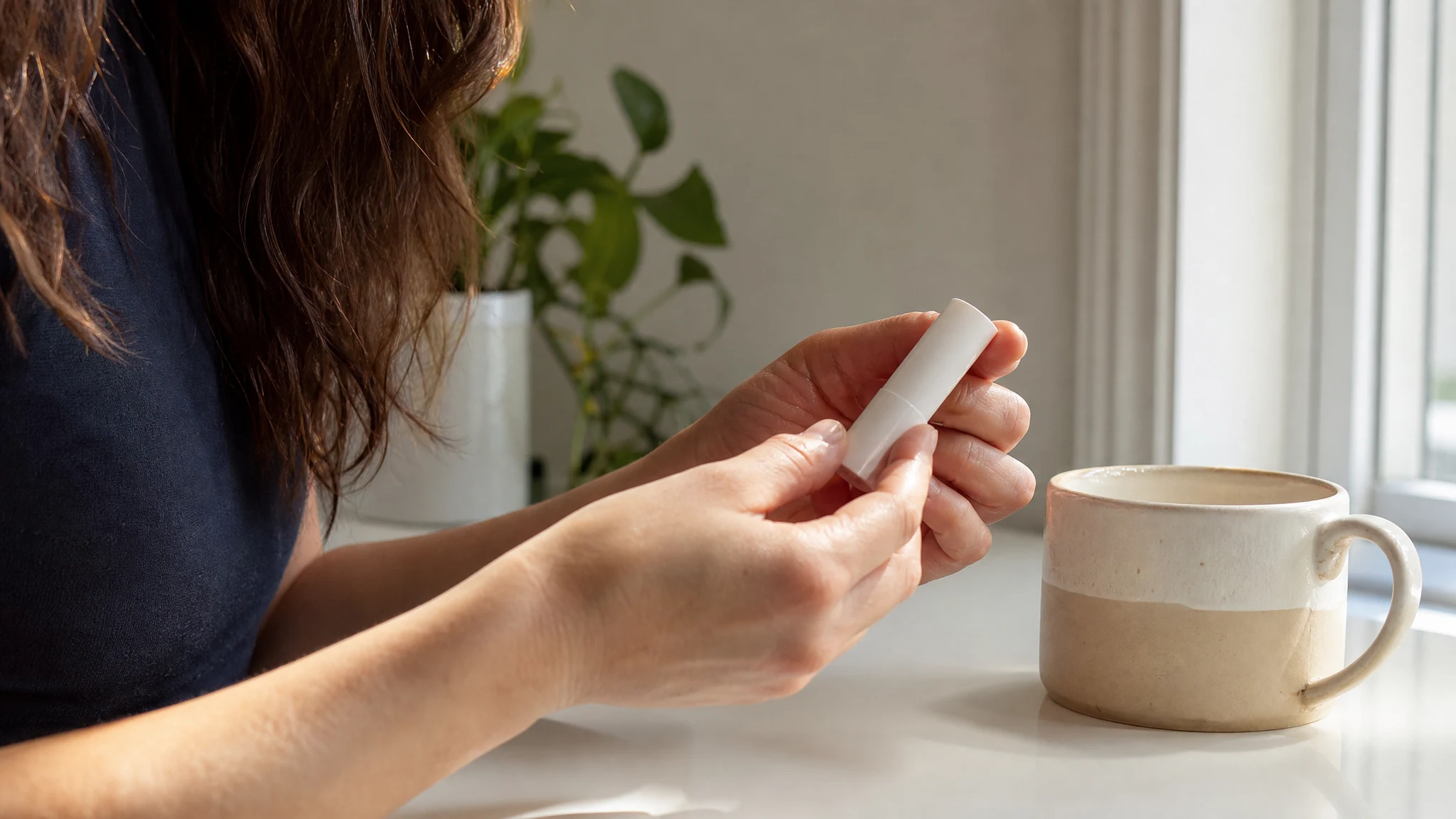
How to Make a Litsea Cubeba Inhaler, Counted in Drops
A personal inhaler is the most concentrated way to meet litsea cubeba oil, because the whole dose sits on a cotton wick a few centimetres from your nose, so this recipe goes lower than a diffuser would and counts the oil in drops, not percent. The formulation below is worked out from supplier information and our own figures. We have not made it or worn it, so build one wick first and treat it as a trial.

Litsea Cubeba Essential Oil
Our own Litsea Cubeba Essential Oil, in sizes from 0.5 oz to bulk.
From $12.99
Shop Now →Step 1: decide whether an inhaler is what you want
A diffuser fills a room; an inhaler is a small closed tube you open and sniff. The inhaler needs no electricity and no water, and it keeps the scent away from other people in the room, which matters for children, pets and pregnancy (see the safety articles linked at the end). It is also the format where oil sits closest to the airway, which is why the lower count matters. No mood, focus or sleep claim comes with it: the FDA regulates aromatherapy products mainly by how they are intended to be used, and says that coming from a plant does not keep an ingredient from being regulated as a drug (FDA aromatherapy page, current as of 09/08/2023). We describe the oil's scent and how to handle it, and nothing more.
Step 2: get the parts, and ask the right questions
We sell only the oil. Blank inhalers and spare cotton wicks come from aromatherapy, soap-making or craft supply shops. Three product pages we read describe the same basic design: a cotton wick in a tube with a snug cap. One is an aluminium case with an inner glass vial and a vented lid; one is an empty plastic stick described as BPA-free PET; one is an empty stick inhaler with a cotton wick. Ask any supplier:
- What is the body made of? We found no compatibility data for litsea oil with any plastic, so a glass vial or metal body is the lower-risk guess. This is reasoning, not a test.
- Does the wick take undiluted essential oil? Our oil is sold neat.
- Does the cap seal? A snug cap is deliberate, according to one page, to keep the scent from drying out.
Step 3: count the oil
None of the three product pages gives a drop count beyond "a few drops." The only stated capacity is a French supplier's page, which says the wick is "soaked with 1 to 2 ml of essential oil(s)" (Essenciagua product page). That is a ceiling for how much a wick can hold, not a recommended amount. Here it is in our oil's terms, using the 0.883 relative density on our COA and about 20 drops to the ml (droppers vary; weigh if you can):
| Amount on the wick | Volume | Weight |
|---|---|---|
| 1 drop | about 0.05 ml | about 44 mg |
| 3 drops | about 0.15 ml | about 130 mg |
| Wick fully soaked, 1 ml | 1 ml (about 20 drops) | about 0.88 g |
| Wick fully soaked, 2 ml | 2 ml (about 40 drops) | about 1.77 g |
Three drops is 15% of the lower capacity figure and 7.5% of the upper, so the wick is nowhere near full. For scale, 3 drops is also the oil in one ounce of a 0.5% skin blend (the low end of our own 0.5% to 2% skin copy, roughly 3 to 12 drops per ounce of carrier), except here it is held in one spot near the nose, undiluted. That comparison is the reason to start low. A 0.5 oz bottle holds about 296 drops, so at three drops a wick it is roughly 98 charges, and there is no economy in overloading.
Step 4: the recipe
One oil, one wick. Reasoning from the counts above and the irritation warnings below, the working formulation is:
- Hold a clean cotton wick with tweezers, so neat oil does not touch your fingers. Our copy says citral is a recognised skin sensitiser and that oil goes well down in a carrier for skin; a neat drop on a fingertip is the opposite of that.
- Put 2 drops of litsea cubeba oil on the wick (about 88 mg). Seat the wick in the tube and close the cap.
- Open it and sniff once, from about 15 cm, not with the opening against a nostril. If it is faint after a few minutes, add 1 drop. Stop at 3.
- Label the tube with the oil, the date and the batch number (our published COA is for batch LICQGCLCCNC003A, best by 04/30/2028).
- Wipe any oil from the outside, wash your hands, keep the cap closed between uses, and do not reuse the wick for a different oil.
A two-oil version is possible, but the second oil brings its own hazards, so keep the combined count at 3 drops and look up the other oil's cautions first. Our diffuser blends and uses article cover partners and ratios for open rooms; do not carry those drop counts across to an inhaler.
What citral does to the nose and eyes
EFSA's 2021 opinion on litsea berry oil says it should be considered an irritant to skin and eyes, a skin sensitiser and a presumed respiratory sensitiser, and that no user-specific data were supplied (EFSA FEEDAP, 2021). The oil analysed there averaged about 66% geranial plus neral, the two isomers of citral; our COA has no composition data. The European Commission's SCCS summary lists citral among the 26 fragrance allergens (European Commission, 2012). Practical reasoning from those two statements: keep the oil off your fingers and away from your eyes, stop if your nose, eyes or skin react, and if you have asthma or another airway condition, ask your physician before using any inhaled essential oil. We have no source that says litsea oil is acceptable for an airway condition, and we are not offering one.
Who should not use it
- Children: our copy says keep the oil away from children. Do not hold an inhaler to a child's face; for the exposure data see pregnancy and children.
- Pregnant or nursing readers: ask your obstetric clinician or midwife first.
- Anyone with fragrance allergy or airway disease: ask a physician.
- Homes with cats, dogs or birds: a closed tube is not an active diffuser, but a pet that mouths a wick has met neat oil; read litsea oil and pets and keep it out of reach.
Never swallow the oil. Our product pages say it is not for internal use. If anyone does, call Poison Help at 1-800-222-1222 (National Capital Poison Center).
The oil goes in a tube in drops, and the judgment about whether to use it near your airway goes to your physician; for dilution and patch testing of anything that touches skin, start with the skin basics article.
Litsea Cubeba Essential Oil
Litsea Cubeba Essential Oil from our own shop, in sizes from 0.5 oz to bulk.
From $12.99
Shop Now →Sources & Further Reading
- Essenciagua, undated. Empty stick inhaler, product page (wick capacity 1 to 2 ml). essenciagua.fr
- Mountain Rose Herbs, undated. Aroma inhalers, product page (aluminium case, glass vial, vented lid, "a few drops"). mountainroseherbs.com/aroma-inhalers
- Bulk Apothecary, undated. Aromatherapy inhalers, product page (cotton wick, PET plastic body, snug cap). bulkapothecary.com
- EFSA FEEDAP Panel, 2021. Safety and efficacy of litsea berry oil for all animal species. EFSA Journal 19(6):e06623. PMC8193530
- European Commission, SCCS opinion summary on fragrance allergens (GreenFacts), 2012. ec.europa.eu
- US FDA, 2023. Aromatherapy. fda.gov/cosmetics/cosmetic-products/aromatherapy
- National Capital Poison Center, undated. Essential oil poisonings. poison.org