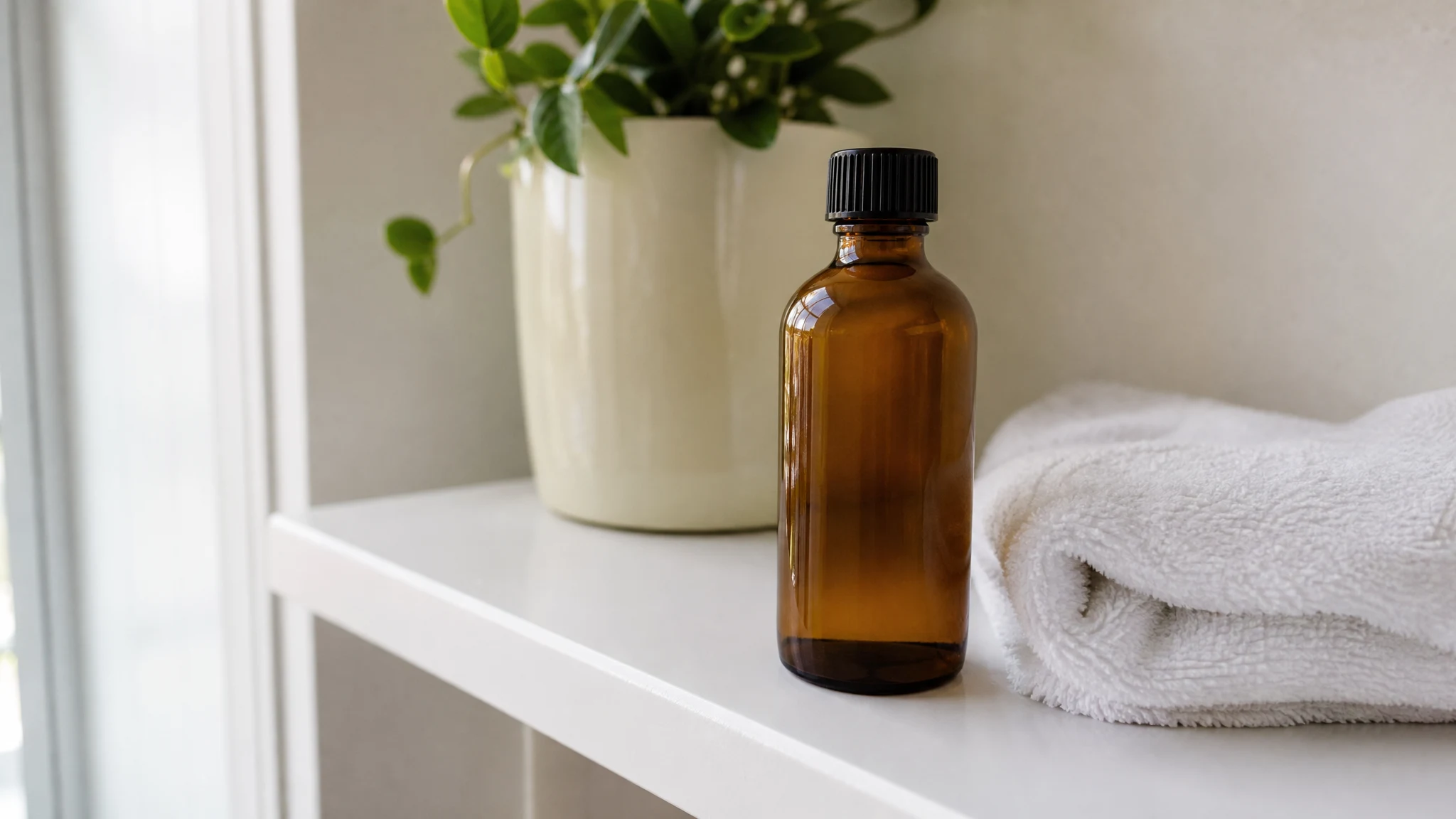
A Litsea Cubeba Face Oil Starts With One Drop
Most face oils are a carrier with a hint of scent, and litsea cubeba is a good example of why the hint should be small. It is a bright, sweet, lemon-drop oil, and nearly all of that character comes from citral, a compound the fragrance industry limits tightly in anything that stays on the face. The practical result is a recipe that begins with a single drop.

Litsea Cubeba Essential Oil
Our own Litsea Cubeba Essential Oil, in sizes from 0.5 oz to bulk.
From $12.99
Shop Now →Where the limit sits for face products
Our oil is sold neat, so dilution is yours to work out. Our general skin guidance is 0.5% to 2% in a carrier oil, with a patch test first. For a face oil we would begin below that range, and the reason is arithmetic. The IFRA Standard: Citral, 2020 (Amendment 49) caps citral at 0.15% of the finished product in Category 5B, where the Guidance for the use of IFRA Standards (51st Amendment) places facial moisturizers and creams, and the same 0.15% applies to body oils in Category 5A. Face oils are not named individually, so planning to the 0.15% figure is the careful reading.
Oil share equals the cap divided by the citral fraction of the oil. Fruit oils from eight Chinese sites measured 78.7% to 87.4% citral (Si et al., 2012), and our Certificate of Analysis does not list composition, so we plan from the higher figure: 0.15 divided by 0.874 is about 0.17% oil. These limits bind products sold commercially; for a bottle you make for yourself they are a sensible guide, because the face is where you will first notice a reaction and where a scent you love can easily become too much.
One drop in 30 ml
A drop of our oil is about 0.05 ml and 44 mg (the batch on our COA has a relative density of 0.883, and about 20 drops make a milliliter, which depends on the dropper). Here is the sum for common bottle sizes, as arithmetic:
| Bottle of carrier | Drops of litsea | Oil share, about |
|---|---|---|
| 30 ml | 1 | 0.17% |
| 60 ml | 2 | 0.17% |
| 100 ml | 3 | 0.15% |
One drop is a coarse tool. A dropper that makes large drops, say 15 to the milliliter, puts the 30 ml bottle at about 0.22%, a little over the planning figure. If you want repeatable batches, weigh instead: 0.15 g of oil into 100 g of carrier on a scale that reads to 0.01 g. A larger batch also makes the weighing easier, and a face oil keeps best in small bottles you will use up, so make the big batch and decant a bottle at a time.
Choosing the carrier
Jojoba is the carrier people most often reach for in a face oil, and a 2021 review explains what makes it unusual: it is about 98% wax esters rather than a triglyceride oil, a liquid wax. The review reports that crude jojoba oil is highly stable against oxidation thanks to natural antioxidants, and that refining reduces that stability, so an unrefined or cold-pressed grade keeps those qualities (Jojoba Oil: An Updated Comprehensive Review on Chemistry, Pharmaceutical Uses, and Toxicity). Whichever carrier you choose, we do not sell it; a cosmetic or soap supplier will, and its data sheet should list the INCI name. Ask for it, and buy in small amounts.
We make no skin-type claims for our oil. If it is oily-feeling skin that sent you looking, a scented oil is a pleasure product, not a treatment, and a dermatologist is the right person for questions about skin concerns.
Making it
- Pour 30 ml of carrier into a clean, dry, dark glass bottle.
- Add one drop of litsea cubeba oil, cap, and roll the bottle gently between your palms.
- Label it with the date and the oil level, and keep it free of water. Anything with water, hydrosol or gel needs a preservative system, which is the territory of a cosmetic chemist or a supplier selling a ready-made base.
- Before using it on your face, patch test the finished oil, not the neat oil, on a small area as described in our skin basics guide, and give it the full waiting time.
Apply well clear of the eyes, and stop if skin reddens, stings or itches. People who react to one fragrance material often react to others, and a persistent rash is a job for a physician or dermatologist. If you are pregnant, nursing, using prescription skin treatments, or buying for a child, ask a physician or pharmacist first. Sun exposure raises its own questions, and our phototoxicity article reads what has been published. Store the bottle cool, dark and closed, as in our storage guide, and let go of it if the aroma changes.
If you would like to see the same arithmetic applied to a bigger, whole-body product, we have worked it through in our body butter post.
A face oil made this way is quiet: a drop of lemon-drop brightness over a soft carrier, which is exactly where litsea cubeba is at its most charming.
Litsea Cubeba Essential Oil
Litsea Cubeba Essential Oil from our own shop, in sizes from 0.5 oz to bulk.
From $12.99
Shop Now →Sources & Further Reading
- IFRA Standard: Citral, 2020 (Amendment 49)
- Guidance for the use of IFRA Standards (51st Amendment)
- Chemical composition of essential oils of Litsea cubeba harvested from its distribution areas in China, Molecules 2012
- Jojoba Oil: An Updated Comprehensive Review on Chemistry, Pharmaceutical Uses, and Toxicity, Polymers 2021