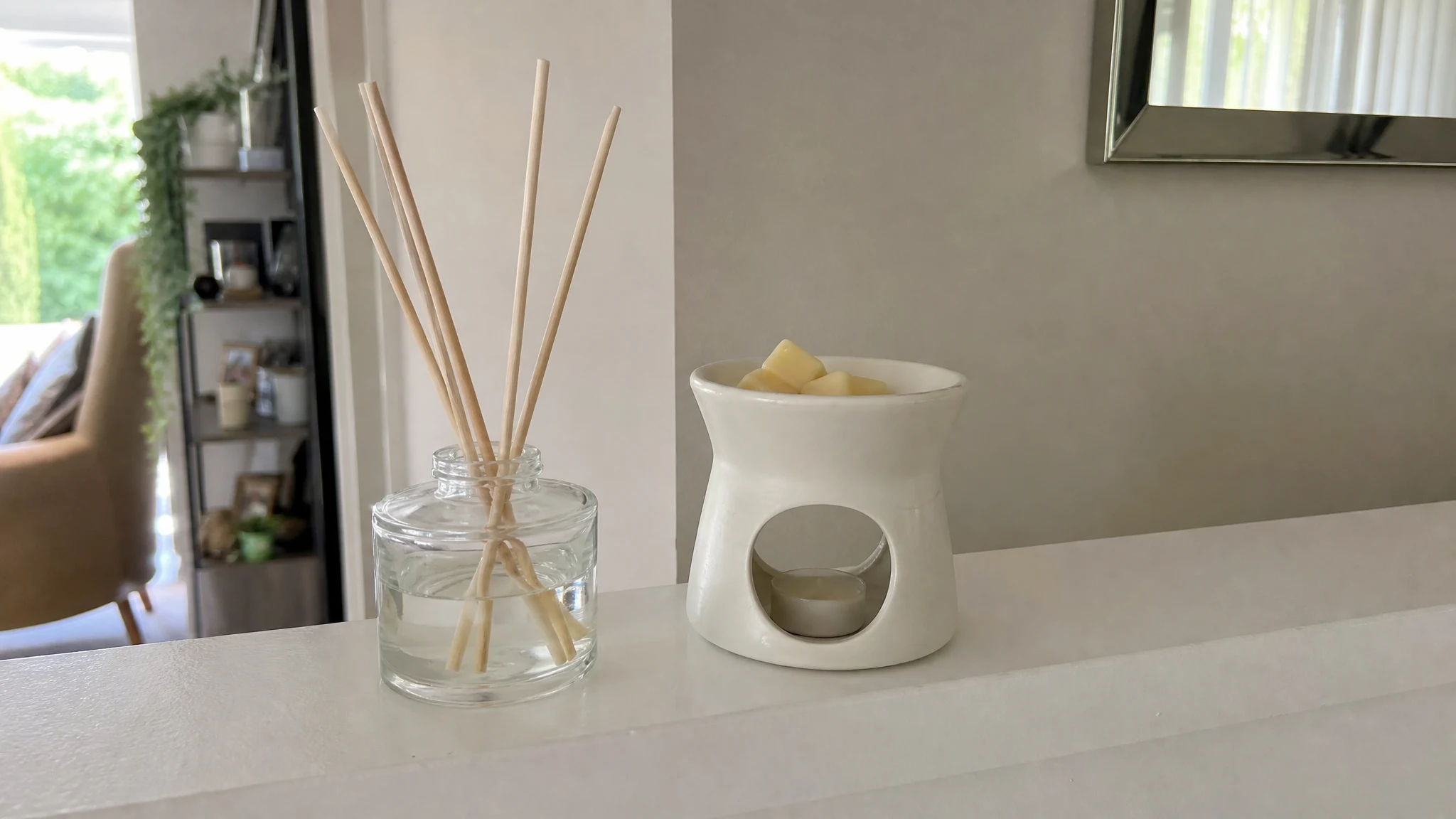
Litsea Cubeba in Reed Diffusers and Wax Melts: The Arithmetic
Start with one sum. Supplier guidance for reed diffusers is a fragrance load of 10% to 20% of the liquid, and ten percent of 100 g is 10 g of oil, about 227 drops. IFRA's citral cap for reed diffuser liquid allows roughly 1.4 to 1.5 g of litsea oil in that 100 g if the oil sits in the citral range found in the literature. A diffuser made with litsea alone at a normal load is therefore about seven times over the cap, while candles sit in a category with no citral cap at all, and IFRA's list does not name wax melts. This article works through both formulations, and says plainly where we have no data.

Litsea Cubeba Essential Oil
Our own Litsea Cubeba Essential Oil, in sizes from 0.5 oz to bulk.
From $12.99
Shop Now →Why the diffuser and the melt are not the same problem
IFRA's Guidance for the use of IFRA Standards (30 June 2023) puts fragranced oil for reed diffusers in Category 10A. Its section 6.5.18 explains that the more restrictive placement was chosen "to reflect the potential exposure during manual handling (flipping) of the soaked reeds and/or the refill." Candles of all types are Category 12, non-skin-contact products. The IFRA Citral standard (Amendment 49, 2020) caps citral at 1.2% in Category 10A and sets no restriction in Category 12. I searched the guidance text and found no entry named for wax melts, so their category is for your regulatory consultant to decide, not for me to assign. Our IFRA compliance guide explains the rules in full, and the live candle article covers wicks and burn pools, which I will not repeat.
The conversion for the diffuser: maximum oil share equals the citral cap divided by the citral fraction of the oil. Si et al. (2012) reported 78.7% to 87.4% neral plus geranial in fruit oils from eight Chinese sites, so 1.2 divided by 0.874 to 0.787 gives about 1.37% to 1.52%. Our COA reports no citral figure, so this is a literature illustration and not a statement about our batch. Any citral in the other fragrance materials in the diffuser counts toward the same cap.
Reed diffuser: a formulation, untested
We have not made this, we have no throw data, and it is a formulation worked out from cited guidance and arithmetic. Make a small test batch before anything larger. Our oil has no published flash point or safety data sheet, so anyone planning to sell a diffuser must ask for safety data in writing first.
Supplier guidance on load comes from a candle-supply shop's blog post of June 8, 2023: the ideal fragrance-to-base ratio is "somewhere between 10 and 20% fragrance," other bases typically hold 20% to 40%, and for a fragrance with a low Category 10A limit that limit should be treated as the maximum. The post recommends test batches at 10%, 15% and 20%.
| Per 100 g of finished diffuser liquid | Oil | Drops | Share of a 10% fragrance load |
|---|---|---|---|
| IFRA 10A ceiling, 87.4% citral oil | 1.37 g | about 31 | about 14% |
| IFRA 10A ceiling, 78.7% citral oil | 1.52 g | about 34 | about 15% |
| Half the ceiling (my suggested start) | about 0.7 g | about 16 | about 7% |
| Litsea alone at a 10% load | 10 g | about 227 | 100% |
Drops use 0.883 g/ml and about 20 drops per ml, so about 44 mg a drop; weigh instead if you can. My working recipe, labelled as reasoning: 100 g of diffuser base from a supply shop, about 16 drops of litsea oil, and the rest of any fragrance load made up from a citral-free material your supplier documents. We do not sell the base, bottle, reeds or any other fragrance. Ask the base supplier for its own safety data sheet, because the hazards of the base are not litsea's. The same arithmetic means a litsea-forward diffuser will smell lighter than a standard 10% to 20% product, and I cannot say how much lighter.
A second reasoning point on materials: citrus-type oils and glycol solvents can soften some plastics, and I found no litsea-specific source, so use a glass bottle and test a drop on any plastic cap or tray before trusting it.
What the poison data say about diffuser liquid
This is the real hazard, and it is about the liquid, not the oil. Panchal et al. (2016) analysed 754 enquiries to the UK National Poisons Information Service from 2010 to 2014; 712 patients were children under 5 and 706 involved ingestion. Among 702 sole ingestions with a known severity score, 574 (81.3%) scored 0, 117 (16.6%) scored 1, 11 (1.6%) scored 2 and none scored 3; nausea and vomiting, coughing and central nervous system depression were the most common features. Where the volume was known (76 of 591 cases) the median was 20 mL. A 2026 letter in the New Zealand Medical Journal reported 94 reed-diffuser exposures to the national poisons centre in 2019, 82% aged 0 to 2, and noted typical fluid is 70% to 90% glycol ether or ethanol solvent and 10% to 30% fragrance or essential oil. It states its "as little as 20 mL" figure comes from case reports and does not show a calculation.
The National Capital Poison Center warns that some reed diffuser fragrances contain up to 70 percent isopropyl alcohol and that the narrow opening is "not too narrow for a child to take a swig or spill the contents." If someone swallows diffuser liquid, call Poison Help at 1-800-222-1222. For a household with children or pets, the simplest answer is no open diffuser within reach; a wax melt in a warmer is the lower-liquid alternative, though a warmer has its own heat risks.
Wax melts: grams from the wax maker's figure
The wax maker sets the load, not us. For Blended Waxes BW 923, a retailer's listing of the maker's figures gives a maximum scent load of up to 15%, a typical melt point of 125 F, a pour range of 160 to 180 F with a suggested start of 160 to 170 F, and an instruction to let melts sit undisturbed for 48 hours before test melting. The figure is for that one wax; another blend will differ, so use the data sheet for yours.
| Load (of wax weight) | Oil per 100 g wax | Drops | Oil per 1 lb (453.6 g) wax |
|---|---|---|---|
| 3% | 3 g | about 68 | 13.6 g (about 0.5 oz) |
| 6% | 6 g | about 136 | 27.2 g (about 1 oz) |
| 8% | 8 g | about 181 | 36.3 g (about 1.4 oz) |
| 10% | 10 g | about 227 | 45.4 g (about 1.7 oz) |
| 15% (that wax's stated ceiling) | 15 g | about 340 | 68.0 g (about 2.6 oz) |
Our working untested formulation: 100 g of that wax at 6%, which is 6 g, about 136 drops, a little under half of a 0.5 oz bottle (about 296 drops, 13.1 g). It sits well under the maker's ceiling, and I chose it only so there is margin for a first batch. Method from the maker's sheet: melt to 180 F, take the wax off heat, add the oil, stir about two minutes, pour. Because our oil's flash point is unpublished, there is no number to compare to the wax temperature, so my reasoning is to add it at the low end of the maker's window (160 to 170 F) and stir gently. Wait the maker's 48 hours before judging. Wax, warmers and molds are not sold by us; a candle or soap supply shop sells them, and the maker's data sheet has the temperatures.
If you plan to sell either product, a buyer or retailer will want IFRA, allergen and safety documents, and the labelling rules in the EU and US differ. See the compliance guide above, and talk to a regulatory consultant or product-safety attorney about warmer and child-safety labelling. For a spray alternative see the room spray, and for blends that pair with the lemon note see the diffuser blends; the technical FAQ covers the maker questions.
A first melt batch needs about 136 drops, and the shop page shows the sizes that cover it.
Litsea Cubeba Essential Oil
Litsea Cubeba Essential Oil from our own shop, in sizes from 0.5 oz to bulk.
From $12.99
Shop Now →Sources & Further Reading
- IFRA, 2023. Guidance for the use of IFRA Standards, 30 June 2023. ifrafragrance.org guidance PDF
- IFRA, 2020. IFRA Standard: Citral (Amendment 49). ifrafragrance.org/standards/IFRA_STD_021.pdf
- Si L et al., 2012. Chemical composition of essential oils of Litsea cubeba harvested from its distribution areas in China. Molecules 17:7057-7066. PMC6268156
- NorthWood Candle and Craft, 2023. What is the best diffuser base to fragrance ratio? northwoodcandleandcraft.com
- Panchal B, Eddleston M, Thomas SHL, Thompson JP, Vale JA, 2016. 754 exposures to reed diffusers reported to the UK National Poisons Information Service 2010-2014. awttc.nhs.wales
- Cressey P, 2026. Reed diffusers: a potential cause of poisoning in young children in New Zealand. N Z Med J 139(1637):164-166. nzmj.org.nz
- National Capital Poison Center. Reed diffusers: potential household risk. poison.org/articles
- Voyageur Soap and Candle, product listing for Blended Waxes BW 923 Natural Tart/Melt Wax Blend (manufacturer's figures as listed by the retailer). voyageursoapandcandle.com