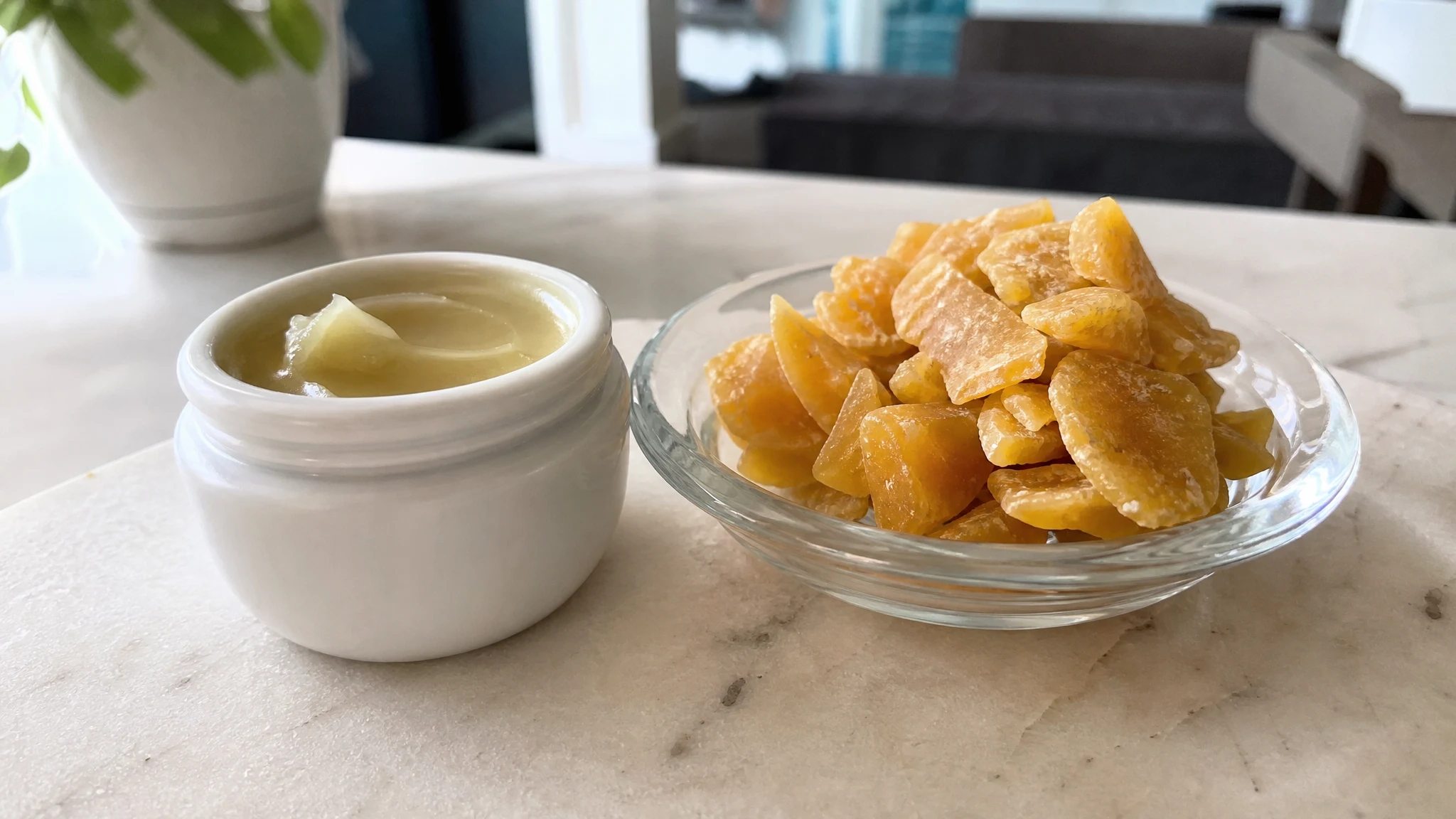
A Solid Perfume Balm Built Around Litsea Cubeba
A solid perfume is one of the nicest ways to wear a bright citrus: a little tin in a pocket, a dab on a wrist. Litsea cubeba suits it well, but with one condition. The amount you can use is set by a cap on citral, not by how loud you want the scent, and it is lower than most online balm recipes assume.

Litsea Cubeba Essential Oil
Our own Litsea Cubeba Essential Oil, in sizes from 0.5 oz to bulk.
From $12.99
Shop Now →Start with the ceiling
IFRA's guidance puts solid perfume in Category 4, the fine-fragrance group for products applied to the neck, face and wrists. The IFRA Standard for Citral allows 0.60% citral in the finished product there. Because the cap is on citral rather than on the oil, the oil share depends on how much citral the oil carries, and published figures vary: 78.7% to 87.4% in eight hydrodistilled fruit samples in one study, and about 66% from the batch means in an EFSA opinion on commercial batches. Dividing the cap by each gives a ceiling of roughly 0.69% to 0.91% litsea oil in the finished balm.
That is why we recommend the low end of our own dilution range, 0.5% oil, for a perfume. Our general guidance for skin is 0.5% to 2% in a carrier with a patch test first, but the top of that range is more than twice the Category 4 ceiling, so we do not suggest it here and we would never call 2% safe. These caps also count citral from every ingredient, so a second citral-rich oil such as lemongrass or lemon myrtle draws on the same allowance.
A 100 g batch, as arithmetic
Here is a water-free formulation worked out from the figures above, making about ten small tins.
| Ingredient | Weight | Share |
|---|---|---|
| Beeswax, cosmetic grade | 20.0 g | 20% |
| Jojoba oil | 79.5 g | 79.5% |
| Litsea cubeba essential oil | 0.5 g (about 11 drops) | 0.5% |
You will find beeswax and jojoba at a craft or soap-supply shop or a carrier-oil supplier, as we sell only the litsea oil. The Certificate of Analysis we publish for one batch gives a relative density of 0.883, so with a rough 20 drops to the millilitre a drop is about 44 mg. Droppers differ a lot, so weigh the oil on a 0.01 g scale rather than counting. At 0.5% the batch carries roughly 0.33% to 0.44% citral, which leaves a little room under the 0.60% ceiling.
The ratios come from reasoning, not from a perfume-balm recipe in the literature. A 2026 review of beeswax in pharmaceutical products says it is typically used at 5% to 20% to give creams and ointments their body. A tin has to hold its shape in a pocket, so we start at the top of that range. If the result is too hard, trim the wax to 15% and move the difference into jojoba; if it slumps, go the other way. Jojoba is a good partner for a scent balm: it is described as a liquid wax made mostly of wax esters, with high thermal and oxidative stability.
Making it
Beeswax typically melts at around 61 to 66 C. PubChem lists flash points for citral itself between 82 C and 91 C (closed cup), without naming the isomer; those figures are for the compound, not our oil. Reading the two together, the base needs to stay above about 66 C to pour, and the oil should go in with the heat off and the jar somewhat below 80 C. A thermometer beats guessing.
- Melt the beeswax and jojoba together in a heatproof jar set in hot water, stirring until clear.
- Take the jar off the heat and let it cool to about 70 C.
- Weigh in the litsea oil, stir for half a minute, and pour at once into tins on a level surface.
- Leave the tins uncovered until set, then cap and label with the date.
Nothing in the formula contains water, so it needs no preservative. Keep it that way: adding hydrosol or aloe makes it a different product that needs a preservative chosen by a cosmetic formulator.
Set your expectations for the scent
Bright citrus is a runner, not a marathon. A 2012 perfumery analysis found that scents rated as fresh tend to have low staying power (a correlation of minus 0.85 between a freshness score and a substantivity index), and it observes that citrus and green notes are perceived as fresh and evaporate quickly. Lemon oil scored zero on staying power there, and litsea cubeba was not in the paper, so we cannot predict how long this balm will smell of lemon on skin. If you want the lemon to linger, pair it with something deeper; our piece on using litsea cubeba as a top note covers how.
It is also a product for skin that handles fragrance well. EFSA's panel considered the oil an irritant to skin and eyes and a skin and respiratory sensitiser. People with a known fragrance allergy, anyone with broken skin, and anyone who is pregnant or buying for children should check with a clinician first, and our posts on pregnancy and children and pets summarise what the authorities say. Beeswax allergy is described as rare, and jojoba patch tests in the literature showed no allergic reactions except in hyperallergic people. Always put a small dab on the inner forearm first.
A tin of this on your desk, a lemon sparkle every time you open the lid: that is the whole idea.
Litsea Cubeba Essential Oil
Litsea Cubeba Essential Oil from our own shop, in sizes from 0.5 oz to bulk.
From $12.99
Shop Now →Sources & Further Reading
- IFRA. "IFRA Standard: Citral," 2020 (Amendment 49). ifrafragrance.org/standards/IFRA_STD_021.pdf
- IFRA. "Guidance for the Use of IFRA Standards," June 30, 2023 (51st Amendment). IFRA guidance PDF
- Si L. et al. "Chemical composition of essential oils of Litsea cubeba harvested from its distribution areas in China." Molecules, 2012. pmc.ncbi.nlm.nih.gov/articles/PMC6268156
- EFSA FEEDAP Panel. "Safety and efficacy of a feed additive consisting of an essential oil from the fruits of Litsea cubeba (Lour.) Pers. (litsea berry oil) for use in all animal species (FEFANA asbl)." EFSA Journal, 2021. pmc.ncbi.nlm.nih.gov/articles/PMC8193530
- Huanbutta K. et al. "Beeswax in Pharmaceutical Sciences: A Comprehensive Review of Its Chemical Composition, Functional Applications, Types, and Formulation Roles." International Journal of Molecular Sciences, 2026. pmc.ncbi.nlm.nih.gov/articles/PMC13116613
- Gad H. A. et al. "Jojoba Oil: An Updated Comprehensive Review on Chemistry, Pharmaceutical Uses, and Toxicity." Polymers, 2021. pmc.ncbi.nlm.nih.gov/articles/PMC8197201
- Zarzo M. "What is a fresh scent in perfumery? Perceptual freshness is correlated with substantivity." Sensors, 2012. pmc.ncbi.nlm.nih.gov/articles/PMC3574685
- PubChem. "Citral" (compound 638011), flash point section. pubchem.ncbi.nlm.nih.gov