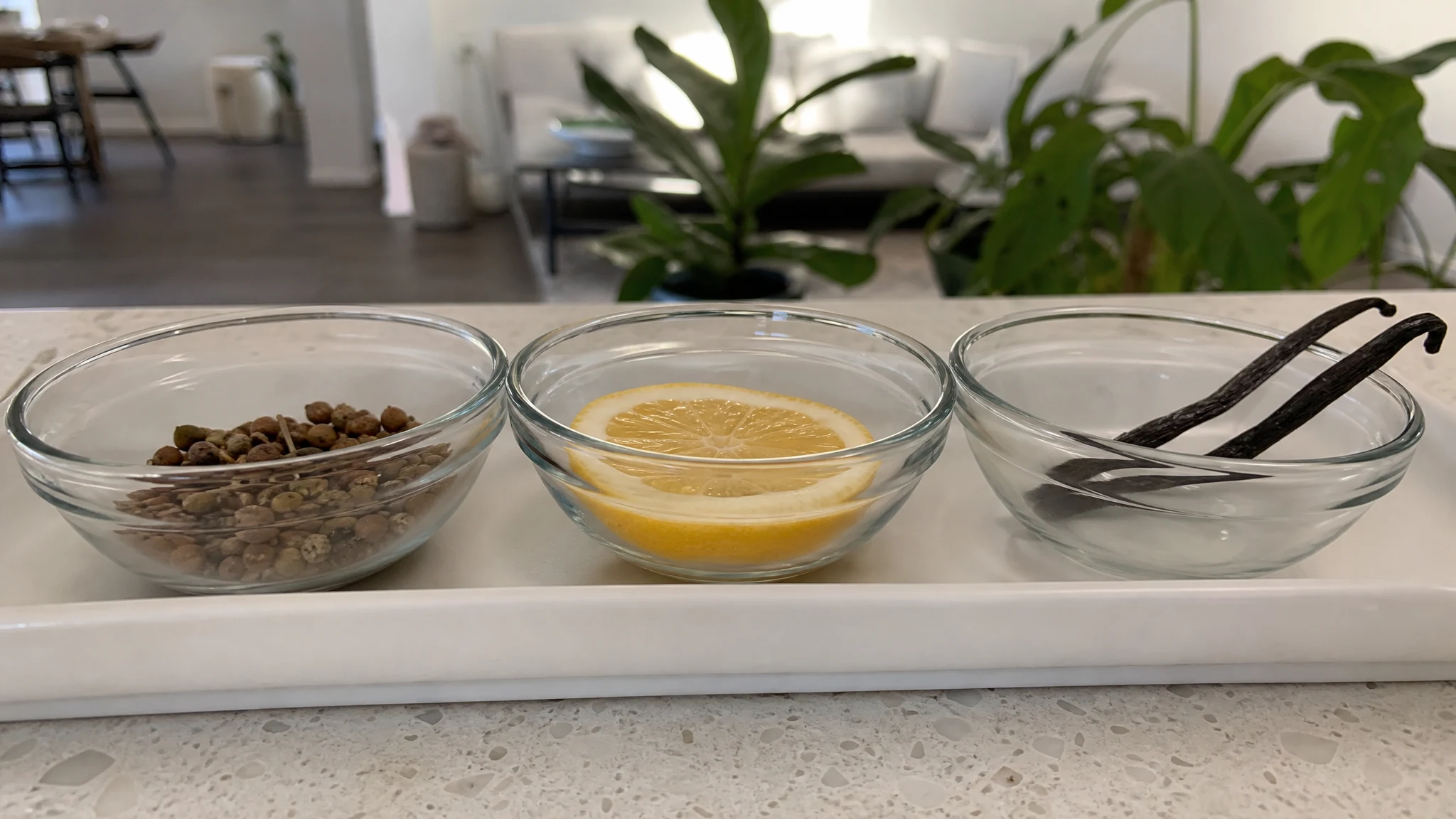
Litsea Cubeba as a Sparkling Perfume Top Note
Open a perfume and the first thing you smell is the top note: bright, quick and gone before you have finished your first cup of coffee. Litsea cubeba is built for that role. Its lemon-drop sparkle makes a lively opening, and the interesting part of using it is not the pyramid itself but learning how much of it a finished perfume can hold.

Litsea Cubeba Essential Oil
Our own Litsea Cubeba Essential Oil, in sizes from 0.5 oz to bulk.
From $12.99
Shop Now →What "top note" really means
A top note is a measured behaviour, not a label on the bottle. In the classic Poucher system, a perfumer times how long a material keeps its typical odour on a smelling strip and scores it from 1 to 100. Materials scoring under 15 count as top notes, 15 to 60 as middle notes and over 60 as base notes. In a 2012 analysis, Zarzo describes the top note as the first odour you perceive, the middle as the body of the blend, and the base as the low-volatility fixatives underneath.
Litsea cubeba is not in that paper, so we cannot quote a score for it. We list it as a top note ourselves, which fits the way a citral-rich lemon behaves. For a sense of the territory, the same paper puts lemon oil at 8 and bergamot at 6, both firmly top notes with very little staying power. A bright citrus opening is something you expect to enjoy first and lose first.
Deciding what you want the lemon to do
The same study found that scents people rate as fresh tend to have little staying power. The correlation was strong (minus 0.85), and the paper quotes the observation that citrus and green notes are perceived as fresh and evaporate quickly. So the first design decision is honest: do you want a sparkling opening that fades, or a lemon that lingers? Both are fine, but they are different perfumes.
For a sparkling opening, use litsea as the first impression and let the heart take over. For a lemon that lingers, give it something to hold onto. We recommend building from oils we already know pair well with litsea: geranium for a rounded floral middle, ylang ylang for a creamy one, bergamot to extend the citrus, and vetiver for a dark, earthy base that anchors the lemon. Using vetiver as an anchor is perfumery logic rather than a measurement, and none of those oils are ones we sell, so you will find them at an aromatherapy or perfume-supply shop.
How much litsea can the perfume hold?
This is where litsea differs from a peel oil. The IFRA Standard for Citral caps citral at 0.60% of a Category 4 product, which covers fine fragrance and solid perfume, since its guidance describes those as applied to the neck, face and wrists. Published citral figures for litsea oil run from about 66% to about 87%, so the cap allows roughly 0.69% to 0.91% litsea oil in the finished perfume. What that means for your formula depends on how strong the perfume is.
Here is the arithmetic. If your finished perfume contains a given percentage of fragrance concentrate, the largest share of that concentrate that can be litsea is the cap divided by that percentage:
| Concentrate in the finished perfume | Most litsea in the concentrate |
|---|---|
| 5% | about 14% to 18% |
| 10% | about 7% to 9% |
| 15% | about 5% to 6% |
| 20% | about 3.5% to 4.5% |
In other words, the stronger the perfume, the smaller the litsea slice, and it is not a large one even at a light dilution. A 15% concentrate gets perhaps one part litsea in twenty. That is plenty for a lift: a drop of a bright oil goes a long way at the front of a blend. It also means litsea works best as a sparkle on top of a composition, not as its backbone. The cap counts citral from every ingredient, so a second citral-rich oil such as lemongrass or lemon myrtle uses up the same allowance.
Building a first trial
Pick your concentrate strength first, then do the sums. Then write the formula in grams, not drops. The Certificate of Analysis we publish for one batch gives a relative density of 0.883, so a drop of litsea weighs very roughly 44 mg, which makes drop counts too imprecise for a cap this tight. A 0.01 g scale does the job.
Smell it on a strip, then on skin, and again after a few hours. Perfume changes as it dries, and top notes show their character in the first minutes. If the lemon vanishes too quickly for your taste, the answer is rarely more litsea, since the cap will not allow it; it is usually a stronger heart or a better anchor. For skin use, our guidance is the low end of our 0.5% to 2% range with a patch test first, and for a perfume that low end is the right place to stay. Our solid perfume article turns the same arithmetic into a worked balm, and our skin basics article covers patch tests. If you want more partner ideas, our pairing guide is a good next stop.
Think of litsea as the first sentence of the perfume, short, bright and memorable, and let the rest of the blend write the story.
Litsea Cubeba Essential Oil
Litsea Cubeba Essential Oil from our own shop, in sizes from 0.5 oz to bulk.
From $12.99
Shop Now →Sources & Further Reading
- Zarzo M. "What is a fresh scent in perfumery? Perceptual freshness is correlated with substantivity." Sensors, 2012. pmc.ncbi.nlm.nih.gov/articles/PMC3574685
- IFRA. "IFRA Standard: Citral," 2020 (Amendment 49). ifrafragrance.org/standards/IFRA_STD_021.pdf
- IFRA. "Guidance for the Use of IFRA Standards," June 30, 2023 (51st Amendment). IFRA guidance PDF
- Si L. et al. "Chemical composition of essential oils of Litsea cubeba harvested from its distribution areas in China." Molecules, 2012. pmc.ncbi.nlm.nih.gov/articles/PMC6268156
- EFSA FEEDAP Panel. "Safety and efficacy of a feed additive consisting of an essential oil from the fruits of Litsea cubeba (Lour.) Pers. (litsea berry oil) for use in all animal species (FEFANA asbl)." EFSA Journal, 2021. pmc.ncbi.nlm.nih.gov/articles/PMC8193530