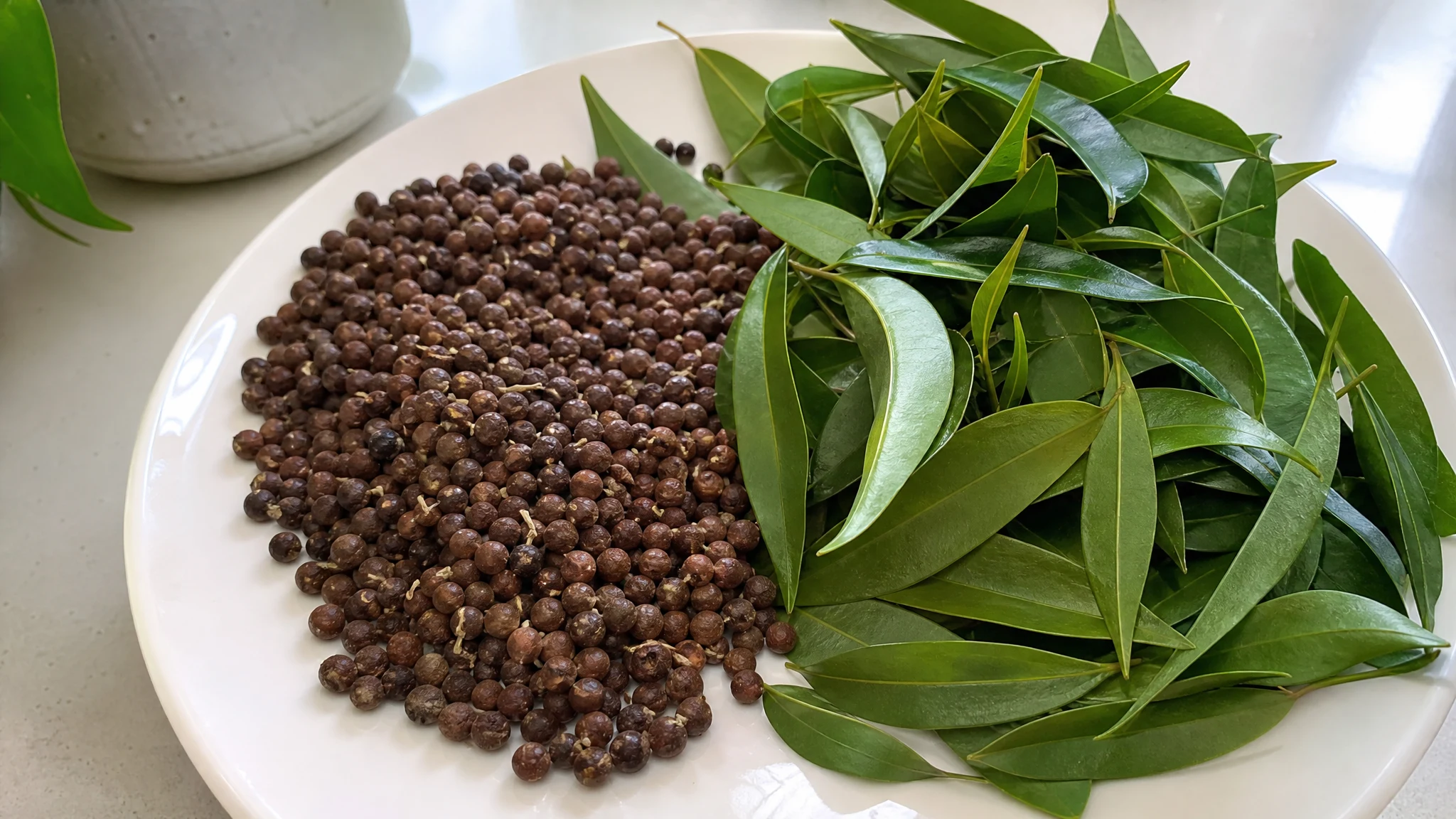
Litsea Cubeba or Lemon Myrtle for a Citral Lemon Note
If you are weighing litsea cubeba against lemon myrtle because one of them has "more citral", here is a twist: the numbers will not settle it, and because the safety cap is set on citral itself, a higher-citral oil is allowed in a smaller amount, not a larger one. We sell litsea cubeba and not lemon myrtle, so this is a comparison from the published sources, with our own oil's limits stated plainly.

Litsea Cubeba Essential Oil
Our own Litsea Cubeba Essential Oil, in sizes from 0.5 oz to bulk.
From $12.99
Shop Now →Two lemons from different parts of the plant
Lemon myrtle (Backhousia citriodora) is a tree native to the east coast of Queensland in Australia, and its oil is steam-distilled from the leaf and terminal branches. A review by Southwell puts the citral-rich type at 80% to 96% citral. Litsea cubeba oil comes from the small pepper-like fruit of a different tree altogether, a member of the laurel family, which is why it is sometimes described as a lemon aroma without a citrus fruit in sight.
Litsea's citral figure depends on whose analysis you read: 78.7% to 87.4% in eight fruit samples from six Chinese provinces, about 66% as the average of six commercial batches in a European Food Safety Authority opinion, and 63% to 78% in Southwell's own listing. The top of one litsea range sits inside the lemon myrtle range, and the bottom of another sits well below it. So "lemon myrtle is higher" is true on average and untrue for some pairs of lots. The review's title calls lemon myrtle "an unrivalled source of citral", which is the author's view in a paper about lemon myrtle. We have no way to compare scent quality between the two from that paper, and we do not claim our oil is better or worse.
Why more citral means less oil
The IFRA Standard for Citral caps citral by product category: 0.15% for body lotions and creams (Categories 5A to 5C), 0.60% for fine fragrance and solid perfume (Category 4), 1.2% for soap and household cleaners (Categories 9 and 10A), and no restriction for candles (Category 12). Divide the cap by the oil's citral fraction and you get the most oil the product can hold.
| Product type (citral cap) | Most lemon myrtle oil | Most litsea cubeba oil |
|---|---|---|
| Fine fragrance (0.60%) | about 0.63% to 0.75% | about 0.69% to 0.91% |
| Body lotion (0.15%) | about 0.16% to 0.19% | about 0.17% to 0.23% |
| Soap (1.2%) | about 1.25% to 1.50% | about 1.37% to 1.82% |
The two oils land within a hair of each other, and the higher-citral oil is held to the smaller figure. That is the single most useful thing to know when you are choosing between them: the cap makes them close to interchangeable, as long as you convert by citral weight and not by drops. One gram of litsea carries roughly 0.66 to 0.87 g of citral, so lemon myrtle at 80% to 96% needs about 0.69 to 1.09 g to match. Our substitutes article and citral comparison carry the full tables.
For skin, our general guidance for litsea is 0.5% to 2% in a carrier with a patch test first, but the lotion row above shows how much room the cap leaves, so we start at the low end and we do not call 2% safe. At 0.5% oil, the citral delivered is about 0.33% to 0.44%, already two to three times the lotion cap.
What the safety text rests on
Both oils are citral oils, and both carry the sensitiser label that goes with citral. EFSA's panel considered litsea oil an irritant to skin and eyes and a skin and respiratory sensitiser, with a local lymph node assay estimate of 8.4%, and classed it as a weak sensitiser. Southwell's review notes that, because of toxicity investigations on citral, topical use at less than 1% in a topical formulation is recommended for lemon myrtle, and that citral-rich oils should be restricted during pregnancy because of a possible teratogenic hazard, citing earlier reviews we did not read. Anyone who tells you one of these oils is gentle and the other harsh is working from the citral percentage, because we found no head-to-head study. Our pages on pregnancy and children and skin basics cover what is published for litsea.
Choosing for the job
- Candles, soap, room sprays. There is no citral cap for candles and a workable one for soap, so the deciding factors are your supply and how well each lot is documented, not a safety gap.
- Leave-on skin products. With a cap as low as 0.15% citral, either oil is a trace ingredient, and the lot's documentation matters most.
- A labelled origin story. Lemon myrtle has an Australian standard (AS 4941-2001, per Southwell) and litsea oil has ISO 3214:2000, on which EFSA's specification is based, so ask a supplier which one the lot was checked against.
The Certificate of Analysis we publish for one litsea batch (LICQGCLCCNC003A) lists a relative density of 0.883, a refractive index of 1.483 and an optical rotation of +10.04 degrees. It has no GC-MS profile and no citral figure, so we cannot tell you where our oil sits in any range above. If a citral figure matters to your product, ask us in writing through our contact page before you order, and get the answer in writing.
Two lemons, one rule: let the citral cap do the choosing, and let your nose do the rest.
Litsea Cubeba Essential Oil
Litsea Cubeba Essential Oil from our own shop, in sizes from 0.5 oz to bulk.
From $12.99
Shop Now →Sources & Further Reading
- Southwell I. "Backhousia citriodora F. Muell. (Lemon Myrtle), an Unrivalled Source of Citral." Foods, 2021. pmc.ncbi.nlm.nih.gov/articles/PMC8305781
- Si L. et al. "Chemical composition of essential oils of Litsea cubeba harvested from its distribution areas in China." Molecules, 2012. pmc.ncbi.nlm.nih.gov/articles/PMC6268156
- EFSA FEEDAP Panel. "Safety and efficacy of a feed additive consisting of an essential oil from the fruits of Litsea cubeba (Lour.) Pers. (litsea berry oil) for use in all animal species (FEFANA asbl)." EFSA Journal, 2021. pmc.ncbi.nlm.nih.gov/articles/PMC8193530
- IFRA. "IFRA Standard: Citral," 2020 (Amendment 49). ifrafragrance.org/standards/IFRA_STD_021.pdf