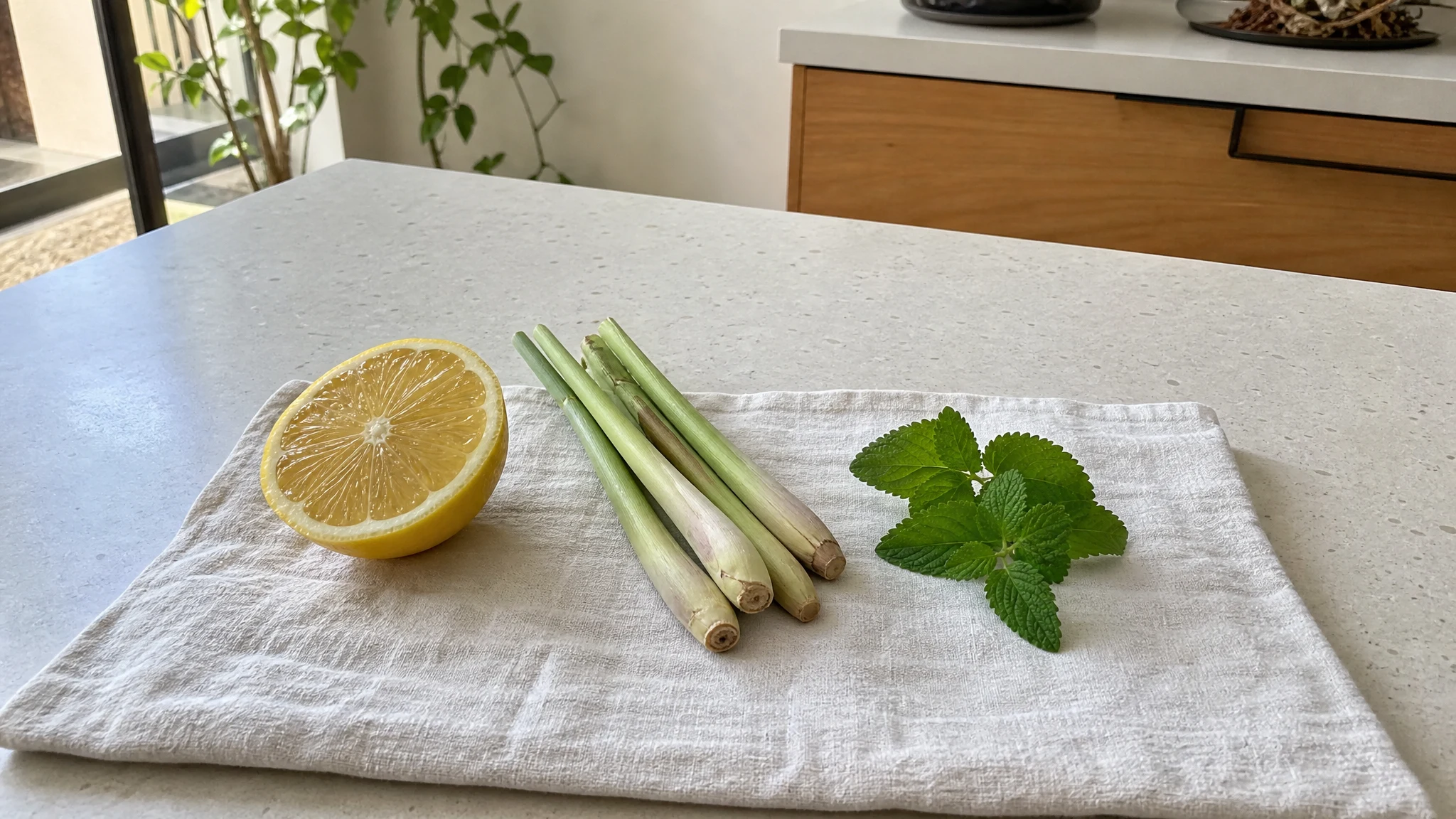
One Citral Number, Four Possible Plants
Imagine two bottles that both say "citral 80%." One could be litsea cubeba, the other lemon myrtle, and a third bottle labeled lemongrass could sit within a few points of them. Citral is a pair of molecules, geranial and neral, and several lemon-scented plants make a great deal of them. That overlap is the interesting part of this family of oils, and it is also why the number on a label tells you less than you might expect.

Litsea Cubeba Essential Oil
Our own Litsea Cubeba Essential Oil, in sizes from 0.5 oz to bulk.
From $12.99
Shop Now →Four lemon-scented oils, side by side
The figures below come from published analyses, each a single study with its own samples, so read them as examples of what is reported rather than as fixed properties of each plant. Citral here means geranial plus neral.
| Oil | Citral reported | What was analyzed |
|---|---|---|
| Litsea cubeba, fruit | 78.7% to 87.4% | Eight samples from six Chinese provinces (Si et al., 2012) |
| Litsea cubeba, fruit | about 66% | Six commercial batches from China, our sum of the two isomer averages (EFSA, 2021) |
| Lemongrass, leaf | about 70% | Fresh Egyptian leaves, geranial 36.08 plus neral 34.22 (Aly et al., 2025) |
| Lemon myrtle, leaf | 80% to 96% | Range quoted in a review of the citral-type oil (Southwell, 2021) |
| Lemon verbena, leaf | 34.0% to 37.3% | One commercial batch, two distillation methods (Sprea et al., 2023) |
What the overlap means
Look at the litsea rows alone and you see the first lesson: two reputable sources put the same oil nearly twenty points apart. Fruit, season, distillation method and laboratory all move the result, so a single citral figure is a snapshot of one lot, not a description of the species. Now add the other oils. A litsea at 70%, a lemongrass at 70% and the low end of lemon myrtle's range are all plausible bottles, so citral percentage cannot identify a plant by itself.
The remainder of the profile does more of that work. Litsea fruit oil carries a little limonene, a lemon-peel molecule, in amounts that vary by study from under 1% to around 13%. Lemongrass in the Egyptian analysis carried about 14% myrcene. Lemon myrtle, by simple subtraction from its range, has between 4% and 20% of everything else. The ratio of geranial to neral does not settle matters either, since these oils largely share the same band. It is the supporting cast that gives each oil its own character, even when the headline number matches.
Why the number still matters
Citral drives the safety limits that apply to all of these oils. The fragrance industry's standard for citral caps it in the finished product (0.60% for fine fragrance, 0.15% for body lotions and creams), and the oil you can add is the cap divided by the oil's citral share. As example inputs, not figures for our oil: 0.60% divided by 0.874 allows about 0.69% of a litsea that is 87.4% citral, while 0.60% divided by 0.654 allows about 0.92% of one at 65.4%, and a bottle at 40% citral would allow 1.5%. Whoever formulates for sale should check the current IFRA citral standard, which covers citral from every source in a formula, and talk to a safety assessor. Our IFRA post works through the compliance side.
Where our oil fits
We sell one litsea cubeba oil, steam-distilled from the fruit. The Certificate of Analysis for our current batch gives a relative density of 0.883, a refractive index of 1.483 and an optical rotation of +10.04 degrees. Those three constants cannot tell citral oils apart, because when most of an oil is the same two molecules they dominate the bulk properties (that is our reasoning, not a measurement). If you need a citral figure or a full profile for a lot, ask us in writing through the contact page before you order, and read it with our guide to GC-MS reports.
For one-on-one comparisons, see lemongrass, lemon myrtle, lemon verbena and melissa. We sell litsea only, and every oil in this family is rich in a skin sensitizer, so whichever you choose, dilute gently and patch test.
Knowing that the number is only the headline lets you shop for the scent you want and ask better questions about the rest.
Litsea Cubeba Essential Oil
Litsea Cubeba Essential Oil from our own shop, in sizes from 0.5 oz to bulk.
From $12.99
Shop Now →Sources & Further Reading
- Si L, et al. Chemical composition of essential oils of Litsea cubeba harvested from its distribution areas in China. Molecules, 2012. pmc.ncbi.nlm.nih.gov
- EFSA Panel on Additives and Products or Substances used in Animal Feed, Safety and efficacy of a feed additive consisting of an essential oil from the fruits of Litsea cubeba (Lour.) Pers. (litsea berry oil) for use in all animal species (FEFANA asbl). EFSA Journal, 2021. pmc.ncbi.nlm.nih.gov
- Aly SH, et al. Chemical composition and biological activity of lemongrass volatile oil and n-Hexane extract: GC/MS analysis, in vitro and molecular modelling studies. PLoS One, 2025. pmc.ncbi.nlm.nih.gov
- Southwell I. Backhousia citriodora F. Muell. (Lemon Myrtle), an Unrivalled Source of Citral. Foods, 2021. pmc.ncbi.nlm.nih.gov
- Sprea RM, et al. Volatile Compounds and Biological Activity of the Essential Oil of Aloysia citrodora Paláu: Comparison of Hydrodistillation and Microwave-Assisted Hydrodistillation. Molecules, 2023. pmc.ncbi.nlm.nih.gov
- IFRA, Standard: Citral, 2020 (Amendment 49). ifrafragrance.org