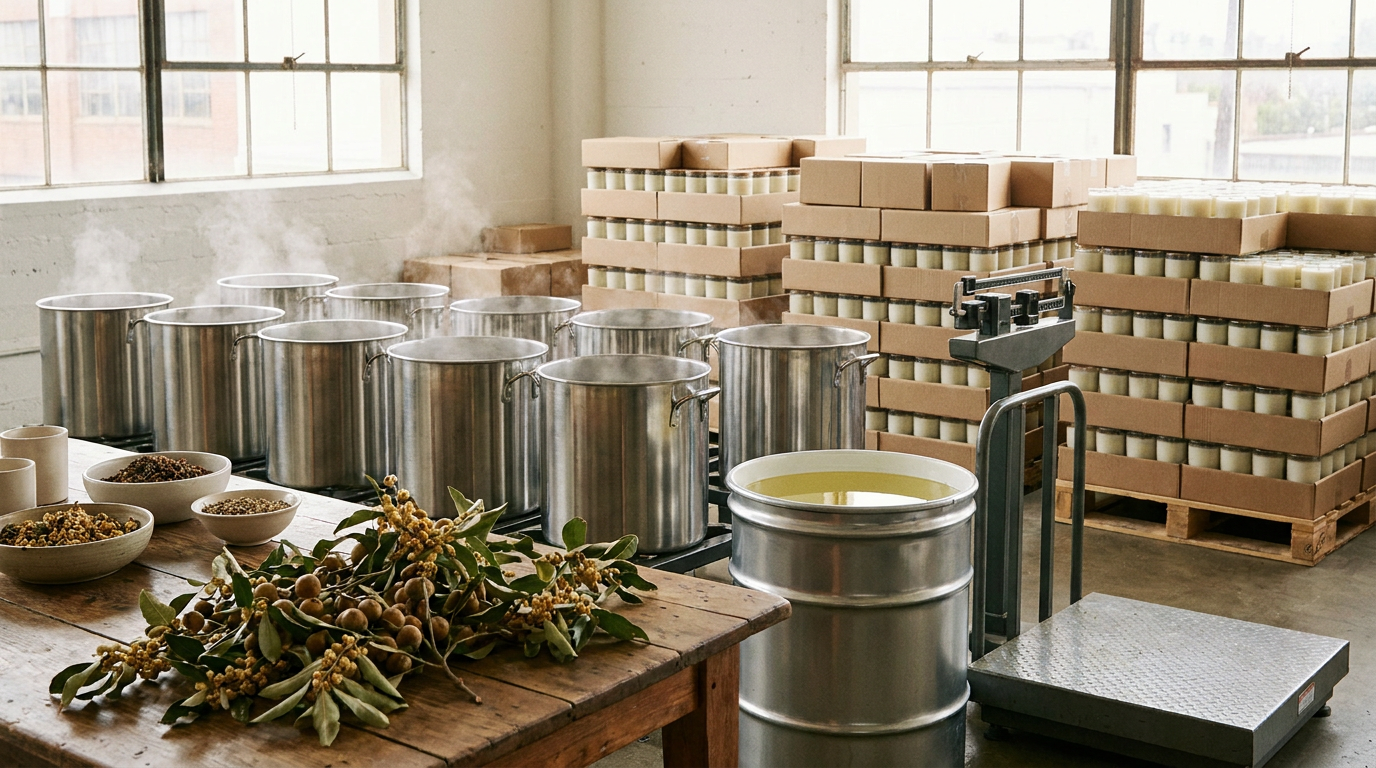
Candle makers buy this oil by the pound for one reason: it keeps a bright lemon character through a hot pour that flattens most citrus scents. This page is part of our Guide to Buying Litsea Cubeba Essential Oil in Bulk.
Check current pound pricing on the wholesale page before you scale up your candle line.
Expressed lemon and lime oils are notoriously fragile in hot wax; their lighter aromatic compounds cook off before the candle ever cures. Litsea cubeba's natural citral content behaves differently, which is exactly what one candle studio documented when it ran a six-batch trial comparing throw across pour temperatures.
The result is a scent that survives cure time and still throws on day one of the burn, the same durability covered in a walkthrough of building a long-lasting lemon candle. For a candle line, that is the difference between a scent that reads as lemon on the shelf and one that reads as lemon in the room.
Most candle formulators load this oil as the dominant top note in a citrus blend, often paired with a rounder base like vetiver or a green note to keep the lemon from reading thin. Because it is a fragrance-forward oil rather than a functional additive, usage rate is a formulation decision made against your specific wax and wick combination, not a fixed dose.
Test any new batch in a small pour before committing it to a full production run: wax type, pour temperature, and cure time all shift how the oil's citral content reads once the candle is finished.
Small studios typically prove out a scent at 1 oz or 2 oz before scaling; production candle lines move to 5 lbs or 25 lbs pails, with 100 lbs drums reserved for established, high-volume lines.
Reach out and we will walk through what we know about behavior at pour temperature.