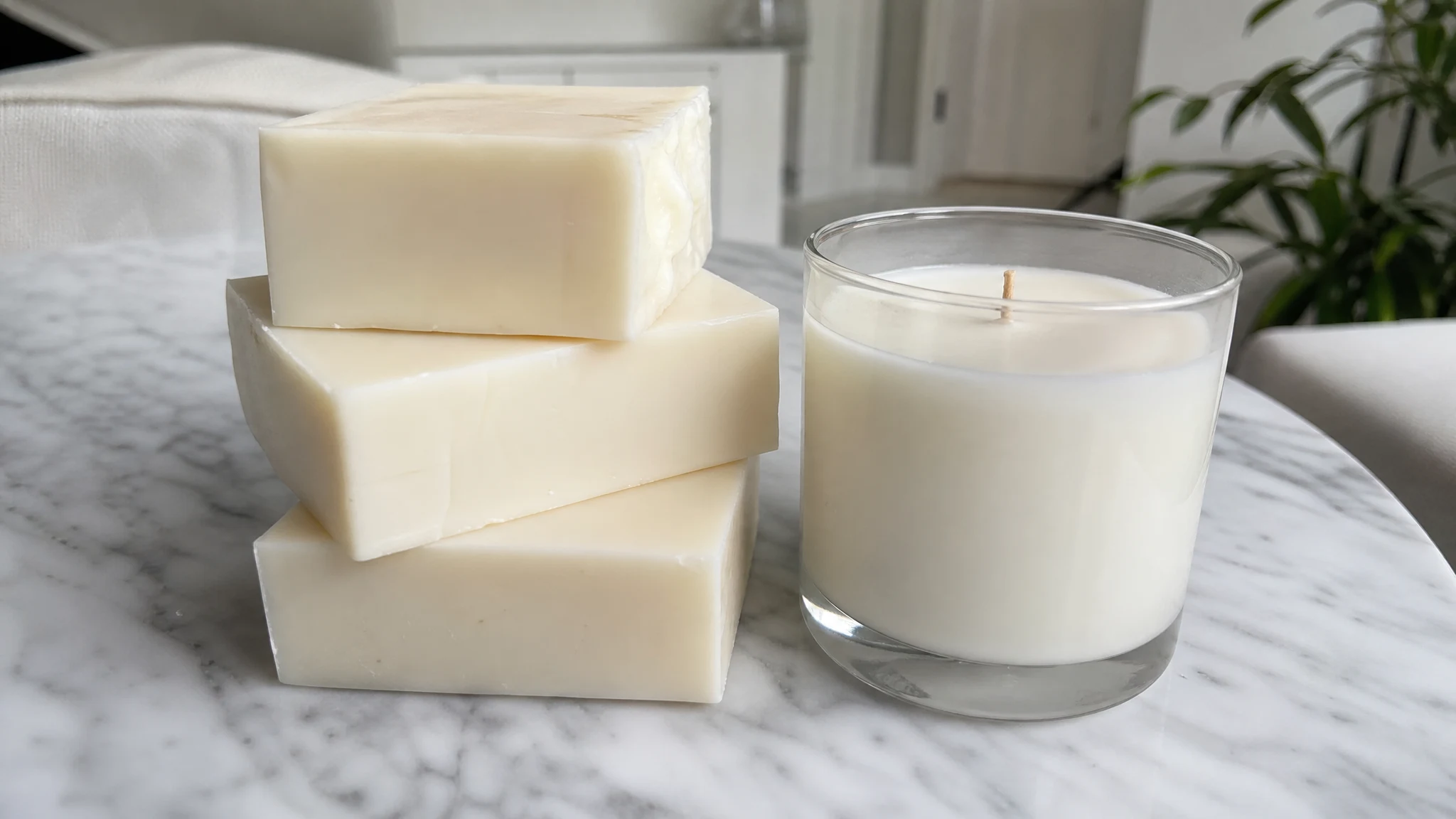
Candle and Soap Makers' Questions About Litsea Cubeba
Candle and soap makers ask us a handful of questions again and again, usually about limits, temperatures and amounts. Here are straight answers, with the numbers worked out and the sources named. We sell one litsea cubeba oil, steam-distilled from the fruit and sold neat, and none of the wax, lye, oils, wicks or moulds, so those you will find at a candle-supply or soap-supply shop.
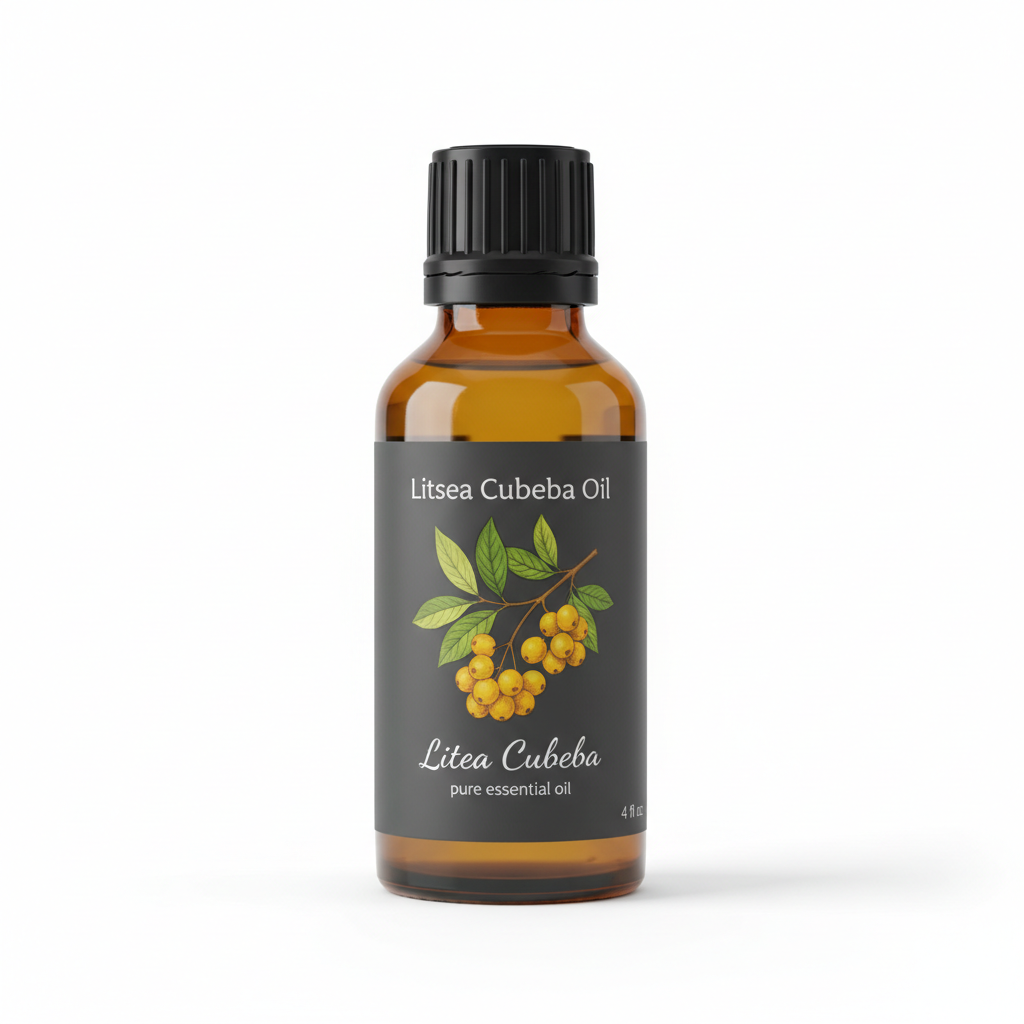
Litsea Cubeba Essential Oil
Our own Litsea Cubeba Essential Oil, in sizes from 0.5 oz to bulk.
From $12.99
Shop Now →Does IFRA cap litsea cubeba in a candle?
Not through citral. The IFRA Standard for Citral sets a cap for each product category, and Category 12 is listed as having no restriction. IFRA's guidance places candles of all types in Category 12. So citral does not limit how much litsea you can add. That does not make any load right for any wax, and it does not cover other restricted ingredients in a blend. The guidance itself notes that following the standards may not be sufficient for regulatory compliance, so anyone selling candles should check the current text.
How much oil can a candle carry?
Your wax decides. One candle-supply guide says soy wax typically takes 6% to 10% fragrance oil, paraffin up to 12% and beeswax about 3% to 6%, calculated as wax weight times load, and warns that overloading can cause burning problems, wick clogging and an unstable wax pool. Those figures are for fragrance oils in general, so follow your wax maker's number and start under it. As arithmetic, 1 lb of wax is 453.6 g, so a 6% load is about 27 g of oil. The Certificate of Analysis we publish for one batch gives a relative density of 0.883, which makes 27 g about 31 ml.
When should the oil go into the wax?
The same guide gives 185 F as a typical temperature for adding fragrance, which is 85 C. PubChem lists closed-cup flash points for citral itself of 82 C and 91 C, without naming the isomer. Those figures are for the compound and not for our oil, but they suggest adding it at the lowest temperature at which your wax stays liquid and mixes, with the heat off, and following your wax supplier's instructions. For a flash point of our oil itself, ask us in writing through our contact page before you order; our Certificate of Analysis does not list one.
What is the IFRA limit in soap?
Bar and liquid soap are Category 9, where citral is capped at 1.2% of the finished product. Because the cap is on citral, the oil share depends on how much citral the oil carries. Published figures run from about 66% in an EFSA opinion on six commercial batches to 87.4% at the top of a study of eight fruit samples, so the cap allows about 1.37% to 1.82% litsea oil. That is roughly 6.9 g to 9.1 g per 500 g of cured soap. Work from the cured bar weight, since a bar loses water as it cures and the same grams of oil become a larger share of a lighter bar. Citral from any other ingredient counts toward the same 1.2%. Our IFRA article shows the arithmetic for other categories.
Will the scent hold in cold process soap?
We say plainly that litsea scent does fade a bit faster than synthetic fragrance oil in cold process soap, so some makers use it slightly heavier than they would a synthetic. We suggest a small test batch first and writing down the oil weight, the cure date and when you smell it, so that the result tells you something for the next batch. Keep any heavier use within the Category 9 figure above.
Will it colour the soap or wax?
The oil is pale yellow and typically does not tint finished soap or lotion. Your base and any other ingredients decide the final shade, so look at a small batch after cure.
Is lye the bigger hazard?
In the pot, yes. Sodium hydroxide burns skin and eyes, so wear eye protection and gloves and keep children and pets out of the room. The oil has its own, smaller list of cautions: EFSA's panel considered it an irritant to skin and eyes and a skin and respiratory sensitiser, and we advise keeping it away from eyes, children and pets and never taking it internally.
Is soap a cosmetic?
It depends on what the product is called. FDA says a product counts as soap when most of its nonvolatile matter is an alkali salt of fatty acids, its cleansing comes from those salts, and it is labelled and sold solely as soap. Those products fall under the Consumer Product Safety Commission rather than the FDA. Make a skin-benefit claim and a product can fall outside that definition, so take your wording to a regulatory consultant before you sell.
Can I get an IFRA certificate from you?
IFRA's guidance explains that a Certificate of Conformity is established by the maker of the fragrance mixture, with IFRA not involved. A maker who needs one for a litsea blend normally supplies it or has a consultant prepare it. If you need a citral figure or GC-MS profile for a lot, ask us in writing through our contact page before ordering and get the answer in writing; the certificate we publish is for one batch (LICQGCLCCNC003A) and lists density, refractive index and optical rotation.
For more on burning and melting, our reed diffuser and wax melt article and candle article go further. Happy making.
Litsea Cubeba Essential Oil
Litsea Cubeba Essential Oil from our own shop, in sizes from 0.5 oz to bulk.
From $12.99
Shop Now →Sources & Further Reading
- IFRA. "IFRA Standard: Citral," 2020 (Amendment 49). ifrafragrance.org/standards/IFRA_STD_021.pdf
- IFRA. "Guidance for the Use of IFRA Standards," June 30, 2023 (51st Amendment). IFRA guidance PDF
- Nature's Garden. "How Much Fragrance Oil Do I Add to a Candle?" naturesgardencrafts.com
- PubChem. "Citral" (compound 638011), flash point section. pubchem.ncbi.nlm.nih.gov
- Si L. et al. "Chemical composition of essential oils of Litsea cubeba harvested from its distribution areas in China." Molecules, 2012. pmc.ncbi.nlm.nih.gov/articles/PMC6268156
- EFSA FEEDAP Panel. "Safety and efficacy of a feed additive consisting of an essential oil from the fruits of Litsea cubeba (Lour.) Pers. (litsea berry oil) for use in all animal species (FEFANA asbl)." EFSA Journal, 2021. pmc.ncbi.nlm.nih.gov/articles/PMC8193530
- FDA. "Is It a Cosmetic, a Drug, or Both? (Or Is It Soap?)" fda.gov