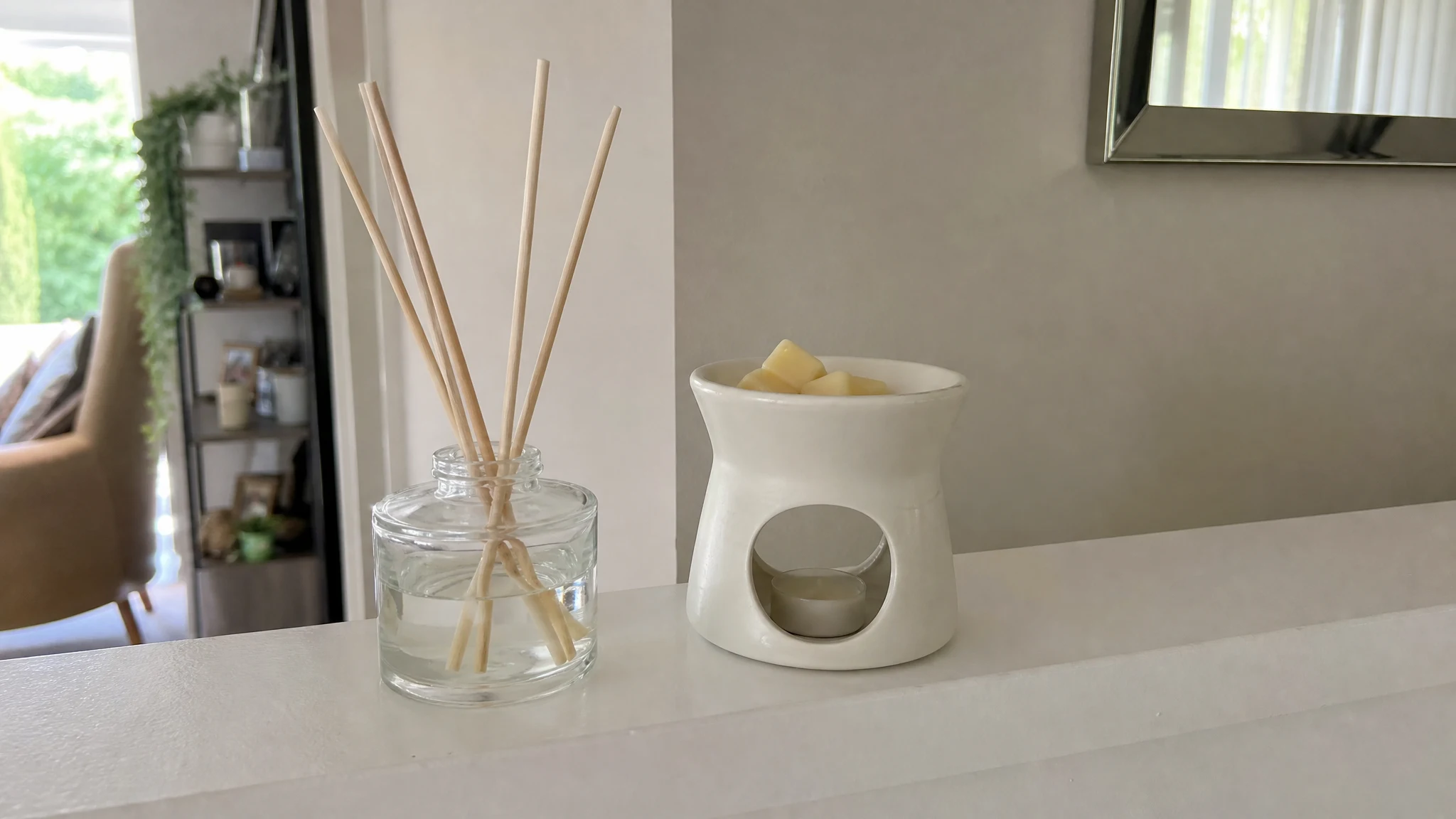
Litsea Cubeba in Reed Diffusers and Wax Melts
Start with one sum. Reed diffuser makers commonly work with a fragrance load of 10% to 20% of the liquid, and 10% of 100 g is 10 g of oil, about 227 drops. IFRA's citral limit for diffuser liquid allows roughly 1.4 to 1.8 g of litsea cubeba in that same 100 g. Litsea can be a bright part of a diffuser, but it is the accent, not the whole fragrance, and the rest of this article shows the numbers.

Litsea Cubeba Essential Oil
Our own Litsea Cubeba Essential Oil, in sizes from 0.5 oz to bulk.
From $12.99
Shop Now →Why a diffuser and a melt are different questions
The Guidance for the use of IFRA Standards (51st Amendment) places fragranced oil for reed diffusers in Category 10A, a more cautious placement chosen to reflect exposure while handling the soaked reeds and refills. Candles of all types are Category 12, where skin exposure is negligible. The IFRA Standard: Citral, 2020 (Amendment 49) caps citral at 1.2% in Category 10A and sets no restriction in Category 12. We found no entry for wax melts in the guidance text, so which category suits a melt is a question for your own regulatory adviser, particularly if you plan to sell it.
The conversion for the diffuser is the cap divided by the citral fraction of the oil. Fruit oils from eight Chinese sites measured 78.7% to 87.4% citral (Si et al., 2012), and six commercial batches in EFSA's review averaged about 66%. Our Certificate of Analysis lists density, refractive index and optical rotation but not composition, so we plan from the higher figure and treat the lower as extra room. That gives 1.37 g to 1.82 g of oil per 100 g of finished liquid. Any citral in other fragrance materials in the same diffuser counts toward the same cap.
Reed diffuser, in grams
A candle-supply shop's guidance puts the usual fragrance-to-base ratio for reed diffusers at somewhere between 10% and 20% fragrance, and suggests test batches at 10%, 15% and 20% (What is the best diffuser base to fragrance ratio?). Here is how litsea fits that picture, with drops at about 44 mg each (the batch on our COA has a relative density of 0.883, and a milliliter is about 20 drops, with dropper variation):
| Per 100 g of liquid | Litsea oil | Drops |
|---|---|---|
| At the 10A limit, 87.4% citral | 1.37 g | about 31 |
| At the 10A limit, 66% citral | 1.82 g | about 41 |
| Half the limit (our suggested start) | about 0.7 g | about 16 |
| Litsea alone at a 10% load | 10 g | about 227 |
Our suggestion, arithmetic and judgment rather than a standard, is 100 g of diffuser base from a supply shop with about 16 drops of litsea, and any remaining fragrance load made up from a citral-free material whose supplier documents it. A litsea-led diffuser will naturally be lighter than a standard 10% to 20% product, since the oil is working at a fraction of that. We do not sell the base, bottle, reeds or other fragrance. Use glass for the bottle, and ask your base supplier for its own safety data sheet, because the base carries hazards of its own.
The household side of a diffuser
Reed diffuser liquid deserves a short, practical note. Poison Control points out that the opening is narrow but not too narrow for a child to take a swig or spill the contents, that some reed diffuser fragrances contain up to 70 percent isopropyl alcohol, and that swallowing can make a child drowsy and cause vomiting. If someone swallows diffuser liquid, call Poison Help at 1-800-222-1222 (Reed diffusers: Household risk). That is why we place a diffuser high and out of reach of children and pets, and why a scented wax melt, which carries no liquid, is worth considering for a home with small children, though its warmer has heat to respect.
Wax melts, in grams
The wax maker sets the scent load for a melt, and the data sheet for your wax is the number to use. Because loads are quoted as a share of wax weight, the arithmetic is simple:
| Load, share of wax | Oil per 100 g wax | Drops |
|---|---|---|
| 3% | 3 g | about 68 |
| 6% | 6 g | about 136 |
| 10% | 10 g | about 227 |
A first batch at 6%, about 136 drops in 100 g of wax, is a reasonable place to begin and a little under half of a 0.5 oz bottle, which holds about 296 drops. Add the oil off the heat at the low end of your wax maker's pour window and stir gently, a precaution we suggest because we have no published flash point for our oil. Follow the maker's instructions for resting time before you judge the scent. Waxes, warmers and molds come from a candle or soap supply shop.
If you plan to sell either product, buyers and retailers will ask for IFRA, allergen and safety documents, and labeling rules differ between the EU and US. Our IFRA compliance guide goes through those rules, the candle article covers wicks and burn pools, and our technical FAQ answers common maker questions. For a spray alternative see the room spray post. If you want a documented citral or composition figure for your own formulation, ask us in writing through the contact page before you plan around it.
Litsea cubeba's lemon-drop lift suits a diffuser or a melt best when the numbers are worked first and the scent is built around them.
Litsea Cubeba Essential Oil
Litsea Cubeba Essential Oil from our own shop, in sizes from 0.5 oz to bulk.
From $12.99
Shop Now →Sources & Further Reading
- IFRA Standard: Citral, 2020 (Amendment 49)
- Guidance for the use of IFRA Standards (51st Amendment)
- Chemical composition of essential oils of Litsea cubeba harvested from its distribution areas in China, Molecules 2012
- What is the best diffuser base to fragrance ratio? | NorthWood Candle & Craft
- Reed diffusers: Household risk | Poison Control