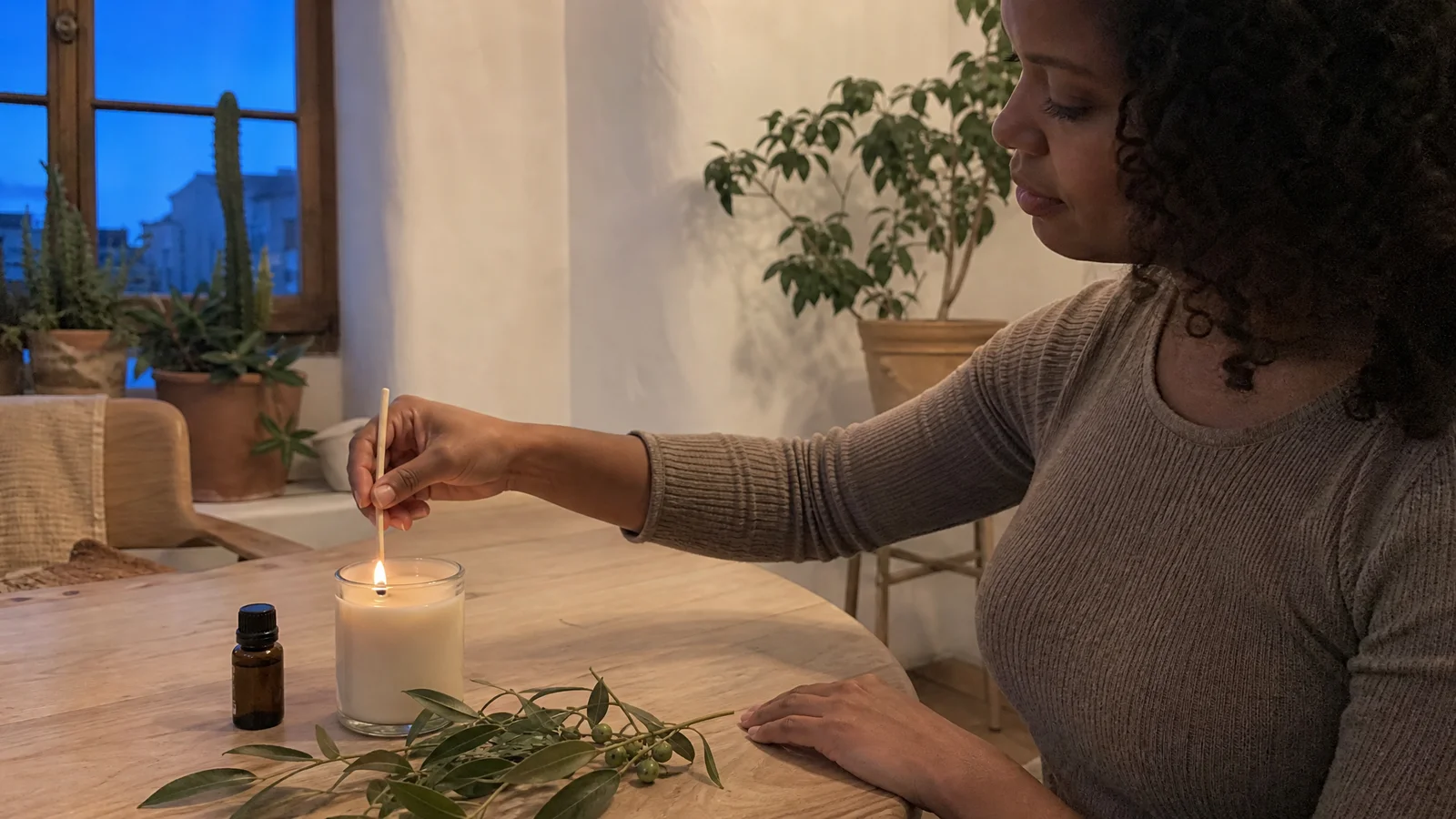
A Litsea Cubeba Soy Candle, Worked Out in Grams
A litsea cubeba candle is a lovely idea, and the secret to a good one is working in grams rather than guesses. We sell the oil, not wax, wicks or jars, so what follows is a formulation built from supplier guidance and arithmetic: how much to weigh for a 200 g soy candle, a three-jar series that lets your own nose set the amount, and what the safety standards say about candles.

Litsea Cubeba Essential Oil
Our own Litsea Cubeba Essential Oil, in sizes from 0.5 oz to bulk.
From $12.99
Shop Now →How much oil, and why start below the usual load
Candle suppliers quote fragrance loads as a percentage of wax weight. Nature's Garden says soy wax typically holds 6% to 10% fragrance oil, gives the formula as wax weight times load, and warns that too much can cause burning issues, wick clogging or an unstable wax pool. That range is for fragrance oils in general. Litsea is a single-note essential oil and mostly citral (about 66% in EFSA's commercial batches, our addition of two means, and 78.7% to 87.4% in Si et al., 2012). Our reasoning is that a focused oil at the top of a general range is more likely to overwhelm than impress, so the series below starts lower.
Three jars
| Jar | Soy wax | Load | Litsea | About |
|---|---|---|---|---|
| A | 200 g | 3% | 6 g | 6.8 ml, about 136 drops |
| B | 200 g | 4% | 8 g | 9.1 ml, about 182 drops |
| C | 200 g | 5% | 10 g | 11.3 ml, about 227 drops |
The series needs 24 g of oil. The conversions use the 0.883 relative density on the Certificate of Analysis we publish for one batch, plus the common convention of 20 drops to the millilitre, which droppers do not follow, so weigh on a scale that reads to 0.1 g and treat the drop column as a sanity check. A 1 oz bottle holds about 26.1 g by that density, so the whole series fits with about 2 g to spare, while a 0.5 oz bottle (about 13.1 g) covers one or two jars.
Order of work
- Set up three identical jars with the same wick, sized by the wick maker's chart, and wax from the same lot. Change one thing only: the oil load.
- Melt the wax to the temperature your wax supplier's data sheet gives for adding fragrance, then let it cool toward the lowest temperature at which it still stirs freely.
- Weigh the litsea into the wax and stir thoroughly. Nature's Garden says most waxes absorb fragrance best around 185 F (85 C).
- Pour, label and cure for the time your wax supplier recommends, and wait before judging the scent.
- Compare each jar cold, then burning for the recommended time in a ventilated room, noting how far the scent travels and how the wick and wax pool behave.
A note on hot wax
That 185 F is close to some published flash points for citral, the main component. PubChem's record for citral lists 195 F (91 C) closed cup from one source, 82 C closed cup from another and 215 F from a third. The record does not say which isomer those refer to, and they describe citral itself, not litsea oil. Reasoning from that, add the oil at the lowest working temperature your wax allows and keep the oil and the pour away from any flame. If you need a flash point for a particular bottle, ask us in writing through our contact page.
What the safety standards say
Candles of all types are Category 12 in IFRA's 51st Amendment guidance, and the IFRA Standard for Citral lists no restriction for Category 12, against 0.15% in body lotion and 0.60% in fine fragrance. That is why a candle is the one use where the citral cap does not bind. IFRA's guidance does add that following its Standards may not be enough to ensure regulatory compliance, so anyone selling candles should check labelling rules with a regulatory consultant.
EFSA's panel considered the oil an irritant to skin and eyes and a skin and respiratory sensitiser, so a candle is lower in limits, not free of care. Burn it in a ventilated room, stop if anyone reacts, and do not use it where a cat, dog or small child is likely to be shut in with it. Our pages on cats and dogs and pregnancy and children set out what is published.
Reading the results
Record the wax lot, wick, jar, load, pour temperature, cure time and burn time for each jar before you judge it, so the next batch is repeatable. Compare cold smell, hot smell and the room after the flame is out, ideally with someone who did not pour them. If jar A is clearly enough, stop there, because more oil is not a better candle. If none of the three reads as lemon, a different wax or wick is the next variable to change.
For wax melts and reed liquid, where the maths differs, see that article. For pairing litsea with other scents, the autumn candle ideas and the blending article are good next reads. Wax, wicks, jars and a scale come from a candle-supply or craft shop.
Weigh carefully, start small, and let your nose pick the winner.
Litsea Cubeba Essential Oil
Litsea Cubeba Essential Oil from our own shop, in sizes from 0.5 oz to bulk.
From $12.99
Shop Now →Sources & Further Reading
- Nature's Garden. How Much Fragrance Oil Do I Add to a Candle? naturesgardencrafts.com
- PubChem. Citral (compound 638011), flash point and solubility entries. pubchem.ncbi.nlm.nih.gov/compound/638011
- IFRA, 2023. Guidance for the Use of IFRA Standards (51st Amendment). IFRA guidance PDF
- IFRA, 2020. IFRA Standard: Citral (Amendment 49). ifrafragrance.org/standards/IFRA_STD_021.pdf
- EFSA FEEDAP Panel, 2021. Safety and efficacy of a feed additive consisting of an essential oil from the fruits of Litsea cubeba (Lour.) Pers. (litsea berry oil) for use in all animal species (FEFANA asbl). EFSA Journal 19(6):e06623. pmc.ncbi.nlm.nih.gov/PMC8193530
- Si L et al., 2012. Chemical composition of essential oils of Litsea cubeba harvested from its distribution areas in China. Molecules 17(6):7057. pmc.ncbi.nlm.nih.gov/PMC6268156