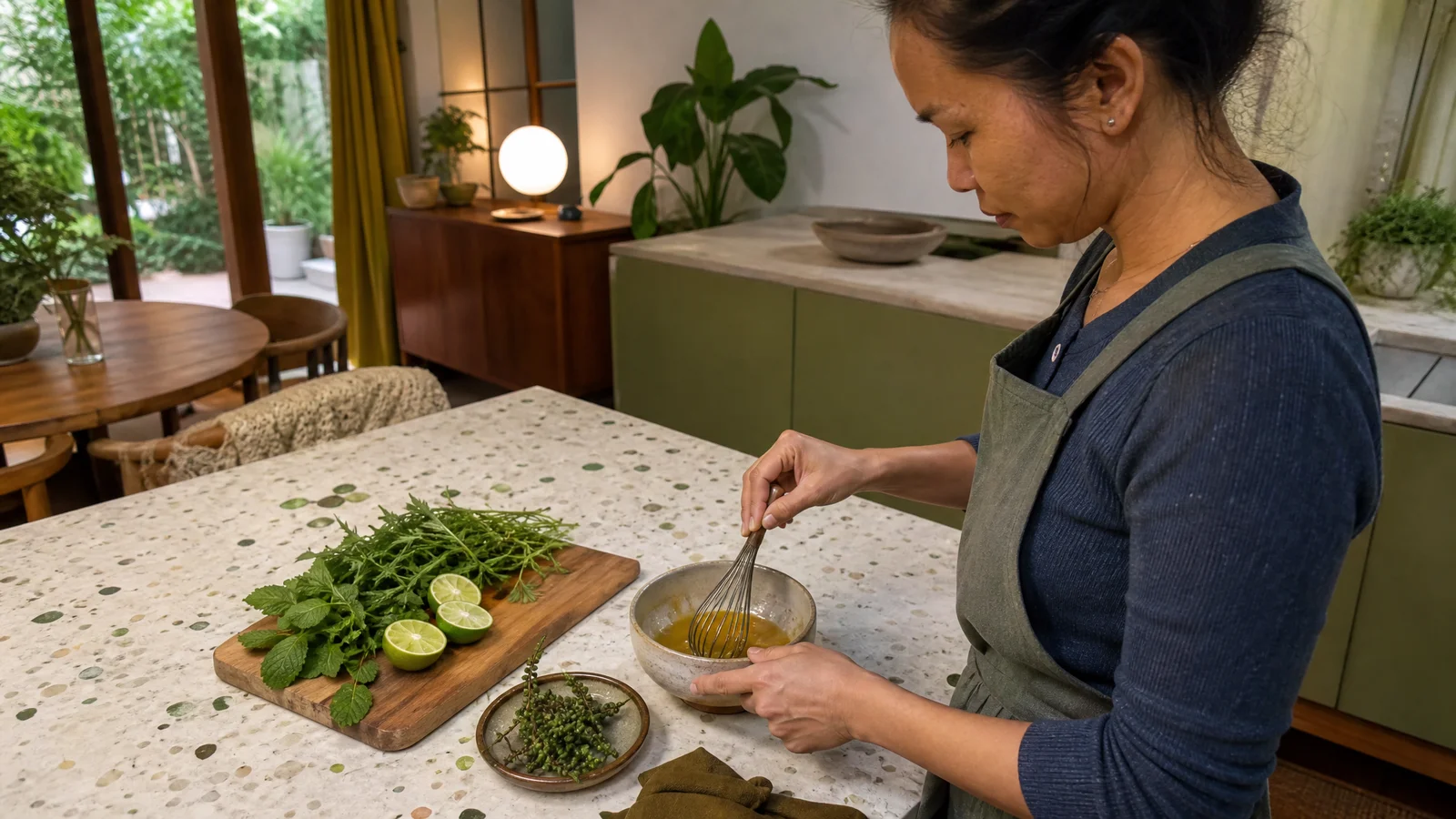
Litsea Cubeba Belongs in the Room, Not the Pot
Litsea cubeba has a culinary side, and it is worth knowing about. In parts of Southeast Asia the small fruits, sometimes called mountain pepper, are eaten whole or crushed. That does not make a bottle of the essential oil a kitchen ingredient, and the difference is worth a closer look.

Litsea Cubeba Essential Oil
Our own Litsea Cubeba Essential Oil, in sizes from 0.5 oz to bulk.
From $12.99
Shop Now →The fruit is a spice, and has been for a long time
An ethnobotanical review of native herbs and spices in Thailand lists litsea cubeba among plants used in cooking, with the fruits going into dishes such as bamboo soup and chili pastes and standing in for pepper (Culinary and medicinal wonders of the wild: An ethnobotanical review of native herbs and spices in Thailand). It is a lovely detail: the same fruit that gives the oil its lemon-drop scent has a place in traditional food. But whole fruit in a pot is a very different thing from concentrated oil. A gram of dried fruit holds, on the order of, 30 to 46 mg of oil (from the 3% to 4.5% yield in the Chinese study, Chemical composition of essential oils of Litsea cubeba harvested from its distribution areas in China), roughly one drop, spread through a whole dish.
What regulators say about the oil as a flavouring
EFSA's panel notes that litsea berry oil is recognised as a flavouring and cites a handbook of flavour ingredients that reports use levels from 2 mg per kilogram in meat products to 500 mg per kilogram in gelatines and puddings (Safety and efficacy of a feed additive consisting of an essential oil from the fruits of Litsea cubeba (Lour.) Pers. (litsea berry oil) for use in all animal species (FEFANA asbl)). Those are controlled uses of a specified material, dosed by weight. The same opinion considers the oil an irritant to skin and eyes and a skin and respiratory sensitiser.
Here is what that looks like in a kitchen, as arithmetic. The Certificate of Analysis we publish gives a relative density of 0.883 for its batch, so with about 20 drops per millilitre one drop is roughly 44 mg. In a 400 g pot of stew, one drop is about 110 mg per kilogram, 55 times the lowest figure in that range. In a 100 g serving of pudding it is about 440 mg per kilogram, close to the top of it. A dropper delivers lumps far bigger than a flavour trade would use, which is why flavourists work from pre-diluted preparations.
Why we keep ours for scent
Our oil is sold as an external cosmetic oil and is not for internal use, and we do not describe it as a food or culinary product. Being recognised as a flavouring does not turn any particular bottle into food: that status applies to material made, specified and documented for that purpose. The Certificate of Analysis we publish lists density, refractive index and optical rotation for one batch, which suits a scent and craft material. If you are a food business with specific documentation needs, ask us in writing through our contact page and get the answer in writing.
Poison Control also reminds readers that some essential oils can be poisonous if swallowed, that breathing oil into the lungs can cause pneumonia, and that children may be more susceptible; if anyone swallows an essential oil, call 1-800-222-1222 in the US (Essential oils: Poisonous when misused | Poison Control). The page does not single out litsea cubeba, and we are not suggesting it is worse than others. It is simply the route where we would rather be careful.
What to reach for instead
- For the flavour: look for the dried fruit sold as a spice at a specialist grocer, check that it names Litsea cubeba, and ask the seller about it. We do not sell it.
- For the lemon note: lemon zest or another ingredient sold for eating does the job beautifully.
- For the scent: a diffuser, a few drops on a cotton pad or a homemade cleaner scented in line with the guidance in our IFRA article, which is where the oil shines. If you are curious about the smell itself, this article describes it.
If you are pregnant, take medication or are curious about essential oils in food for health reasons, a doctor or registered dietitian is the right person to ask. We make no medical claims for litsea cubeba, and if you want to know more about the plant, our piece on the tree is a nicer place to start than the spice rack.
Litsea Cubeba Essential Oil
Litsea Cubeba Essential Oil from our own shop, in sizes from 0.5 oz to bulk.
From $12.99
Shop Now →Sources & Further Reading
- Culinary and medicinal wonders of the wild: An ethnobotanical review of native herbs and spices in Thailand
- Chemical composition of essential oils of Litsea cubeba harvested from its distribution areas in China
- Safety and efficacy of a feed additive consisting of an essential oil from the fruits of Litsea cubeba (Lour.) Pers. (litsea berry oil) for use in all animal species (FEFANA asbl)
- Essential oils: Poisonous when misused | Poison Control