Meet the Mountain Pepper Tree Behind Litsea Cubeba Oil
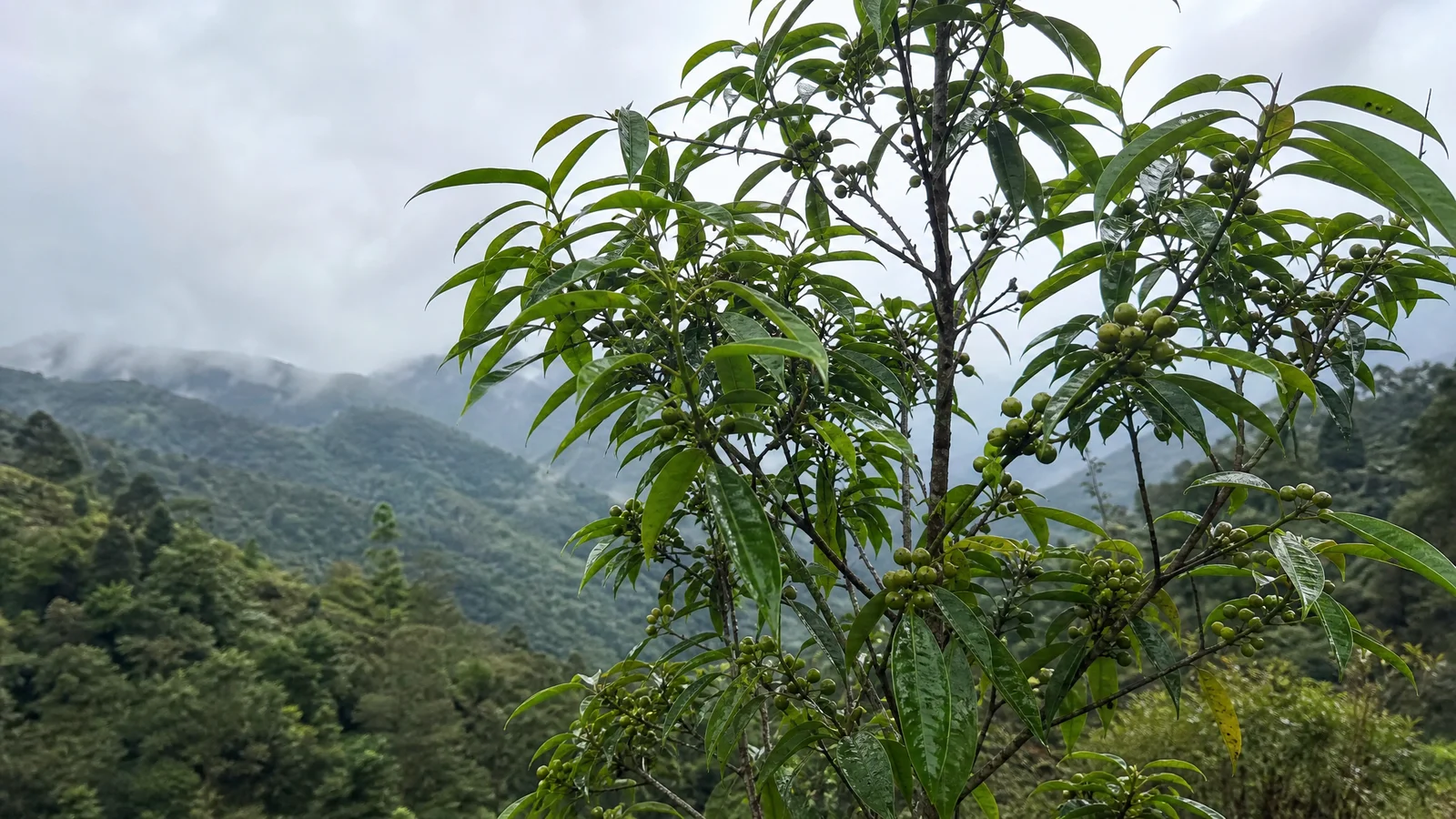
The tree behind litsea cubeba oil does not look like it is working hard for the fragrance trade. It is a modest deciduous shrub or small tree that grows happily in sun or shade and turns up along streams and roadsides across southern China. The part that is distilled is its small, pepper-like fruit.

Litsea Cubeba Essential Oil
Our own Litsea Cubeba Essential Oil, in sizes from 0.5 oz to bulk.
From $12.99
Shop Now →A hill-country native
Litsea cubeba belongs to the laurel family. EFSA gives its common names as may chang and mountain pepper, and describes it as native to mountainous regions of China and parts of Southeast Asia, now also cultivated commercially in China, Japan and Indonesia. Qiu and colleagues place it mainly south of the Yangtze River and call it both light-loving and shade tolerant, which is why it can survive in undergrowth. In the Dong villages of Guizhou surveyed by He and colleagues, it is a characteristic streamside plant, found in woodland rather than at the edges of rice paddies. The genus is large: Si and colleagues note about 622 Litsea species worldwide, 74 of them in China.
Male trees and female trees
The species is dioecious, meaning individual trees are male or female. Wang and colleagues’ 2023 study of flower development found that both pistil and stamen structures are present in the earliest flower buds, and the flower then develops as one sex or the other. Reasoning from that, only the female trees bear fruit, so a stand of trees yields fruit in proportion to how many females it holds. The fruit that is distilled comes from female trees by definition, which is a nice small fact to know.
One fruit, two oils
The fruit holds two very different oils. The essential oil, the one we sell, comes from the fruit itself and has a yield of about 4% according to Qiu. Si and colleagues report 3.04% to 4.56% from mature fruit that was dried and distilled. Inside the fruit is a seed with its own fatty oil. Liao and colleagues, sampling wild trees from 21 provenances across eight provinces of southern China in 2026, found kernel oil from the Yunnan provenances particularly high in lauric acid, at 60% or more. That is a completely different material from the essential oil; the two share only a tree.
Our oil is the essential oil. The Certificate of Analysis we publish lists the part used as fruit, the extraction as steam distilled and the ingredient as litsea cubeba fruit oil, and we sell it neat. It is not a seed or kernel oil.
Why two bottles can differ
A single species can give oils that smell and measure differently. Qiu and colleagues note that composition varies with the plant part used, with soil, altitude, climate and irrigation, and with harvest time, ripeness and handling after harvest. Even fruit oils alone show a wide range: Si reports citral from 78.7% to 87.4% across eight sites in six provinces, while EFSA’s six commercial batches add up to roughly two-thirds citral by our sum. That spread is part of why one litsea oil can smell a little different from another, and why an exact composition belongs to a particular lot and not to the species.
If you need to know the origin of a lot or its make-up, ask us in writing through our contact page before you order. For how to judge quality, see our quality article, and for how people use the plant where it grows, see our traditional-use article.
The fruit of this unassuming tree is cooked with, distilled and admired, and the oil carries a little of the hillside in its brightness.
Litsea Cubeba Essential Oil
Litsea Cubeba Essential Oil from our own shop, in sizes from 0.5 oz to bulk.
From $12.99
Shop Now →Sources & Further Reading
- Qiu Y et al., 2021. An Overview on Total Valorization of Litsea cubeba as a New Woody Oil Plant Resource toward a Zero-Waste Biorefinery. Molecules.
- Si L et al., 2012. Chemical composition of essential oils of Litsea cubeba harvested from its distribution areas in China. Molecules.
- EFSA FEEDAP Panel, 2021. Safety and efficacy of a feed additive consisting of an essential oil from the fruits of Litsea cubeba (Lour.) Pers. (litsea berry oil) for use in all animal species (FEFANA asbl). EFSA Journal.
- He J et al., 2022. Traditional knowledge of edible plants used as flavoring for fish-grilling in Southeast Guizhou, China. Journal of Ethnobiology and Ethnomedicine.
- Liao G et al., 2026. Variation in seed and kernel oil characteristics of wild Litsea cubeba influenced by major ecological factors across southern China. BMC Plant Biology.
- Wang S et al., 2023. The Association between BZIP Transcription Factors and Flower Development in Litsea cubeba. International Journal of Molecular Sciences.