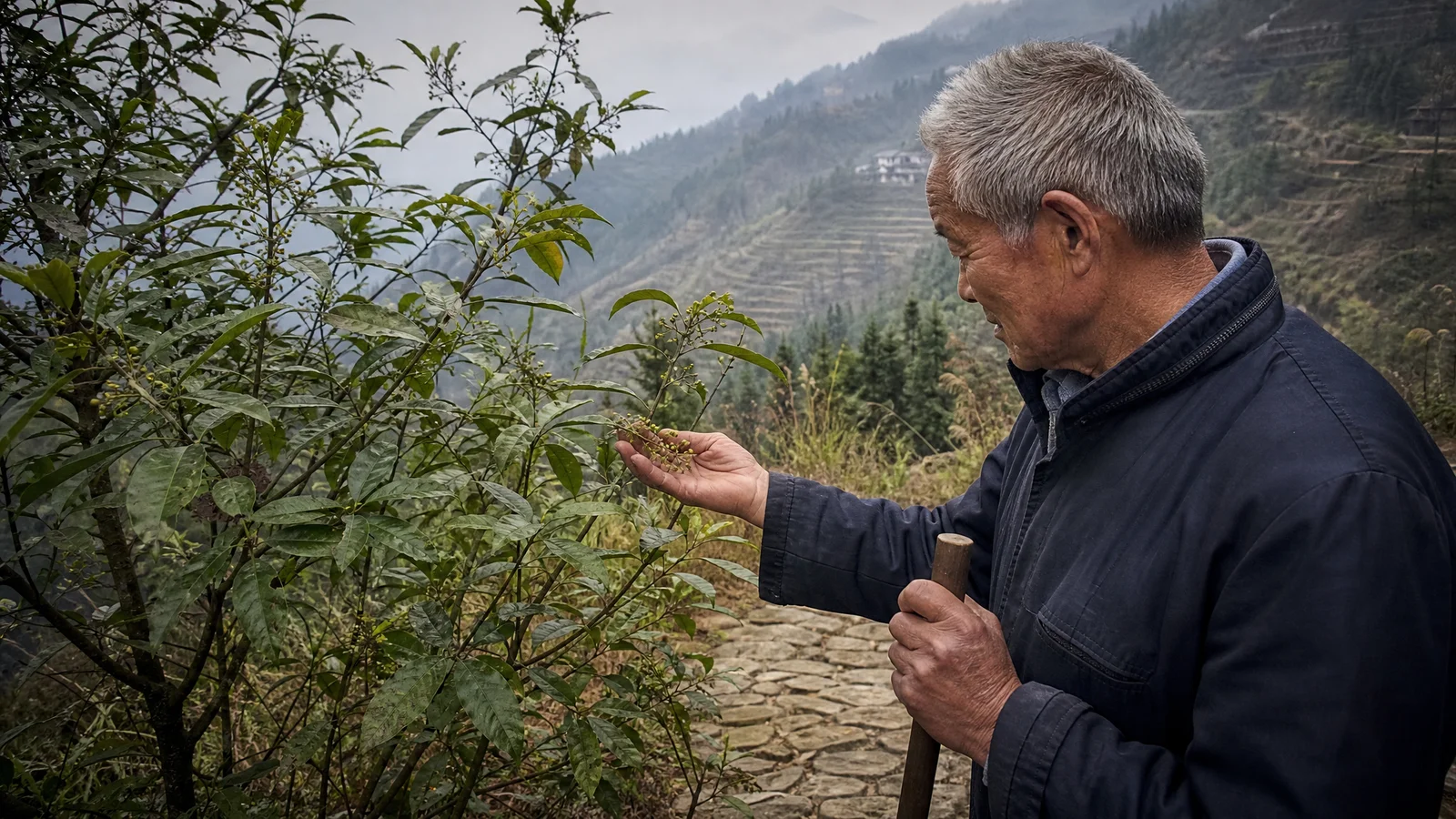
Mountain Pepper: How May Chang Is Used Where It Grows
In villages in southeast Guizhou, may chang leaves and fruit go onto the grill alongside fish. In the hills of northern Thailand, the whole fruit is dropped into spicy bamboo soup, pounded into chili paste, or used where black pepper would be. Once you have seen those uses, the plant’s nickname, mountain pepper, makes perfect sense.

Litsea Cubeba Essential Oil
Our own Litsea Cubeba Essential Oil, in sizes from 0.5 oz to bulk.
From $12.99
Shop Now →A cook’s plant first
Two ethnobotanical studies give a good picture. He and colleagues interviewed 430 people in three Dong villages in Qiandongnan, Guizhou, about edible plants used as flavouring for grilling fish, and Litsea cubeba was among the 34 plants recorded, used as leaves and fruit. A 2025 review of wild herbs and spices across Thailand, by Inta and colleagues, lists it among the more frequently recorded species. There, entire fruits, fresh or dried, are added to spicy bamboo soup by Hmong communities and to chili paste by the Akha and Karen, and the Lisu use it as a substitute for black pepper.
These are surveys of what people say they do, and they describe the plant, not a distilled oil. They also describe something rather lovely: a hill-country fruit that people have found worth gathering because its aroma and pepper-like character add something to a dish.
In traditional Chinese medicine
A 2021 review by Qiu and colleagues notes that in China the plant is also known as Bi Cheng Qie and has been commonly used as a traditional herbal medicine, with the fruits, root bark and leaves all used. We pass that on as a record of tradition. It is not a claim about the plant or its oil, and we make no medical claim for ours.
It does come with a good tip for anyone reading older records. A 2022 review of cubeb (Piper cubeba), a different plant in a different family, lists the same name, Bi Cheng Qie, among its Chinese names. A pharmacy or historical note under that name could therefore mean either plant, so check which species a source means before you read too much into it.
From hill spice to fragrance material
The modern story is easier to document. Qiu and colleagues describe the tree as mainly growing south of the Yangtze River, and say that for decades the essential oil has been the main product traded from it, with China the largest producer and exporter. The citral in the oil is also a raw material for making other aroma chemicals such as ionone, geraniol and citronellol. Si and colleagues add that China’s health ministry approved the oil as a food additive under the standard GB 2760-2007. So a plant that began as a local flavouring now also feeds a global fragrance trade, and the bottle on your bench sits at the end of that second story.
That is why the whole fruit and the oil are not interchangeable. The EFSA evaluation records that the berry-like fruits are eaten as food, and that the oil is an irritant to skin and eyes and a skin sensitiser. EFSA also cites food flavouring levels that start at 2 milligrams per kilogram in meat products. One drop of oil weighs roughly 44 milligrams (our arithmetic from a density of 0.883 g/ml and about 20 drops per millilitre), so a drop is a very different thing from a few dried fruits in a pot. We sell our oil as an aroma ingredient, and it is not for internal use; if you want the flavour tradition, that belongs to the whole spice fruit. Our kitchen article goes through the arithmetic.
The same pepper-like fruit that cooks in Guizhou and Thailand value is what gives the oil its character: bright, sweet and lemon-like. You can read more about the tree itself in our tree article, and about the oil in our overview.
It is a plant with a lot of everyday life behind it, and that is what makes its name so apt.
Litsea Cubeba Essential Oil
Litsea Cubeba Essential Oil from our own shop, in sizes from 0.5 oz to bulk.
From $12.99
Shop Now →Sources & Further Reading
- He J et al., 2022. Traditional knowledge of edible plants used as flavoring for fish-grilling in Southeast Guizhou, China. Journal of Ethnobiology and Ethnomedicine.
- Inta A et al., 2025. Culinary and medicinal wonders of the wild: An ethnobotanical review of native herbs and spices in Thailand. Heliyon.
- Qiu Y et al., 2021. An Overview on Total Valorization of Litsea cubeba as a New Woody Oil Plant Resource toward a Zero-Waste Biorefinery. Molecules.
- Cubeb (Piper cubeba L.f.): A comprehensive review of its botany, phytochemistry, traditional uses, and pharmacological properties. Frontiers in Nutrition, 2022.
- Si L et al., 2012. Chemical composition of essential oils of Litsea cubeba harvested from its distribution areas in China. Molecules.
- EFSA FEEDAP Panel, 2021. Safety and efficacy of a feed additive consisting of an essential oil from the fruits of Litsea cubeba (Lour.) Pers. (litsea berry oil) for use in all animal species (FEFANA asbl). EFSA Journal.