Why May Chang Leads a Blend and Who Pairs With It
Open a bottle of may chang next to most other oils and the lemon-drop note tends to walk straight over the top of them. That is the single most useful thing to know about blending with litsea cubeba, and it explains most of what goes right and wrong when people pair it.

Litsea Cubeba Essential Oil
Our own Litsea Cubeba Essential Oil, in sizes from 0.5 oz to bulk.
From $12.99
Shop Now →Why it leads
A 2023 study in LWT distilled the fruit of three litsea chemotypes and measured 27 odorants by gas chromatography-olfactometry. Ten of them were present above the level at which a nose can detect them, and geranial, one half of citral, stood far above the rest, with neral not far behind. Put simply, citral carries most of the smell, so in a mixture the two citral isomers stay the loudest voices until litsea is a small share. That is reasoning from lab numbers on the oil alone, not a measured result for a particular partner.
It also matches what we say about our own oil: a heavy hand will dominate a blend as well as a wrist. The size of that citral share is large; Si and colleagues found 78.7% to 87.4% in fruit oils from eight sites in China, though the EFSA opinion on a commercial oil gives batch means nearer 66%. The certificate of analysis we publish covers one batch and gives density, refractive index and optical rotation. A buyer who needs a citral or GC-MS figure should ask us in writing through the contact page before relying on one.
The partners we suggest
We suggest ginger, rosemary, geranium, vetiver, bergamot and ylang ylang as oils that blend well with litsea cubeba, and lavender too. They span herbs, flowers, a root oil and a citrus, so there is plenty of room to explore. We sell may chang only, so those oils come from other suppliers. Two practical notes follow from what we have read.
Lavender and litsea share linalool: 1.2% to 1.6% in the Si samples and a 1.92% batch mean in EFSA's analysis. The overlap is small, so do not expect lavender to change litsea's character, and do ask your supplier for the lot's GC-MS if you need to know how much linalool you are adding. For bergamot, ask the supplier for the documentation on that bottle before it goes into anything for skin.
Beyond that, we do not tell you geranium softens the edges or ginger adds warmth as established fact, because those are perfumer's judgments and your nose will form its own. Our scent profile article sets out what we can say about how may chang smells on its own.
Why one long sniff misleads
Your nose gets in the way too. Fallon and colleagues had 19 volunteers rate a pleasant fragrance for ten minutes and found that perceived intensity declined, faster when attention was elsewhere. A strong citral oil fades from your perception within minutes, which tempts you to add more, and then the blend overwhelms the next person who walks in. So judge in short sniffs, and let a fresh nose confirm.
A strip test for your own ratio
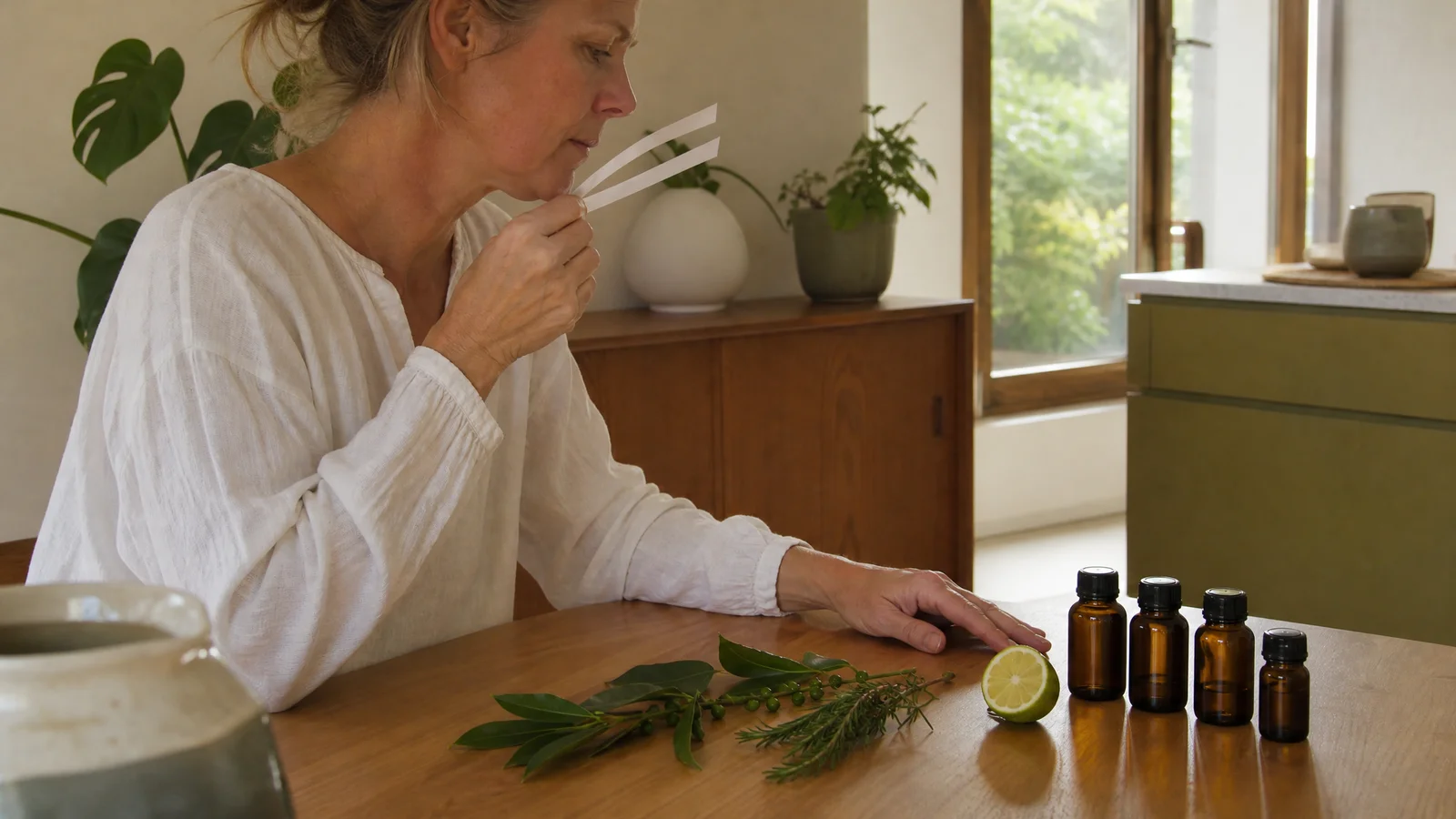
Our recommendation is a short, unglamorous procedure:
- Make stocks by weight. One part litsea to nine parts of an odourless carrier oil you will actually use gives a 10% stock, and the same for the partner. With the 0.883 relative density on the certificate for one batch, a drop at 20 per millilitre is about 44 mg, so one drop of stock holds about 4.4 mg of litsea. A 0.01 g scale beats counting drops.
- Combine the stocks at 1:4, 1:1 and 4:1 by weight, and keep a litsea-only strip and a partner-only strip as controls.
- Label each strip with its ratio and the partner's lot number, then smell right away, after ten minutes and after an hour, with clean air between strips.
- Change one thing at a time, partner or ratio, never both.
- Note what surprised you. That note is worth more than any list.
When the blend touches skin
For anything that will sit on skin, the first number is the citral cap, not the scent. The IFRA citral standard sets 0.15% citral in body lotions and oils and 0.60% in fine fragrance. A partner with no citral lowers the blend's citral share and so raises the dose the cap allows, but our skin guidance of 0.5% to 2% litsea in a carrier is above the lotion cap at both ends when litsea is the only citral source, so we start low and never call 2% safe. Our citral budget article has the sums, and the IFRA article covers more categories. A blend is only as well documented as the least-documented oil in it. If a cat, a dog, a baby or a pregnant person shares your space, see the pets article before diffusing, and for a worked pairing with a resin oil see the sunrise pairing article.
Start with the strips, give the lemon-drop a small seat, and let the partner you love show up around it.
Litsea Cubeba Essential Oil
Litsea Cubeba Essential Oil from our own shop, in sizes from 0.5 oz to bulk.
From $12.99
Shop Now →Sources & Further Reading
- Comparative investigation of key aroma terpenoids of Litsea cubeba essential oil by sensory, chromatographic, spectral and molecular studies (Zhao et al., LWT, 2023)
- Chemical composition of essential oils of Litsea cubeba harvested from its distribution areas in China (Si et al., Molecules, 2012)
- Safety and efficacy of a feed additive consisting of an essential oil from the fruits of Litsea cubeba (Lour.) Pers. (litsea berry oil) for use in all animal species (FEFANA asbl) (EFSA Panel on Additives and Products or Substances used in Animal Feed, EFSA Journal, 2021)
- Attentional modulation of desensitization to odor (Fallon et al., Attention, Perception, & Psychophysics, 2018)
- IFRA Standard: Citral, 2020 (Amendment 49)