Litsea Cubeba or Lemon Oil: Peel Versus Pepper Fruit
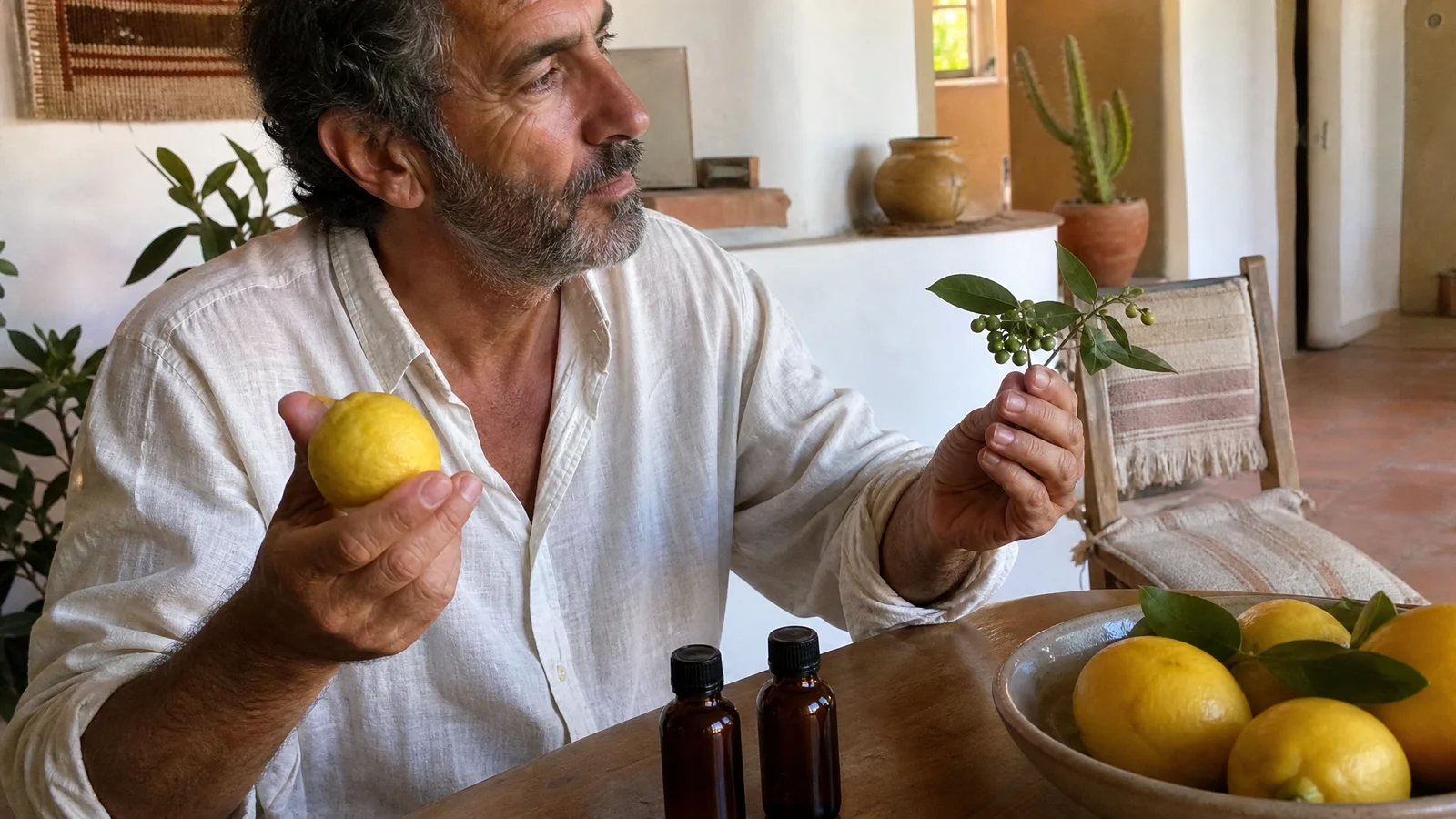
Squeeze a lemon and the scent that hits you comes from the peel. Smell litsea cubeba and you get something sharper, sweeter and more candy-like, yet it is still unmistakably lemon. The two smells come from entirely different places, and knowing where explains almost everything about how to use them.

Litsea Cubeba Essential Oil
Our own Litsea Cubeba Essential Oil, in sizes from 0.5 oz to bulk.
From $12.99
Shop Now →A peel oil and a fruit-distilled oil
A review of lemon chemistry describes lemon essential oil as obtained by cold-pressing the fresh outer part of the peel. Litsea cubeba oil comes from a different kind of fruit altogether: the small pepper-like fruit of a tree in the laurel family. We sell a litsea cubeba oil that is steam-distilled from the fruit, which matches what the Certificate of Analysis we publish for one batch records: part used fruit, extraction steam distilled.
Pressing and distilling leave different things behind. Pressed peel oil carries heavier components that distillation does not carry over, and that matters for safety, as we will see below.
The chemistry behind the smell
In the review's lemon peel analysis, limonene made up about 70% of the oil and citral only about 4.4% (geranial 2.9% plus neral 1.5%). Litsea is close to the reverse. In laboratory distillates from eight sites across six Chinese provinces, citral was roughly 79% to 87% of the oil and limonene only about 1% to 5%. An EFSA opinion on commercial steam-distilled litsea reported citral near 66% from its six batches (our addition of the two reported means) and limonene near 13%.
Put plainly, lemon oil is a limonene oil with a hint of citral, and litsea is a citral oil with little limonene. That is why litsea reads as a concentrated, sweet lemon-drop. We describe ours as intense, sweet and lemon-bright, with a soft fruity, floral roundness, which is a different character from fresh peel, not an imitation of it. We list it as a top note for perfumery, the bright first impression in a blend.
Two oils, two sets of safety notes
Because the two oils are built differently, their handling notes differ too. Cold-pressed lemon oil carries furanocoumarins such as bergapten, which is why IFRA restricts it for products applied to skin that will be exposed to UV light. Distillation largely removes them, so a distilled lemon oil is a different product with different rules. If you are choosing a lemon oil for skin, check whether it is cold-pressed or distilled with the supplier.
Litsea cubeba's guidance revolves around citral, a recognised skin sensitiser. IFRA's standard for citral caps it by product category, and for leave-on skin products the allowed oil share is small, well under a quarter of one percent for body lotion. Our own dilution guidance for skin is 0.5% to 2% in a carrier oil with a patch test first, and we suggest starting at the low end. Lemon oil happens to carry far less citral than litsea, so the citral cap is rarely what limits it, while the furanocoumarin limit is what you check for a pressed peel oil. Our IFRA article shows the citral arithmetic, and the phototoxicity article covers what research says about litsea and light.
Picking the right lemon for the job
- A fresh peel smell for a room, laundry or surface scent: lemon oil is the natural fit.
- A sharp, sweet, candy-lemon top note that needs very little oil: litsea. Weigh rather than count drops, and see the substitutes article for converting between lemon-scented oils by citral weight.
- Something you plan to put on skin and sell: the IFRA category sets the ceiling for either oil, and a cosmetic chemist or regulatory consultant should run the sum.
- Anything you eat or drink: litsea cubeba is not for internal use, and food flavouring comes from a food supplier.
If a plain lemon smell is all you are after, lemon oil from a grocery or craft supplier is the simpler choice, and we do not sell it. Litsea earns its place when you want citral in particular, and the citral comparison shows how it sits beside other citral-rich oils. If you are unsure which smell you want, a blotter of each makes the choice obvious. Keep both away from children and pets.
Peel or pepper fruit, both are lemon at heart. Choosing between them is a matter of whether you want the fresh squeeze or the lemon drop.
Litsea Cubeba Essential Oil
Litsea Cubeba Essential Oil from our own shop, in sizes from 0.5 oz to bulk.
From $12.99
Shop Now →Sources & Further Reading
- Klimek-Szczykutowicz M et al. Citrus limon (Lemon) Phenomenon-A Review of the Chemistry, Pharmacological Properties, Applications in the Modern Pharmaceutical, Food, and Cosmetics Industries, and Biotechnological Studies. Plants, 2020. pmc.ncbi.nlm.nih.gov/articles/PMC7020168
- Si L et al. Chemical composition of essential oils of Litsea cubeba harvested from its distribution areas in China. Molecules, 2012. pmc.ncbi.nlm.nih.gov/articles/PMC6268156
- EFSA FEEDAP Panel. Safety and efficacy of a feed additive consisting of an essential oil from the fruits of Litsea cubeba (Lour.) Pers. (litsea berry oil) for use in all animal species (FEFANA asbl). EFSA Journal, 2021. pmc.ncbi.nlm.nih.gov/articles/PMC8193530
- IFRA. IFRA Standard: Citrus oils and other furocoumarins containing essential oils (Amendment 49, 2020). ifrafragrance.org/standards/IFRA_STD_089.pdf
- Tisserand Institute. Phototoxicity. tisserandinstitute.org/safety/phototoxicity