From Pepper-Like Fruit to Bottle: Litsea Cubeba Oil
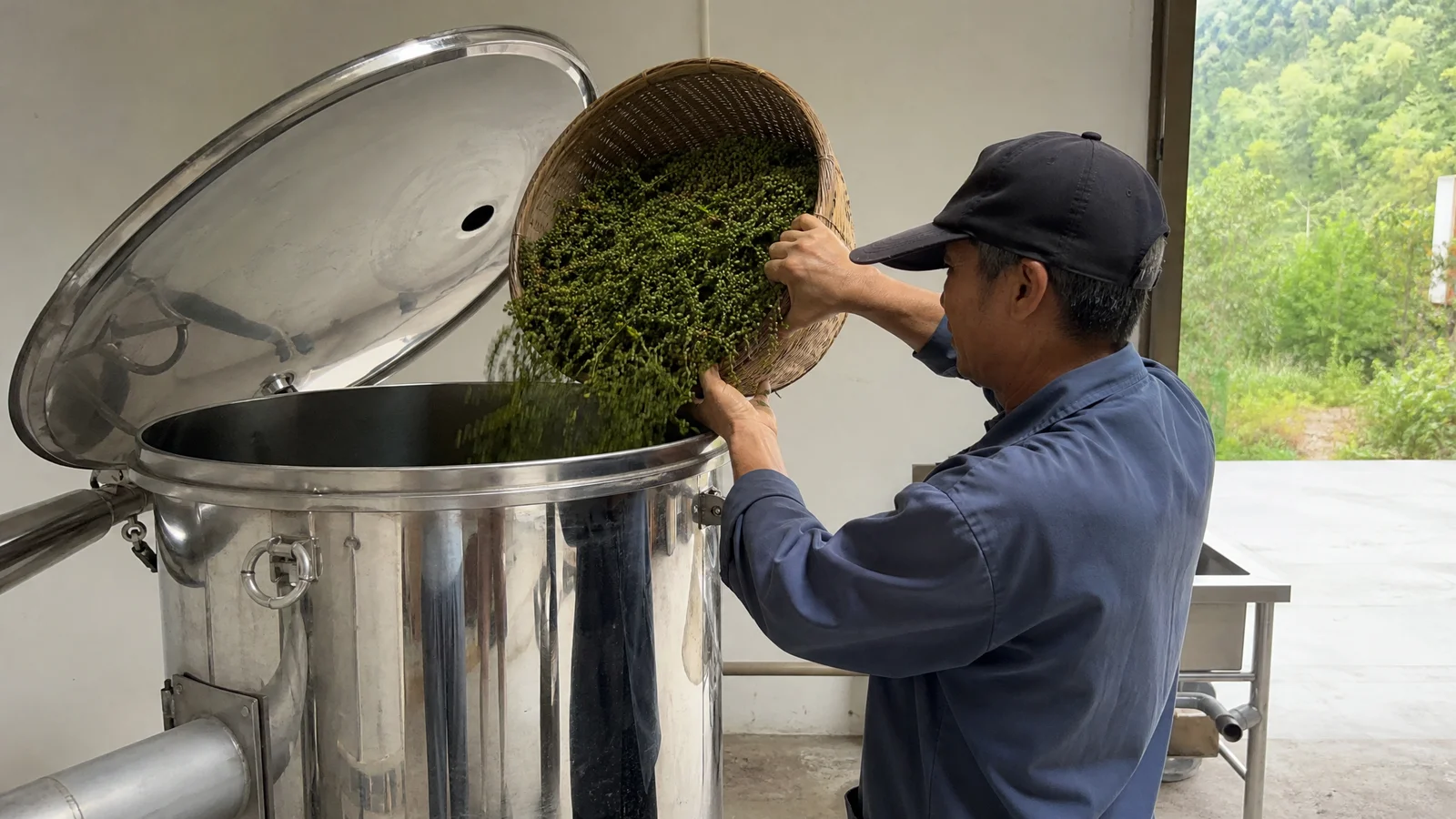
Litsea cubeba oil starts with fruit about the size of a peppercorn. Crush one and you can smell why this tree is also called mountain pepper: a bright, citrusy scent, from a tree that is not a citrus at all. Getting that scent into a bottle is a tidy piece of kitchen-table physics.

Litsea Cubeba Essential Oil
Our own Litsea Cubeba Essential Oil, in sizes from 0.5 oz to bulk.
From $12.99
Shop Now →It begins with the fruit, not the leaf
The raw material is the fruit. EFSA's panel describes the plant as a small tree or shrub in the laurel family, with the oil "obtained by steam distillation from the fruits" (Safety and efficacy of a feed additive consisting of an essential oil from the fruits of Litsea cubeba (Lour.) Pers. (litsea berry oil) for use in all animal species (FEFANA asbl)). That detail matters because the name travels loosely in the trade. The genus has hundreds of species, and a Chinese study notes that oils can be distilled from the fruit, root, flower, stem and leaf, each with a different make-up (Chemical composition of essential oils of Litsea cubeba harvested from its distribution areas in China). The oil we sell is steam-distilled from the fruit and sold neat, in amber glass.
What steam does
In steam distillation, steam is passed up through the plant material. It carries the fragrant oil along as vapour, the vapour travels through a condenser and cools back into liquid, and the liquid collects in a separator. Oil and water do not mix, and because they differ in density, the oil floats on the water and can be drawn off. A lavender study that compared methods describes exactly this, with the oil floating on the aromatic water (the hydrosol), and it notes that steam distillation is the method currently used for most commercial essential oil production (Extraction of Essential Oils from Lavandula × intermedia 'Margaret Roberts' Using Steam Distillation, Hydrodistillation, and Cellulase-Assisted Hydrodistillation: Experimentation and Cost Analysis). The water that comes off with it is a separate product, which is why "distilled" tells you how the oil was collected and not much more.
What comes out
Litsea is generous. The Chinese study found oil yields of roughly 3% to 4.5% of dried fruit weight, so a tonne of dried fruit holds on the order of 30 to 46 kg of oil (our arithmetic from their percentages). Most of what comes out is citral, the lemon-scented pair of molecules called geranial and neral, with smaller amounts of limonene, linalool and others. The authors also note that the oil is a raw material for making citral and, from it, ionones and several vitamins, which is part of why litsea is a staple of the fragrance trade as well as a pleasant bottle on a shelf.
Where and when the fruit is picked, and how it is distilled, all shift the result. A 2026 review (Litsea cubeba essential oil: phytochemistry, bioactivity-driven applications and extraction) reports that composition and yield depend on geographic origin, harvest season, plant part and extraction method. That is also why a figure from a laboratory flask and a figure from a commercial run are not always directly comparable. The six commercial batches in EFSA's opinion averaged around 66% citral (adding the average geranial and neral figures), against 79% to 87% in the laboratory samples of the Chinese study.
What our Certificate of Analysis tells you
We sell one litsea cubeba oil, from 0.5 oz up to 400 lb. The Certificate of Analysis we publish is for one batch (LICQGCLCCNC003A). It lists the part used as fruit, the extraction as steam distilled, a best-by date of 04/30/2028, a relative density of 0.883, a refractive index of 1.483 and an optical rotation of +10.04 degrees. Those physical constants are quick, repeatable checks that sit within the ranges for the ISO 3214:2000 standard for litsea oil.
Questions worth asking before a larger order
- Which part of the plant, and how was it distilled? A fruit oil by steam is what our certificate states, and it is fair to ask any supplier for the same in writing.
- Is there a composition report for the lot you are buying? If you need a citral figure or GC-MS profile, ask us in writing through our contact page before ordering and get the answer in writing.
- What are the physical constants? Density, refractive index and optical rotation are cheap checks you can repeat yourself.
- How should it be stored? We say typically 1 to 2 years, tightly capped, in a cool, dark place.
If this has made you curious, the label and GC-MS guide, the quality guide and our piece on the tree itself are good next reads. It is a lot of tradition and chemistry for something that fits in one small bottle.
Litsea Cubeba Essential Oil
Litsea Cubeba Essential Oil from our own shop, in sizes from 0.5 oz to bulk.
From $12.99
Shop Now →Sources & Further Reading
- Safety and efficacy of a feed additive consisting of an essential oil from the fruits of Litsea cubeba (Lour.) Pers. (litsea berry oil) for use in all animal species (FEFANA asbl)
- Chemical composition of essential oils of Litsea cubeba harvested from its distribution areas in China
- Extraction of Essential Oils from Lavandula × intermedia 'Margaret Roberts' Using Steam Distillation, Hydrodistillation, and Cellulase-Assisted Hydrodistillation: Experimentation and Cost Analysis
- Litsea cubeba essential oil: phytochemistry, bioactivity-driven applications and extraction