Reading a Litsea Cubeba Label and GC-MS Report
A GC-MS report is a fingerprint of one particular lot of oil, and like any fingerprint it is only useful if you know what you are looking at. Before you buy litsea cubeba in any quantity, five questions will tell you most of what you need: does the paper name the species and plant part, does its lot number match the bottle, which method produced the percentages, is citral given as neral plus geranial, and which lab and date does it come from.
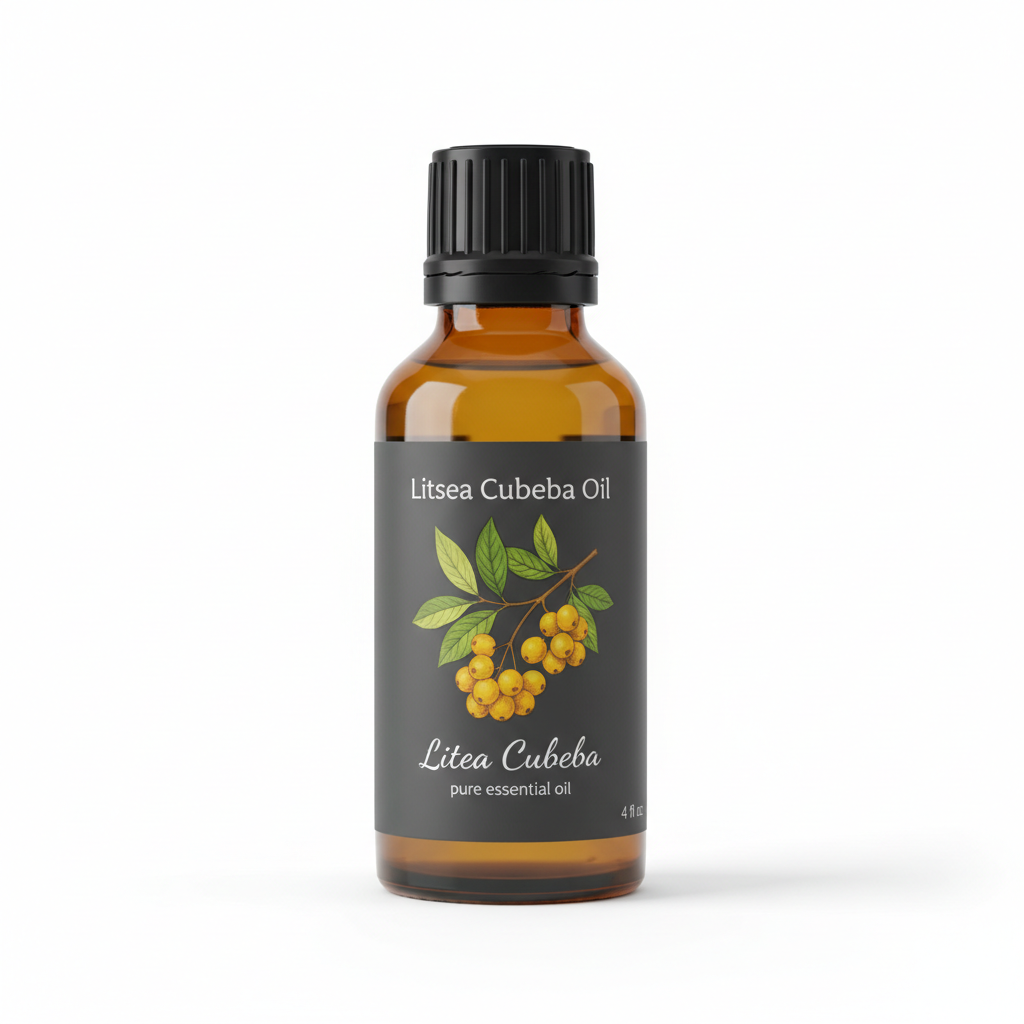
Litsea Cubeba Essential Oil
Our own Litsea Cubeba Essential Oil, in sizes from 0.5 oz to bulk.
From $12.99
Shop Now →What our own certificate shows
We sell one litsea cubeba oil, steam-distilled from the fruit and sold neat. The Certificate of Analysis for our current batch (LICQGCLCCNC003A, best-by 04/30/2028) lists the botanical name Litsea cubeba, the part used (fruit), the extraction (steam distilled) and the ingredient (Litsea cubeba fruit oil). It also gives a relative density of 0.883, a refractive index of 1.483 and an optical rotation of +10.04 degrees, and marks appearance and smell as complying. It is a document for one batch and does not include a GC-MS profile or a citral figure. If you need either, ask us in writing through the contact page before you order, and keep the answer in writing.
The label: plant, part and process
Litsea is a huge genus, around 622 species by one count, 74 of them in China, and oil can be distilled from fruit, root, flower, stem or leaf, each with a different makeup (Si et al., 2012). That is why "litsea cubeba oil" on its own is only the start. A good label gives the species, the part and the method, and some suppliers add a CAS number. For the fruit oil, EFSA's opinion on it lists CAS 68855-99-2 (EFSA, 2021). Our certificate does not print one, so we do not quote one for our oil.
The lot on the paper should be the lot in your hand
A report with no batch code, or a code that is not on your bottle, tells you about oil in general and not about yours. EFSA's six analyzed batches gave different values for the same compounds, and that variation is exactly why lot-by-lot paperwork matters.
Physical constants: a first filter
Density, refractive index and optical rotation are quick to measure and can be compared with a standard. The ISO standard for litsea cubeba oil gives ranges at 20 C of 0.8800 to 0.8920 for relative density, 1.4800 to 1.4900 for refractive index and +3 to +12 degrees for optical rotation (we read the public preview page, not the full text, so check the standard itself for anything critical).
| At 20 C | Our batch | Range on our certificate | ISO 3214:2000 |
|---|---|---|---|
| Relative density | 0.883 | 0.880 to 0.890 | 0.8800 to 0.8920 |
| Refractive index | 1.483 | 1.480 to 1.490 | 1.4800 to 1.4900 |
| Optical rotation | +10.04 degrees | 0 to +15 degrees | +3 to +12 degrees |
Our batch sits inside both sets of limits on every line. Our reading of what that means: these are properties of the whole liquid, so they show an oil is in the right neighborhood but cannot say what it is made of. Think of them as a good first filter rather than an identification.
Reading the GC-MS table
A GC-MS report lists compounds with a percentage each. A review of essential oil analysis explains how identification works: a compound is matched to a library by its mass spectrum, and its retention index should land within 10 units of the published value to count as a tentative match. The same review notes that GC-MS quantitation is not regarded as absolute and that flame ionization detection is considered more accurate for quantities (Sadgrove et al., 2022). So a report that lists retention indices has shown its work, and one that gives only names and percentages leaves the check undone.
The litsea numbers show why method matters. The researchers behind the eight-site study, using hydrodistillation and GC-MS, found 78.7% to 87.4% citral and only 0.7% to 5.3% limonene in fruit collected in 2011. EFSA's six commercial batches from China averaged about 66% citral (geranial 36.35% plus neral 29.77%, our addition) with limonene near 13%, and the panel noted that GC-MS underestimated geranial in two of them. The public overview of the ISO standard gives a citral minimum of 70%. Three sources, three answers, and the plain reading is that fruit, lab and method all move the figure. When a report says "citral 75%," it is fair to ask whether that is neral plus geranial, how it was measured, and whether the limonene looks like the published ranges.
What a report cannot catch
Adulteration is found with more specialized tools: the ratios of mirror-image molecules, carbon isotope ratios, and traces left by synthetic routes. The same review gives lemon oil adulterated with citral from a C4 grass as an example. A routine GC-MS table is a profile, not a lie detector, so a clean report is not proof of authenticity and a missing one is not proof of a problem. Our posts on spotting quality and buying cover the nose-and-purchasing side.
What to ask for before a large order
- Which lot, and does its code match the paperwork?
- Which plant part and process? Ours is fruit, steam distilled.
- Is there a GC-MS or GC-FID profile for that lot, with the method, the lab and the date?
- Any IFRA or allergen documentation? If you plan to sell a leave-on product, read our IFRA post first, because the citral cap makes the figure matter.
If you are weighing litsea against other citral oils, our comparison shows the ranges side by side. A good report is a specific one, with a lot code, a method, a date and a lab, and that is what we would look for from any supplier, including us.
Litsea Cubeba Essential Oil
Litsea Cubeba Essential Oil from our own shop, in sizes from 0.5 oz to bulk.
From $12.99
Shop Now →Sources & Further Reading
- Si L, et al. Chemical composition of essential oils of Litsea cubeba harvested from its distribution areas in China. Molecules, 2012. pmc.ncbi.nlm.nih.gov
- EFSA Panel on Additives and Products or Substances used in Animal Feed, Safety and efficacy of a feed additive consisting of an essential oil from the fruits of Litsea cubeba (Lour.) Pers. (litsea berry oil) for use in all animal species (FEFANA asbl). EFSA Journal, 2021. pmc.ncbi.nlm.nih.gov
- Sadgrove NJ, et al. Fundamental Chemistry of Essential Oils and Volatile Organic Compounds, Methods of Analysis and Authentication. Plants, 2022. pmc.ncbi.nlm.nih.gov
- iTeh Standards, ISO 3214:2000 - Oil of Litsea cubeba Quality Standard (preview page). standards.iteh.ai