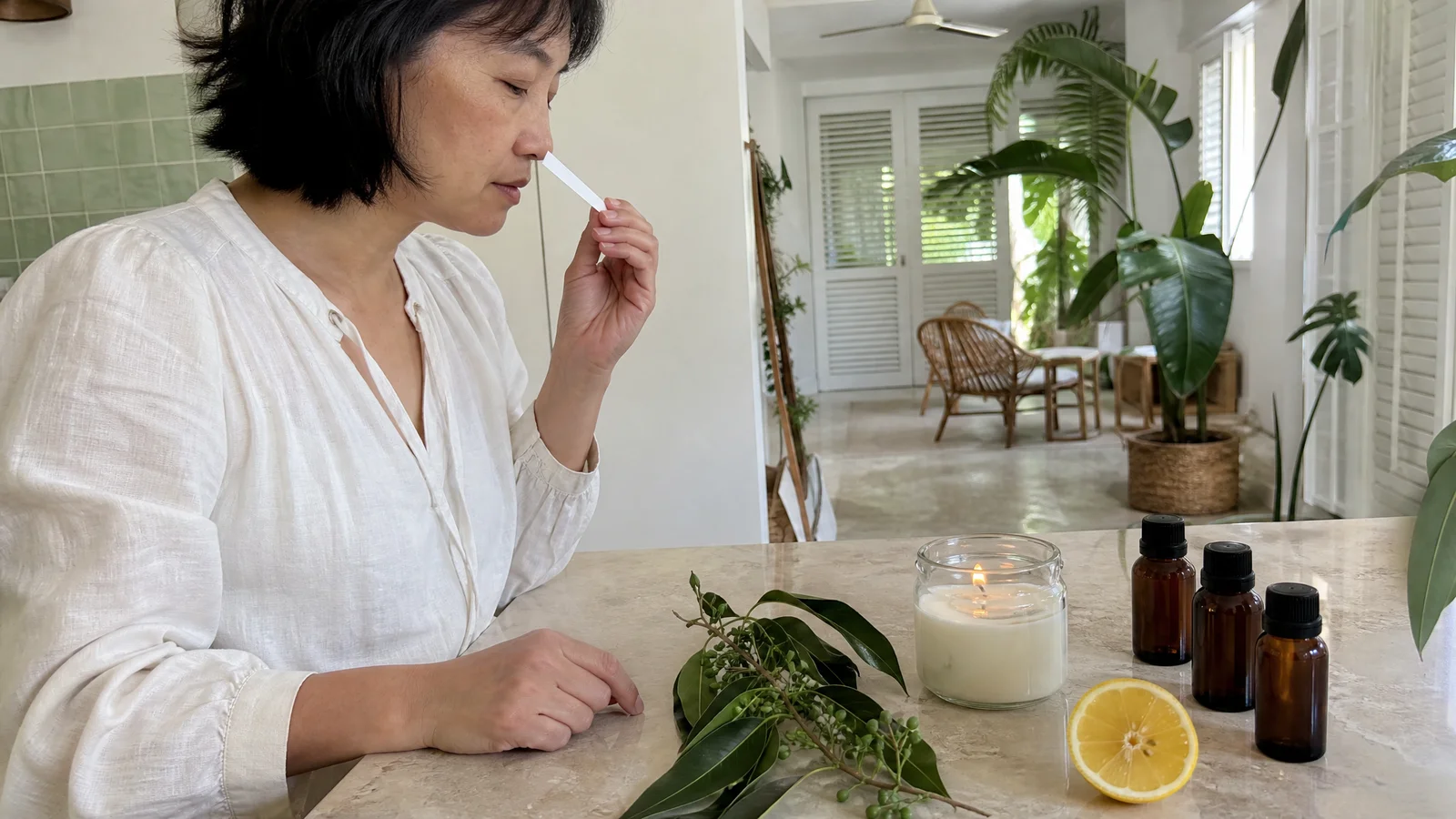
Blending With Litsea Cubeba: Let the Lemon Lead
Blending advice for litsea cubeba usually opens with a list of partner oils. We like to open with a different question: how much of this lemon-bright oil does your blend actually need? Litsea is mostly citral, which makes it a strong, very focused scent, and a little goes a long way. Settle the amount first and the partners almost choose themselves.

Litsea Cubeba Essential Oil
Our own Litsea Cubeba Essential Oil, in sizes from 0.5 oz to bulk.
From $12.99
Shop Now →Our partner list
The oils we would reach for alongside litsea are ginger, rosemary, geranium, vetiver, bergamot, ylang ylang and lavender. Litsea's sweet, lemon-drop top note has a soft fruity, floral roundness, so it sits comfortably on top of warm, woody or floral bases, and it lifts a heavier oil rather than competing with it. We sell the litsea; the partners come from other suppliers.
One thing worth keeping in mind is that a focused oil leads easily. A heavy hand will dominate a blend as well as a wrist. Reasoning from its composition (roughly two-thirds to nine-tenths two molecules, as we explain below), litsea is a good candidate for the supporting-actor role in a blend, where a few drops add sparkle rather than take over.
Budgeting the citral
Fragrance makers work out a blend's ceiling with one line of arithmetic: litsea's share of the blend, times the blend's dose in the product, times litsea's citral fraction, must stay under the category cap in the IFRA Standard for Citral. That cap is 0.15% for body lotions (Category 5A), 0.60% for fine fragrance (Category 4), 1.2% for soap, hard-surface cleaners, fabric sprays and reed-diffuser oil (Categories 9 and 10A), and nothing for candles (Category 12). IFRA's own guidance sorts everyday products into those categories.
The citral fraction is the one unknown, because the literature varies: 78.7% to 87.4% in laboratory distillates of fruit from eight Chinese sites (Si et al., 2012) and about 66% across six commercial batches (EFSA, 2021, our addition of two means). Here is what that looks like with some round, illustrative doses (our arithmetic, not recommendations):
| Product | Illustrative dose of the blend | Most litsea the blend can hold (87.4% to 66% citral) |
|---|---|---|
| Body lotion (5A) | 1% | about 17% to 23% |
| Fabric spray or reed liquid (10A) | 2% | about 69% to 91% |
| Fine fragrance (4) | 10% | about 7% to 9% |
To make the fine fragrance row concrete: in 100 g of perfume at a 10% blend dose, the cap allows about 0.69 g of litsea at the higher citral figure. From the 0.883 relative density on the Certificate of Analysis we publish for one batch, a drop is about 44 mg, so that is roughly 16 drops. Weigh rather than count, since droppers vary. Any other citral-rich oil you add, lemongrass for instance, draws on the same budget, which our citral comparison helps you track.
Where our skin guidance fits
Our dilution guidance for skin is 0.5% to 2% in a carrier oil, with a patch test first, which works out to roughly 3 to 12 drops per ounce of carrier. Against the lotion cap above, the allowed oil share is only about 0.17% to 0.23%, so 0.5% to 2% is two to twelve times higher. For a leave-on blend we start at the low end and let the cap lead rather than treating 2% as safe. Our skin basics article covers the patch test.
Keeping the blend repeatable
Bright top notes are the part of a scent the nose loses first, so it helps to treat a blend like a perfumer would: make small test batches that differ in one thing only, weigh everything, and keep notes so the next batch repeats the last good one. For wax, the candle article works the load out in grams, and our substitutes guide shows how to scale a citral oil by weight.
Where we would not blend it
We sell an external cosmetic oil, so anything meant for a baby, for pregnancy, for a pet's space or to be swallowed belongs with a pharmacist, physician, midwife or veterinarian instead. Our pages on pregnancy and children and cats and dogs set out what is published. Skip it, too, if you have reacted to fragranced products or to citral-bearing oils before.
The simple version of our approach: set the citral budget from the product category, spend it on litsea first because it is the strongest lever, then fill out the blend around it.
Litsea Cubeba Essential Oil
Litsea Cubeba Essential Oil from our own shop, in sizes from 0.5 oz to bulk.
From $12.99
Shop Now →Sources & Further Reading
- IFRA, 2020. IFRA Standard: Citral (Amendment 49). ifrafragrance.org/standards/IFRA_STD_021.pdf
- IFRA, 2023. Guidance for the Use of IFRA Standards (51st Amendment). IFRA guidance PDF
- Si L et al., 2012. Chemical composition of essential oils of Litsea cubeba harvested from its distribution areas in China. Molecules 17(6):7057. pmc.ncbi.nlm.nih.gov/PMC6268156
- EFSA FEEDAP Panel, 2021. Safety and efficacy of a feed additive consisting of an essential oil from the fruits of Litsea cubeba (Lour.) Pers. (litsea berry oil) for use in all animal species (FEFANA asbl). EFSA Journal 19(6):e06623. pmc.ncbi.nlm.nih.gov/PMC8193530