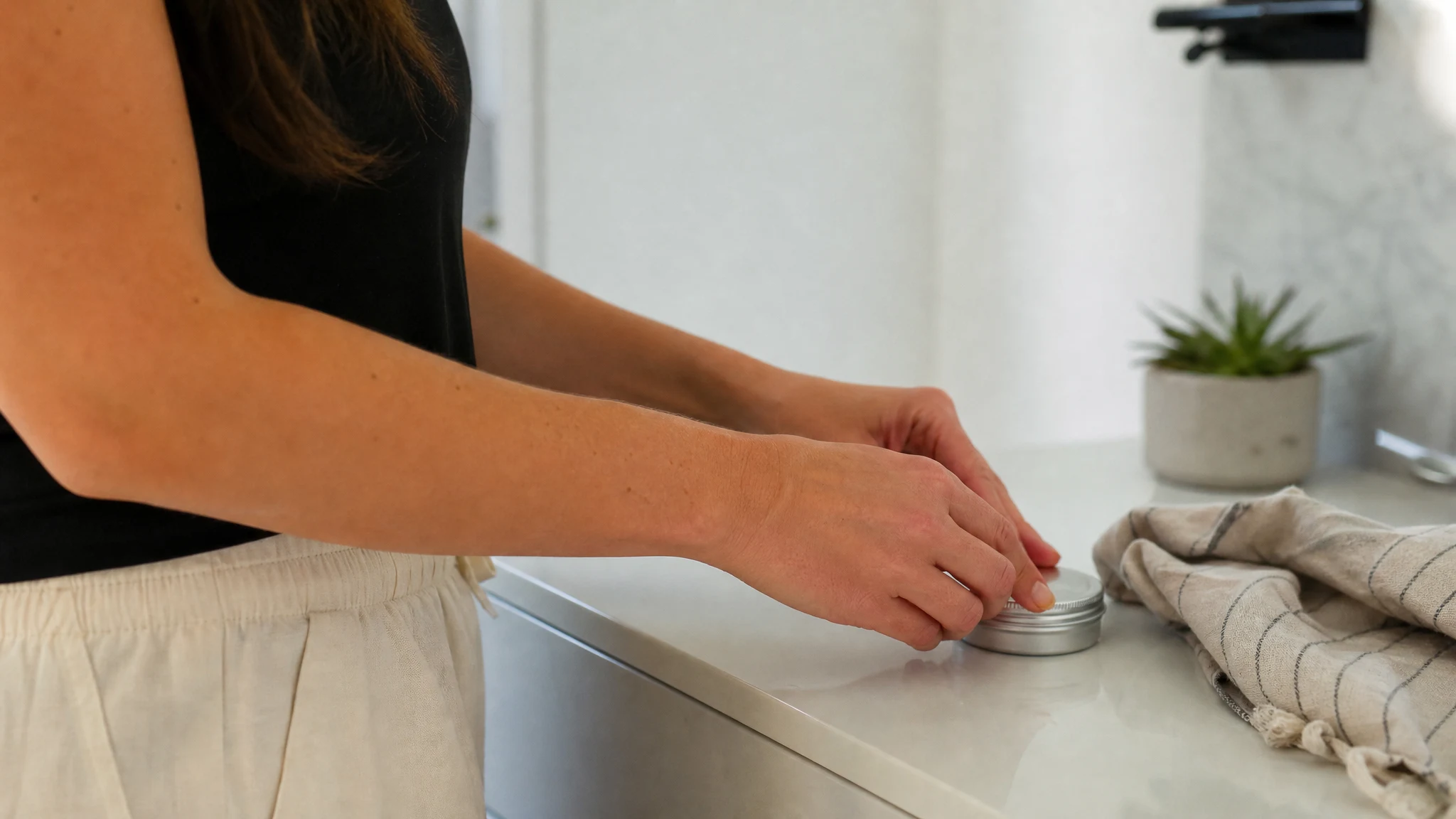
Litsea Cubeba in Natural Deodorant: A Fraction of a Drop
Litsea cubeba smells like a lemon drop, which makes it a tempting choice for a deodorant stick. It also happens to be one of the oils where the fragrance industry's numbers matter most, and the underarm is the place where those numbers are tightest. Working through them tells you something useful: not that litsea has no place in your craft room, but where it shines.

Litsea Cubeba Essential Oil
Our own Litsea Cubeba Essential Oil, in sizes from 0.5 oz to bulk.
From $12.99
Shop Now →The underarm limit
The Guidance for the use of IFRA Standards (51st Amendment) puts deodorants and antiperspirants of all types, including any product meant for the underarm or labeled as such, in Category 2. The IFRA Standard: Citral, 2020 (Amendment 49) caps citral at 0.032% of the finished product in that category, the tightest figure on its list.
The oil share a cap allows is the cap divided by the citral fraction of the oil. Fruit oils from eight Chinese sites measured 78.7% to 87.4% citral (Si et al., 2012); six commercial batches in EFSA's review averaged about 66%. Our Certificate of Analysis lists density, refractive index and optical rotation, not composition, so we plan from the higher number. The sum:
| Finished product | IFRA category | Citral cap | Oil share, about |
|---|---|---|---|
| Deodorant stick | 2 | 0.032% | 0.04% to 0.05% |
| Body butter or body oil | 5A | 0.15% | 0.17% to 0.23% |
| Solid perfume | 4 | 0.60% | 0.69% to 0.91% |
| Bar soap | 9 | 1.2% | 1.4% to 1.8% |
In a 50 g stick, 0.04% oil is 0.02 g. A drop of our oil weighs about 44 mg (relative density 0.883 on the one batch on our COA; about 20 drops to the milliliter, with dropper variation), so the allowance is about half a drop. That is well under our general skin guidance of 0.5% to 2% in a carrier, which is a broad starting range, not a deodorant figure. IFRA's rules bind products sold commercially, and a stick for yourself is your own call, but we would not exceed the cap for a product that sits on the same skin every day.
What scent can and cannot do
A 2025 review of body malodor describes underarm odor as a three-step process: odorless compounds are produced in the body, odor-forming bacteria such as Corynebacterium striatum and Staphylococcus hominis take them up, and bacterial enzymes turn them into smelly volatile compounds. The same review classifies deodorant strategies as anti-sweating, antiproliferation of malodor-forming bacteria, masking, and deodorization (Human Body Malodor and Deodorants: The Present and the Future). A scented oil belongs with masking. We make no deodorizing claim for our oil, and a faint lemon note over a base is a scent, nothing else. A product meant to control sweat is a different thing again: the FDA says deodorants that are also antiperspirants must meet the requirements for both cosmetics and drugs (FDA, cosmetic or drug).
So what does half a drop deliver? Very little, which is an honest answer. If you love the idea of a lemon-bright stick, a few thoughts. A pre-diluted stock makes the tiny amount measurable: for example, one drop (44 mg) stirred into about 4.4 g of carrier makes a 1% stock, and 1 g of that stock in a 50 g stick is 0.02% oil, comfortably inside the cap. We offer that as arithmetic, not a tested method, and the result will be a quiet scent.
Where litsea cubeba does shine
The same arithmetic that holds the underarm to a whisper opens a lot of room elsewhere. A solid perfume balm for pulse points sits in Category 4 with a far higher allowance, and our solid perfume balm article works through it. Our top-note post explains how to build a fragrance around that bright opening, bar soap has a ceiling of more than a gram of oil per 100 g of bar (see our cold process soap post), and a room or fabric scent can carry more again.
If you still want a stick, the base is the part that matters, and bases come from a soap or cosmetics supplier, as we do not sell butters, waxes or powders. Keep it small-batch and water-free, use dry tools, and read the supplier's guidance. The FDA lists contaminated materials, packaging that does not protect, and "dipping fingers into the product" among the ways a cosmetic gets contaminated (Microbiological Safety and Cosmetics | FDA).
Testing and who should skip it
Patch test the finished stick on your forearm before it goes underarm, following the steps in our skin basics guide, and stop if skin reddens or stings. If you have eczema, a history of fragrance allergy or any underarm rash, ask a physician or dermatologist before using any scented stick. Pregnant or nursing readers and anyone buying for a child should ask a physician too. Our oil is for external, aroma use only.
Litsea cubeba is better kept for the places where its lemon-drop brightness can be generous, and now you know exactly which those are.
Litsea Cubeba Essential Oil
Litsea Cubeba Essential Oil from our own shop, in sizes from 0.5 oz to bulk.
From $12.99
Shop Now →Sources & Further Reading
- IFRA Standard: Citral, 2020 (Amendment 49)
- Guidance for the use of IFRA Standards (51st Amendment)
- Chemical composition of essential oils of Litsea cubeba harvested from its distribution areas in China, Molecules 2012
- Human Body Malodor and Deodorants: The Present and the Future, Int J Mol Sci 2025
- Microbiological Safety and Cosmetics | FDA
- Is It a Cosmetic, a Drug, or Both? (Or Is It Soap?) | FDA