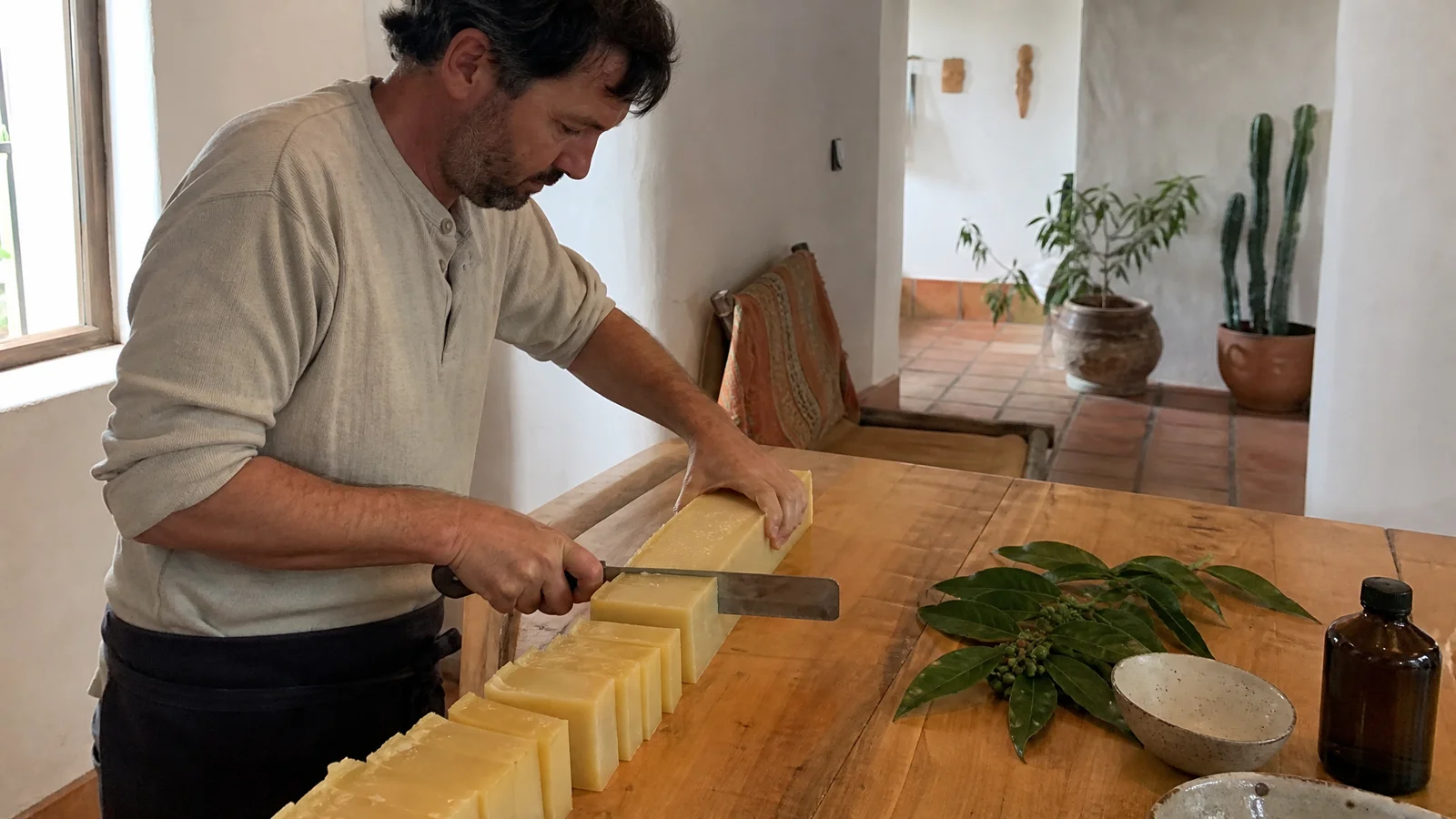
Scenting Cold Process Soap With Litsea Cubeba
Soap makers tend to ask the same thing of a lemon scent: will it still be there after the lye? Litsea cubeba is often suggested for exactly that reason, and we suggest the usual maker's discipline, which is a small test batch first. What we can add is the part that does not depend on anyone's batch: how much oil a bar can carry, worked out in grams.
Litsea Cubeba Essential Oil
Our own Litsea Cubeba Essential Oil, in sizes from 0.5 oz to bulk.
From $12.99
Shop Now →Start with the limit, not the recipe
The Guidance for the use of IFRA Standards (51st Amendment) lists bar soap and body wash in Category 9, and the IFRA Standard: Citral, 2020 (Amendment 49) caps citral at 1.2% of the finished product in that category. IFRA's rules bind products made for sale, and a hobby batch is your own call, but the cap is the clearest published line between a scented bar and an over-scented one. EFSA's panel, in its review of litsea berry oil, considered it an irritant to skin and eyes and a skin sensitizer, which is why the cap is worth respecting even for something that rinses off.
The oil a cap allows is the cap divided by the oil's citral fraction. Fruit oils from eight Chinese sites measured 78.7% to 87.4% citral (Si et al., 2012), and six commercial batches in EFSA's review averaged about 66% (the sum of the geranial and neral means, our addition). Our Certificate of Analysis lists density, refractive index and optical rotation but not composition, so we plan from the high end. 1.2 divided by 0.874 allows 1.37% oil in the finished bar, and divided by 0.66 allows 1.8%.
| Cured bar weight | Most oil at 87.4% citral | Most oil at 66% citral |
|---|---|---|
| 100 g | 1.37 g | 1.8 g |
| 454 g (1 lb) | 6.2 g | 8.3 g |
| 1,000 g | 13.7 g | 18.2 g |
Work from the weight of the cured bar, not the batter, since a bar loses water as it cures. In drops, 6.2 g is about 7 ml at the 0.883 relative density on our COA, or roughly 140 drops by the 20-drops-to-the-milliliter convention that real droppers do not follow. Weigh it.
Where recipes and caps disagree
Soap recipes often state fragrance as ounces per pound of oils, a different base from IFRA's finished-bar percentage. As an invented example to show the gap: if a pound of fats (453.6 g) makes a bar that weighs 650 g when cured, 1 oz (28.35 g) of litsea oil is 4.4% of the bar, more than three times the 1.37% figure. No recipe is being singled out; the point is that the two systems use different units, and litsea's high citral fraction makes the gap wider than it would be for an oil like lemon, whose peel oil measured only about 4.4% citral in one analysis (Klimek-Szczykutowicz et al., 2020). Lemon has its own rule, phototoxicity, which our lemon comparison covers.
We do not give a full recipe because a soap recipe is a lye calculation, and that depends on your fats, superfat and water. Use a lye calculator from a soap-supply shop for the base, then take the litsea amount from the table. We sell only the oil, so lye, fats and molds come from a soap-supply or craft shop.
A first batch, in order
- Decide the cured bar weight and read the maximum off the table, then choose a figure below it.
- Weigh the oil on a 0.1 g scale and keep it capped until you use it. Our guidance is to store it tightly closed in a cool, dark place.
- Add it at trace, with the mold ready, and keep the first pour simple.
- Cure the bars and write down the date, the weight and your own judgment of the scent at day 2, day 14 and day 42. Those notes will tell you more about your own recipe than any article can.
Respect the lye
Sodium hydroxide deserves more caution than the fragrance. NIOSH's pocket guide lists irritation of the eyes, skin and mucous membranes and eye and skin burns among its effects, with first aid of immediate eye irrigation, an immediate water flush for skin, and immediate medical attention if swallowed (Sodium hydroxide | CDC NIOSH Pocket Guide to Chemical Hazards). Wear eye protection and gloves, keep children and pets out of the room, and follow your lye supplier's mixing instructions.
Soap, cosmetic or something else
The FDA says "soap" applies when the bulk of the nonvolatile matter is an alkali salt of fatty acids and the product is labeled, sold and represented solely as soap; such products fall under the Consumer Product Safety Commission, while a bar with other claims may be a cosmetic or a drug (Is It a Cosmetic, a Drug, or Both? (Or Is It Soap?)). If you sell your soap, the label claims shape which of those it is, so take advice from a regulatory consultant. We make no skin or cleaning claim for our oil.
Who should pick a different scent
For soap meant for sensitive skin, for a child, or for someone who reacts to fragrance, a gentler scent is the better first choice than a citral oil, and our skin basics guide covers dilution and patch testing. If you want to scent a leave-on product instead, the body butter post runs the same arithmetic with a much lower ceiling, and our IFRA guide shows the cap for every category. Anyone selling soap will need ingredient documentation from suppliers; if you need a citral figure or composition data from us, ask in writing through the contact page before you plan around it.
A bar that smells of sunny lemon drops is a fine reward for careful weighing, and a few grams is all it asks.
Litsea Cubeba Essential Oil
Litsea Cubeba Essential Oil from our own shop, in sizes from 0.5 oz to bulk.
From $12.99
Shop Now →Sources & Further Reading
- IFRA Standard: Citral, 2020 (Amendment 49)
- Guidance for the use of IFRA Standards (51st Amendment)
- Safety and efficacy of a feed additive consisting of an essential oil from the fruits of Litsea cubeba (Lour.) Pers. (litsea berry oil) for use in all animal species (FEFANA asbl), EFSA Journal 2021
- Chemical composition of essential oils of Litsea cubeba harvested from its distribution areas in China, Molecules 2012
- Citrus limon (Lemon) Phenomenon-A Review of the Chemistry, Pharmacological Properties, Applications in the Modern Pharmaceutical, Food, and Cosmetics Industries, and Biotechnological Studies, Plants 2020
- Sodium hydroxide | CDC NIOSH Pocket Guide to Chemical Hazards
- Is It a Cosmetic, a Drug, or Both? (Or Is It Soap?) | FDA