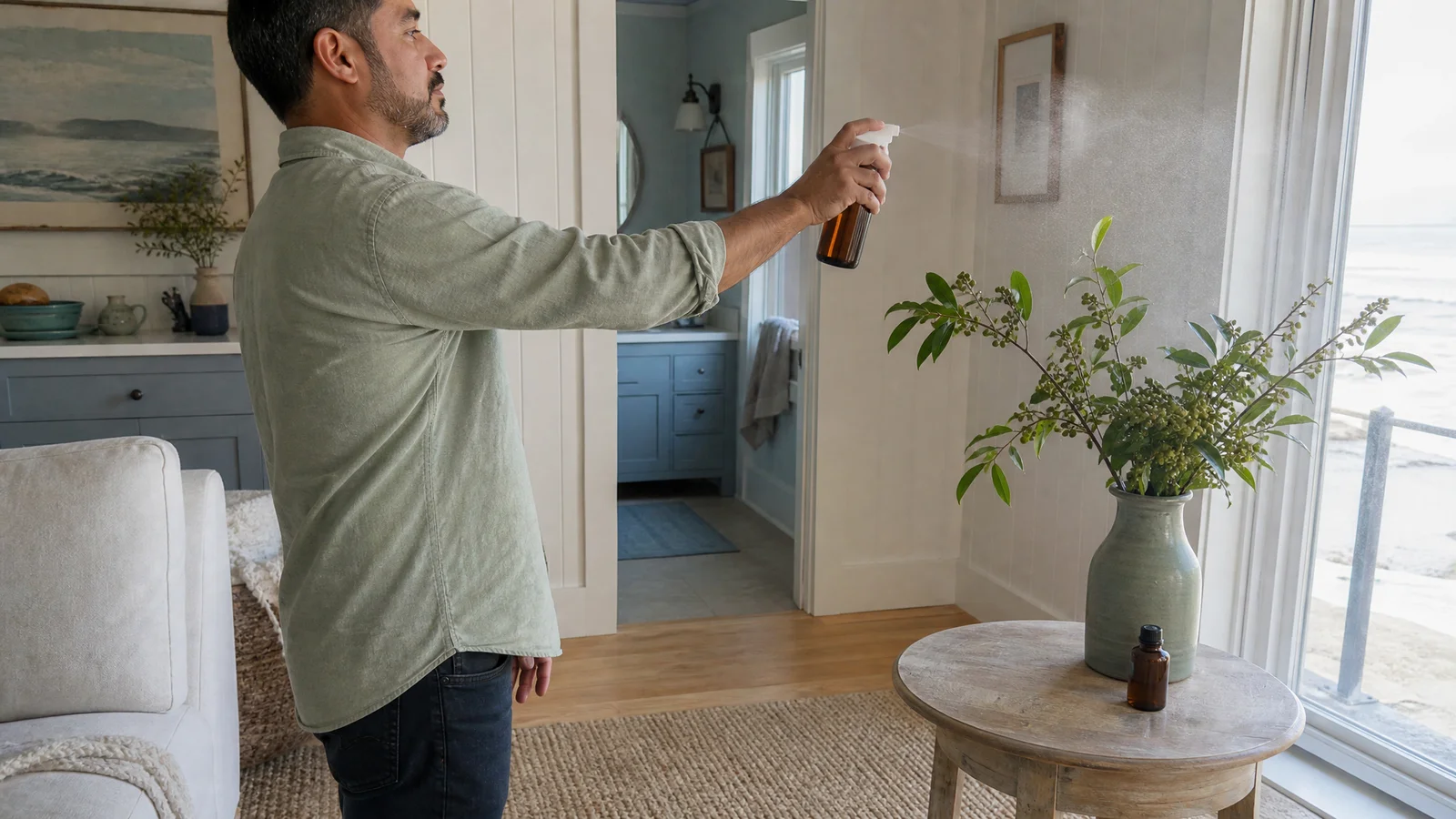
A Litsea Cubeba Room Spray, Worked Out for 100 g
A litsea cubeba room spray sounds as simple as oil and water, until the oil floats. The fun of this one is the chemistry: why the oil will not mix into plain water, the two honest ways round that, and how much oil a 100 g batch can carry. We sell the oil, not bottles, sprayers or ingredients, so this is a formula built from sources and arithmetic.

Litsea Cubeba Essential Oil
Our own Litsea Cubeba Essential Oil, in sizes from 0.5 oz to bulk.
From $12.99
Shop Now →First, will it mix?
PubChem's record for citral, litsea's main component, gathers several solubility measurements: 1,340 mg/L in water at 25 C from one handbook and about 590 mg/L (0.059 g per 100 ml) from an International Chemical Safety Card, which the record itself shows disagreeing. Either way, a 1% spray needs roughly 10,000 mg/L, so plain water cannot hold it. Alcohol is a different story: 1 ml of citral dissolves in 7 ml of 70% alcohol, and it mixes in all proportions with 95% alcohol. Those figures are for citral, not for litsea oil, which also carries limonene and linalool, but they point to the right broad approach: dissolve the oil in strong alcohol, or disperse it in water with a solubilizer.
How much oil
Citral is capped by IFRA, the fragrance industry's standards body. The IFRA Standard for Citral sets limits in the finished product by category, and in IFRA's 51st Amendment guidance manual air freshener sprays are Category 10B (4.2% citral) and fabric enhancing sprays Category 10A (1.2%). A home maker is not bound by IFRA, but the caps are a good published statement of where the industry draws the line, so we use them as a sanity check.
The oil share a cap allows is the cap divided by the oil's citral fraction. Published fractions range from 78.7% to 87.4% in laboratory distillates (Si et al., 2012) to about 66% across six commercial batches (EFSA, 2021, our addition of two means). Because our certificate does not print a citral figure, we use the higher number to stay cautious.
| Spray type (IFRA category) | Citral cap | Oil share at 87.4% citral | At 66% citral |
|---|---|---|---|
| Air spray (10B) | 4.2% | 4.8% | 6.4% |
| Fabric spray (10A) | 1.2% | 1.37% | 1.8% |
For a first batch, we suggest 1% oil by weight, which sits under the stricter fabric figure even at the highest citral. In 100 g, that is 1.0 g. With the 0.883 relative density on the Certificate of Analysis we publish for one batch, 1.0 g is about 1.13 ml, or roughly 23 drops at the common 20 drops per millilitre, which droppers do not follow, so weigh on a 0.1 g scale. Doubling to 2 g would pass the fabric cap, so if the first spritz seems faint, spray more rather than adding oil.
Route one: water and a solubilizer
A solubilizer such as polysorbate 20 holds oil droplets in water. makesy, a cosmetic-ingredient supplier, says a 1:1 ratio of polysorbate 20 to oil is often all you need, suggests starting at 3:1 or higher for citrus oils, and says to mix oil and solubilizer together first, then pour that slowly into the base while stirring. Litsea is a laurel-family oil rather than a citrus, but it behaves like a citrus note, so we would start cautiously at 3:1 and let clarity decide.
- Weigh 1.0 g of litsea and 3.0 g of polysorbate 20 into a small jar and stir until uniform.
- Weigh about 96 g of distilled water into a second container, reducing it by the weight of your preservative so the batch totals 100 g.
- Pour the oil mix into the water slowly, stirring. A hazy or milky result means more solubilizer is needed, not more oil.
- Add a preservative at the rate its supplier states.
That last step matters because a water-based liquid can grow microbes. The FDA's page on microbiological safety and cosmetics names contaminated water and ineffective preservation among the causes of contaminated products. A room spray is not a cosmetic, but a water-based liquid in a warm bathroom behaves the same way. Make small batches, keep them cool, and discard any that cloud or smell off.
Route two: strong alcohol
Skipping the solubilizer is possible with alcohol. For 1.13 ml of oil, the 1 ml in 7 ml of 70% alcohol figure implies at least about 8 ml of 70% alcohol, and a bit more is safer. A mostly alcohol spray avoids the preservative question, but it is flammable, so keep it away from flames and heaters, and spot test any painted, varnished or plastic surface it will land on. It suits an air or linen mist better than a finished wood surface, by our reasoning. Check the bottle maker's chemical resistance chart as well.
Where to spray it, and where not
A spray puts oil into the air and onto whatever the mist reaches. EFSA's panel considered litsea an irritant to skin and eyes and a skin and respiratory sensitiser, so mist in a ventilated room, away from faces, children, beds and pet resting places. Our articles on cats and dogs and pregnancy and children cover what is published. Test a hidden patch of fabric before spraying a sofa, and ask a physician before atomising any citral oil in a home where someone has asthma or a fragrance allergy.
The scent is the draw: intense, sweet and lemon-bright, with a soft fruity, floral roundness. Our blending article sets out how to pair it, and the reed diffuser article does the arithmetic for continuous scenting. For surfaces rather than air, our cleaner article picks up there, and we make no cleaning or deodorising claim for the oil. Bottles, solubilizer, preservative and alcohol come from a craft or soap-supply shop.
Weigh it, mix it in the right order, and one gram goes surprisingly far.
Litsea Cubeba Essential Oil
Litsea Cubeba Essential Oil from our own shop, in sizes from 0.5 oz to bulk.
From $12.99
Shop Now →Sources & Further Reading
- PubChem. Citral (compound 638011), flash point and solubility entries. pubchem.ncbi.nlm.nih.gov/compound/638011
- IFRA, 2020. IFRA Standard: Citral (Amendment 49). ifrafragrance.org/standards/IFRA_STD_021.pdf
- IFRA, 2023. Guidance for the Use of IFRA Standards (51st Amendment). IFRA guidance PDF
- Si L et al., 2012. Chemical composition of essential oils of Litsea cubeba harvested from its distribution areas in China. Molecules 17(6):7057. pmc.ncbi.nlm.nih.gov/PMC6268156
- EFSA FEEDAP Panel, 2021. Safety and efficacy of a feed additive consisting of an essential oil from the fruits of Litsea cubeba (Lour.) Pers. (litsea berry oil) for use in all animal species (FEFANA asbl). EFSA Journal 19(6):e06623. pmc.ncbi.nlm.nih.gov/PMC8193530
- makesy. How to Solubilize Fragrances & Essential Oils. makesy.com
- US FDA. Microbiological Safety and Cosmetics. fda.gov/cosmetics