
A Sunrise Pairing: May Chang and Indian Frankincense
Picture a slow morning with the window cracked open: a bright lemon-drop sparkle on top, something warm and resinous underneath to keep it from feeling thin. That is the pairing people are reaching for when they put may chang next to Indian frankincense, the oil from the Boswellia serrata tree, and it is a lovely idea on its face.
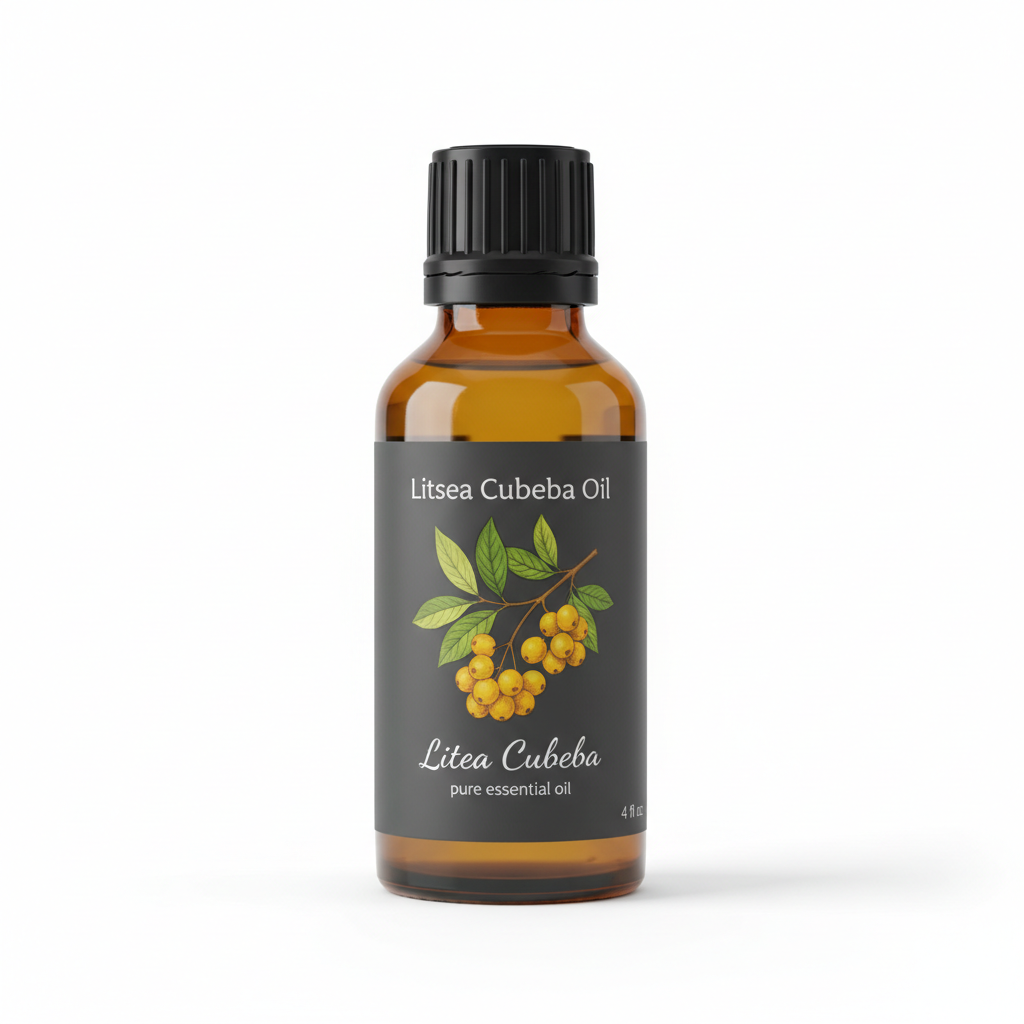
Litsea Cubeba Essential Oil
Our own Litsea Cubeba Essential Oil, in sizes from 0.5 oz to bulk.
From $12.99
Shop Now →May chang is the loud one
The first thing to know is that litsea cubeba rarely plays a supporting role. In fruit oils from eight sites in China, Si and colleagues found neral and geranial, the two halves of citral, making up 78.7% to 87.4% of the oil. Citral is intensely lemony, so even a few drops announce themselves. Our reasoning, and it is reasoning rather than a tested ratio, is that the resin oil should usually take the larger share of the blend and let the may chang act as the bright top note. A blend that is mostly lemon-drop with a whisper of resin is hard to get right; the other way round is much more forgiving.
Frankincense is not one fixed scent
Resin oils vary more than most people expect. A 2026 study steam-distilled 100 g of commercially bought Boswellia serrata resin and got a 5% yield. Its largest constituent was terpinen-4-ol at 7.81%, with a long tail of smaller compounds. A 2025 review that is mostly about a related species describes serrata oils quite differently, led by alpha-thujene or alpha-pinene depending on the analysis it quotes, and it does not reconcile them.
What that means in practice is simple: two bottles labelled Boswellia serrata can smell different next to the same may chang. Smell your resin oil first, and if you are buying it for a product, ask the supplier for a GC-MS report for that lot. We sell litsea cubeba only, so the frankincense comes from another supplier, and the lot report is how you will know what you are working with.
A pairing that makes room under the citral cap
Here is the part we find most interesting. The two oil analyses above do not list citral for the resin, so in this blend the litsea supplies essentially all of it. The IFRA citral standard limits citral by product type, and for body lotions and oils it is 0.15% of the finished product. Taking litsea at between 66% (the batch means in the EFSA opinion) and 87.4% citral, that works out to a ceiling of roughly 0.17% to 0.23% litsea oil in a body product when litsea is used on its own.
Blend it one part litsea to three parts resin by weight and the citral share of the blend drops to roughly 16.5% to 21.9%. The same cap now allows the blend itself at about 0.69% to 0.91%, around four times the dose. A one-to-one blend gives about 0.34% to 0.45%. That is our arithmetic on published limits, not a statement about our own bottle, since the certificate of analysis we publish for one batch lists density, refractive index and optical rotation and no citral figure.
It also tells you where the pairing is most comfortable. Our dilution guidance for skin is 0.5% to 2% in a carrier oil with a patch test, and we start at the low end, because both ends of that range sit above the body-lotion cap when litsea is the only citral source. For anything leave-on, our skin basics article is the place to start. For a diffuser or a candle, where the product category is far less restrictive, you have much more freedom, and the candle article shows the wax arithmetic.
Finding your own ratio
A perfumer's habit works well here, and it needs only a scale and some paper strips. Weigh rather than count drops: with the relative density of 0.883 on the certificate for that one batch, a drop at the common 20 drops per millilitre is about 44 mg, though droppers vary. Mix three small blends by weight, 1:3, 1:1 and 3:1 may chang to resin, and label each with the date and the resin lot number.
Then smell them with rests in between. In a study of 19 volunteers, Fallon and colleagues found that the perceived strength of a pleasant fragrance faded over ten minutes of continuous exposure, faster when attention wandered. Practically, that means your second and third strip will seem weaker than the first, so rest, breathe clean air, and come back to each strip right away, after ten minutes and after an hour. The one that still smells balanced at the hour mark is your sunrise.
If you want more on why citral dominates a mixture and which other oils we suggest alongside may chang, our pairing article picks up there, and the diffuser article covers the tank maths.
Bright over warm, small over large: that is the whole recipe, and your nose and a few strips will do the rest.
Litsea Cubeba Essential Oil
Litsea Cubeba Essential Oil from our own shop, in sizes from 0.5 oz to bulk.
From $12.99
Shop Now →Sources & Further Reading
- Chemical composition of essential oils of Litsea cubeba harvested from its distribution areas in China (Si et al., Molecules, 2012)
- Safety and efficacy of a feed additive consisting of an essential oil from the fruits of Litsea cubeba (Lour.) Pers. (litsea berry oil) for use in all animal species (FEFANA asbl) (EFSA Panel on Additives and Products or Substances used in Animal Feed, EFSA Journal, 2021)
- IFRA Standard: Citral, 2020 (Amendment 49)
- Attentional modulation of desensitization to odor (Fallon et al., Attention, Perception, & Psychophysics, 2018)
- Cytotoxic Activity of Boswellia serrata Roxb. Essential Oil and Acetyl-11-Keto-β-Boswellic Acid (AKBA) on Hepatocellular Carcinoma Cells: In Vitro and In Silico Study (Alarcon-Aguilar et al., International Journal of Molecular Sciences, 2026)
- Phytochemical Analysis and Pharmaceutical Applications of Monoterpenoids Present in the Essential Oil of Boswellia sacra (Omani Luban) (Khan and Rashan, Advances in Pharmacological and Pharmaceutical Sciences, 2025)