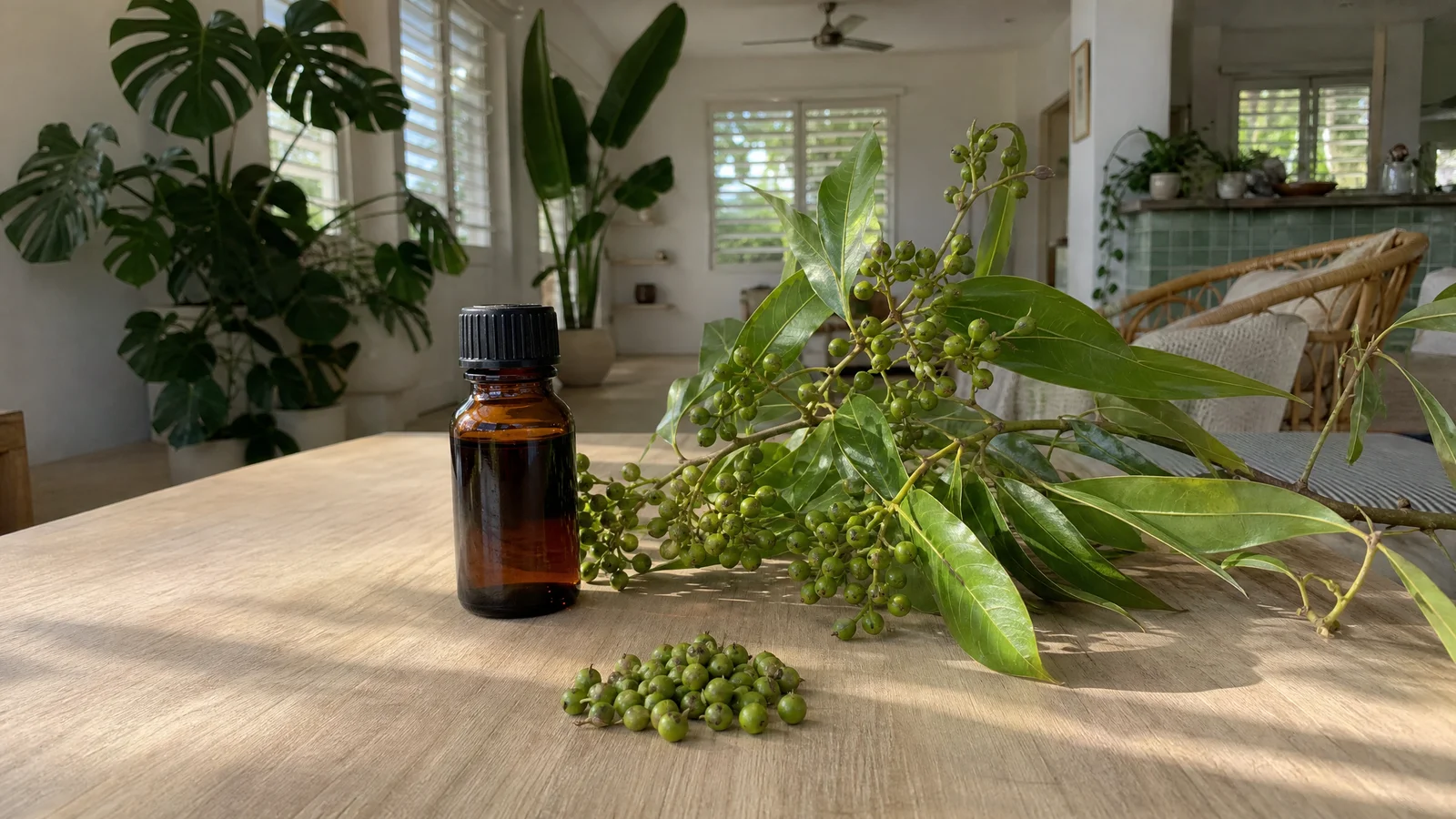
What Is Litsea Cubeba Oil? A Lemon Scent From a Laurel Tree
Litsea cubeba oil smells like lemon, yet it does not come from a citrus tree. It comes from the small, pepper-like fruit of a mountain tree in the laurel family, and it is sometimes sold as may chang. That one surprise opens up most of what is interesting about it, from why the scent is so bright and sweet to why a single percentage on a certificate says less than buyers hope.

Litsea Cubeba Essential Oil
Our own Litsea Cubeba Essential Oil, in sizes from 0.5 oz to bulk.
From $12.99
Shop Now →A laurel, not a lemon
EFSA's opinion on the oil describes Litsea cubeba as a small tree or shrub in the laurel family (Lauraceae), native to mountainous parts of China and Southeast Asia, with "May Chang" and "mountain pepper" among its common names (EFSA, 2021). The "pepper" refers to the look and size of the little berry-like fruit, not to any botanical kinship. The genus is large, with about 622 species worldwide and 74 of them in China, and L. cubeba is a widespread tree or shrub across southern China (Si et al., 2012).
The plant part matters too. Oil can be distilled from the fruit, root, flower, stem or leaf, and each differs in yield and composition, so a bottle labelled "litsea cubeba oil" can describe quite different materials. Ours is steam-distilled from the fruit, which is also how the commercial oil in the EFSA assessment is made: steam through the fruit, then the oil separated from the water.
Two molecules do most of the talking
Most of the oil is neral and geranial, which together are called citral, and citral is what gives it that sharp, sweet lemon character. In a laboratory survey of fruit from eight sites in six Chinese provinces, citral made up 78.7% to 87.4% of the oil. In six commercial batches assessed by EFSA, the two main molecules averaged about 66% together (our addition), with limonene around 13%. Those differ because they are different kinds of sample, which is why we read a figure like "citral 70% to 85%" on a listing as a range from the literature rather than a measurement of the bottle in your hand.
The international standard for the oil, ISO 3214:2000, describes it with physical constants: a relative density of 0.880 to 0.892, a refractive index of 1.480 to 1.490 and an optical rotation of +3 to +12 degrees at 20 C. The Certificate of Analysis we publish for one batch gives 0.883, 1.483 and +10.04 degrees, all inside those ranges. It does not print a citral figure or GC/MS profile, so we do not quote one for our oil. If you need that detail for something you are making, ask us in writing through our contact page before you order. Our citral article explains the molecule itself.
Where the oil turns up
Litsea has a bigger life than the craft table. China approves the oil as a food additive, and it is raw material for isolating citral and for making ionones and perfumery ingredients (Si et al., 2012). EFSA's opinion says it is recognised as a food flavouring at very small amounts, from about 2 mg/kg in meat products to 500 mg/kg in gelatines and puddings. Those are measured industrial quantities, and ours is sold for external use, so we do not recommend it for the kitchen. Anyone who has swallowed an essential oil should call poison control or a physician right away.
For us, it is a scent. We describe the aroma as intense, sweet and lemon-bright, with a soft fruity, floral roundness, and we sell it as a top note. If you want to understand how that differs from lemon peel, our lemon comparison goes through the chemistry, and our tree article covers the plant.
Using it sensibly
Citral is a recognised skin sensitiser, so litsea is an oil to use in small amounts. EFSA's panel concluded that it should be considered an irritant to skin and eyes and a skin and respiratory sensitiser, though its local lymph node assay put it in the weak sensitiser class.
Industry limits work through citral. The IFRA Standard for Citral (Amendment 49) caps it at 0.15% in body lotions and similar leave-on products and 0.60% in fine fragrance. At the Si range, the lotion cap allows roughly 0.17% to 0.19% oil, by our arithmetic. Our guidance for skin is 0.5% to 2% in a carrier with a patch test first, which is roughly two to twelve times that figure, so we start at the low end and do not call 2% safe. Our IFRA article and skin basics article go through the sums.
It is not the oil for a baby, for pregnancy, for a space shared with a cat or dog, or for anyone who has reacted to fragranced products or citral oils before. Check with a pharmacist, physician, midwife or veterinarian rather than a shop on those.
Lemon-bright, laurel-born and very concentrated: that is litsea cubeba, and it rewards a light hand.
Litsea Cubeba Essential Oil
Litsea Cubeba Essential Oil from our own shop, in sizes from 0.5 oz to bulk.
From $12.99
Shop Now →Sources & Further Reading
- EFSA FEEDAP Panel, 2021. Safety and efficacy of a feed additive consisting of an essential oil from the fruits of Litsea cubeba (Lour.) Pers. (litsea berry oil) for use in all animal species (FEFANA asbl). EFSA Journal 19(6):e06623. pmc.ncbi.nlm.nih.gov/PMC8193530
- Si L et al., 2012. Chemical composition of essential oils of Litsea cubeba harvested from its distribution areas in China. Molecules 17(6):7057. pmc.ncbi.nlm.nih.gov/PMC6268156
- ISO 3214:2000 - Oil of Litsea cubeba Quality Standard (public catalogue page). standards.iteh.ai/iso-3214-2000
- IFRA, 2020. IFRA Standard: Citral (Amendment 49). ifrafragrance.org/standards/IFRA_STD_021.pdf